Møkleby Margareta, Øverland Britt
Institute of Health and Society, Medical Faculty, University of Oslo, Oslo, Norway.
Pediatric and Adult Sleep Disorder Clinic, Lovisenberg Diaconal Hospital, Oslo, Norway.
Sleep Biol Rhythms. 2021 Dec 18;20(2):239-246. doi: 10.1007/s41105-021-00361-6. eCollection 2022 Apr.
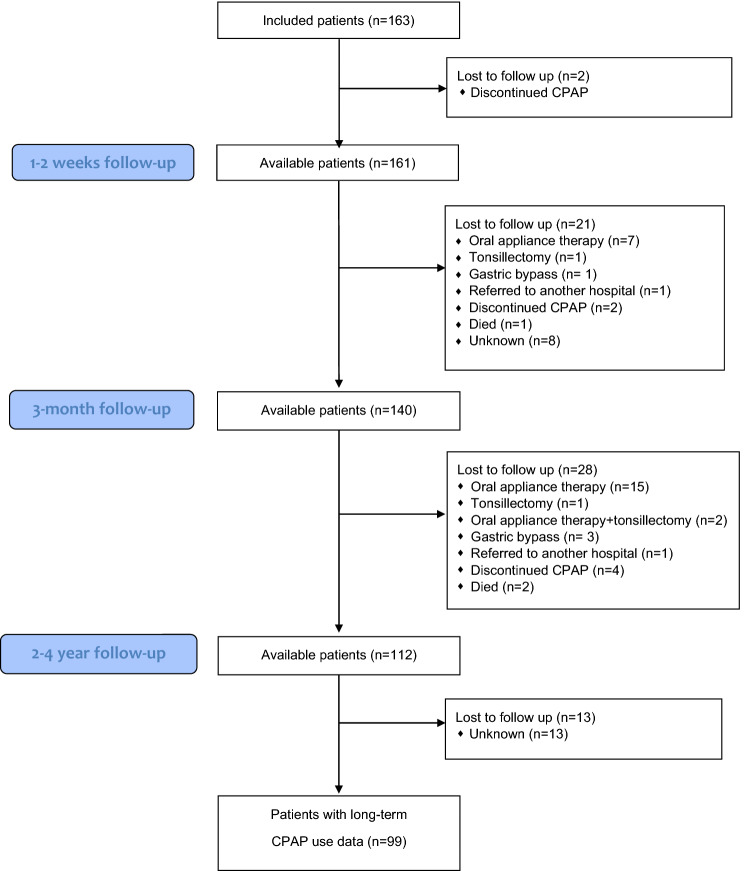
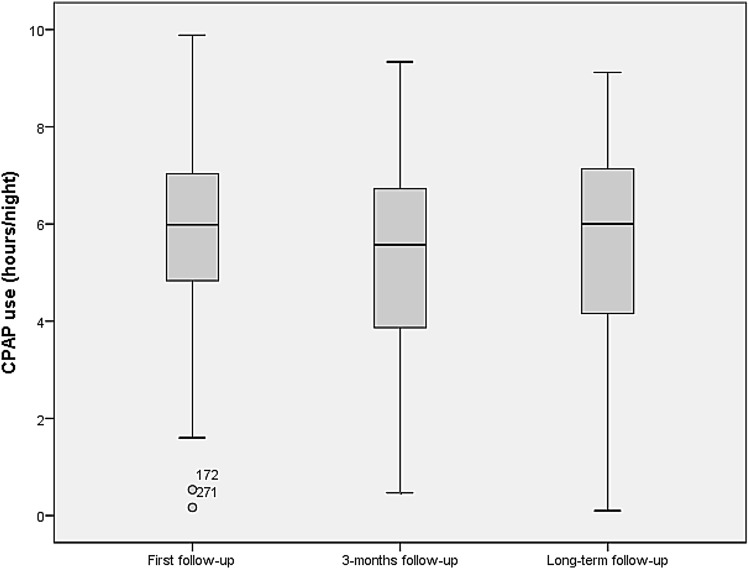
Continuous positive airway pressure (CPAP) is an efficient treatment for obstructive sleep apnea (OSA). Reports of long-term usage vary, as do the factors that predict long-term usage. The aim of this study was to explore long-term CPAP usage and identify potential predictors. This prospective longitudinal cohort study included all patients referred to an outpatient clinic for CPAP treatment during an eight-month period. Clinical data were collected at baseline. Follow-ups were scheduled after one week, three months and two years. Use data were downloaded from the CPAP device at each follow-up. Of 163 included patients, 112 were available for long-term follow-up 2-4 years after starting CPAP, and use data were downloaded for 99 patients. Median duration of CPAP use was 6 h/night (IQR 4.2-7.1). The only significant variable predicting long-term usage was usage at three months. Nearly half (43%) of the patients needed extra consultations beyond the standard treatment plan. Most patients (69%) did not contact the clinic for their recommended two-year follow-up but were instead called into the clinic specifically for the study. There was no significant difference in long-term CPAP usage between patients who initiated contact themselves and those who were called in and would otherwise have been lost for follow-up. Most patients adhere well to CPAP in the long term, although many need extra follow-up. Patients lost for follow-up should not necessarily be considered non-adherent as their reason for not attending could be that they are managing treatment well on their own.
持续气道正压通气(CPAP)是治疗阻塞性睡眠呼吸暂停(OSA)的一种有效方法。关于长期使用CPAP的报告各不相同,预测长期使用的因素也是如此。本研究的目的是探讨CPAP的长期使用情况并确定潜在的预测因素。这项前瞻性纵向队列研究纳入了在八个月期间转诊至门诊接受CPAP治疗的所有患者。在基线时收集临床数据。随访安排在一周、三个月和两年后进行。每次随访时从CPAP设备下载使用数据。在纳入的163例患者中,112例在开始使用CPAP后2至4年可进行长期随访,99例患者下载了使用数据。CPAP的中位使用时长为每晚6小时(四分位间距4.2 - 7.1)。预测长期使用的唯一显著变量是三个月时的使用情况。近一半(43%)的患者需要超出标准治疗计划的额外咨询。大多数患者(69%)没有按照建议进行两年的随访,而是专门为该研究被召回门诊。主动联系的患者与被召回且否则会失访的患者在CPAP长期使用方面没有显著差异。大多数患者长期能很好地坚持使用CPAP,尽管许多患者需要额外的随访。失访的患者不一定应被视为不依从,因为他们未就诊的原因可能是他们自己能很好地管理治疗。