Savio Carlotta, Herren Pascal, Rejasse Agnès, Rios Alfredo, Bourelle William, Bruun-Jensen Annette, Lecocq Antoine, van Loon Joop J A, Nielsen-LeRoux Christina
University of Paris Saclay, INRAE, Micalis, Jouy-en-Josas, France.
Laboratory of Entomology, Department of Plant Sciences, Wageningen University, Wageningen, Netherlands.
Front Insect Sci. 2024 Mar 1;4:1334526. doi: 10.3389/finsc.2024.1334526. eCollection 2024.
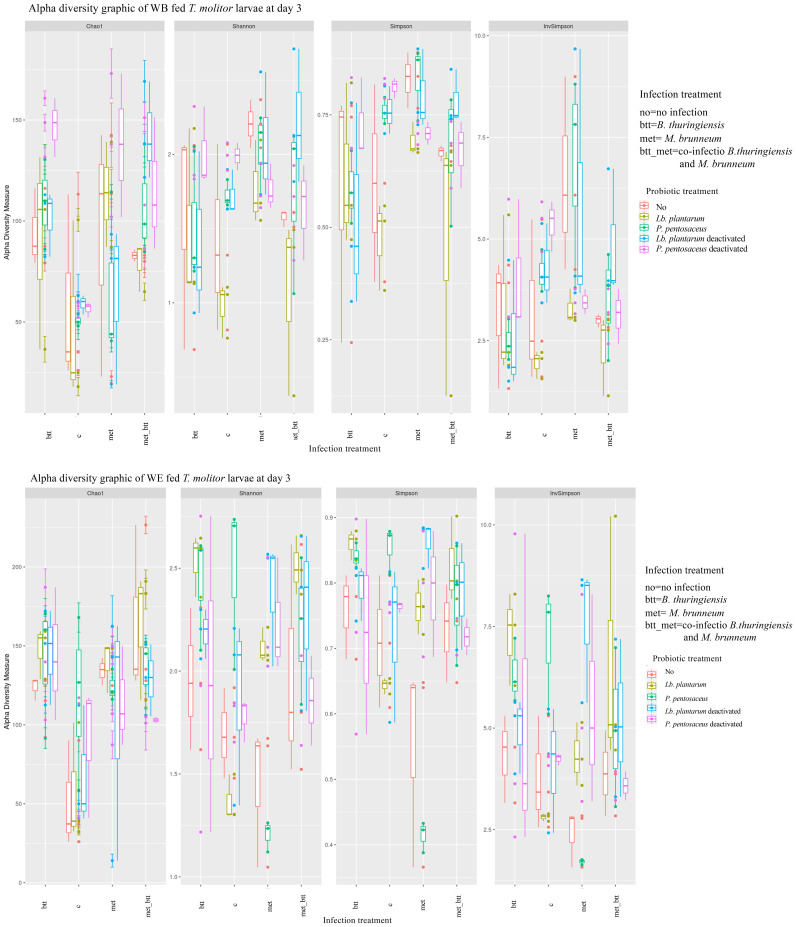
The industrial rearing of the yellow mealworm () for feed and food purposes on agricultural by-products may expose larvae and adults to entomopathogens used as biocontrol agents in crop production. Bacterial spores/toxins or fungal conidia from species such as or could affect the survival and growth of insects. Therefore, the aim of this study was to investigate the potential benefits of a wheat bran diet supplemented with probiotic bacteria and dried egg white on larval development and survival and its effects on the gut microbiome composition. Two probiotic bacterial species, KVL B19-01 and WJB, were added to wheat bran feed with and without dried egg white, as an additional protein source, directly from neonate larval hatching until reaching a body mass of 20 mg. Subsequently, larvae from the various diets were exposed for 72 h to , , or their combination. Larval survival and growth were recorded for 14 days, and the bacterial microbiota composition was analyzed using 16S rDNA sequencing prior to pathogen exposure and on days 3 and 11 after inoculation with the pathogens. The results showed increased survival for larvae reared on feed supplemented with in the case of co-infection. Larval growth was also impacted in the co-infection treatment. No significant impact of egg white or of on larval growth was recorded, while the addition of resulted in a minor increase in individual mass gain compared with infected larvae without the latter probiotic. On day 14, was no longer detected and the overall bacterial community composition of the larvae was similar in all treatments. On the other hand, the relative operational taxonomic unit (OTU) abundance was dependent on day, diet, and probiotic. Interestingly, was present throughout the experiments, while was not found at a detectable level, although its transient presence slightly improved larval performance. Overall, this study confirms the potential benefits of some probiotics during the development of while underlining the complexity of the relationship between the host and its microbiome.
出于饲料和食品目的,利用农业副产品对黄粉虫()进行工业化饲养,可能会使幼虫和成虫接触到作物生产中用作生物防治剂的昆虫病原体。诸如或等物种的细菌孢子/毒素或真菌分生孢子可能会影响昆虫的存活和生长。因此,本研究的目的是调查添加益生菌和干蛋清的麦麸日粮对幼虫发育和存活的潜在益处及其对肠道微生物群组成的影响。将两种益生菌,即KVL B19 - 01和WJB,添加到添加和不添加干蛋清(作为额外蛋白质来源)的麦麸饲料中,从新生幼虫孵化开始直至体重达到20毫克。随后,将来自不同日粮的幼虫暴露于、、或它们的组合中72小时。记录幼虫14天的存活和生长情况,并在病原体暴露前以及接种病原体后第3天和第11天,使用16S rDNA测序分析细菌微生物群组成。结果表明,在共感染情况下,用添加的饲料饲养的幼虫存活率提高。共感染处理也影响了幼虫生长。未记录到蛋清或对幼虫生长有显著影响,而与未添加后一种益生菌的感染幼虫相比,添加导致个体体重增加略有增加。在第14天,不再检测到,并且所有处理中幼虫的总体细菌群落组成相似。另一方面,相对操作分类单元(OTU)丰度取决于天数、日粮和益生菌。有趣的是,在整个实验过程中都存在,而未在可检测水平发现,尽管其短暂存在略微改善了幼虫性能。总体而言,本研究证实了某些益生菌在黄粉虫发育过程中的潜在益处,同时强调了宿主与其微生物群之间关系的复杂性。