Mayobre Carlos, Santo Domingo Miguel, Özkan Elif Nur, Fernández-Borbolla Andrés, Ruiz-Lasierra Javier, Garcia-Mas Jordi, Pujol Marta
Centre for Research in Agricultural Genomics (CRAG) CSIC-IRTA-UAB-UB, Edifici CRAG, Campus UAB, 08193 Bellaterra, Barcelona, Spain.
Institut de Recerca i Tecnologia Agroalimentàries (IRTA), Edifici CRAG, Campus UAB, 08193 Bellaterra, Barcelona, Spain.
Hortic Res. 2024 Jan 16;11(3):uhae020. doi: 10.1093/hr/uhae020. eCollection 2024 Mar.
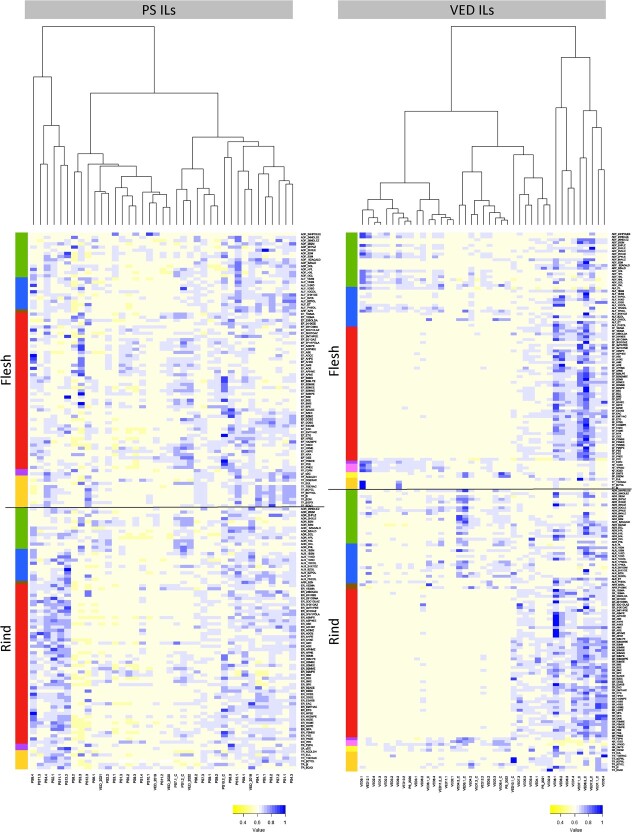
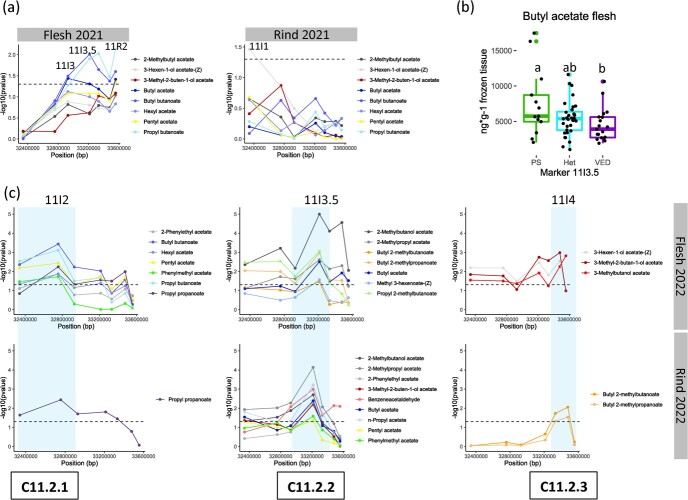
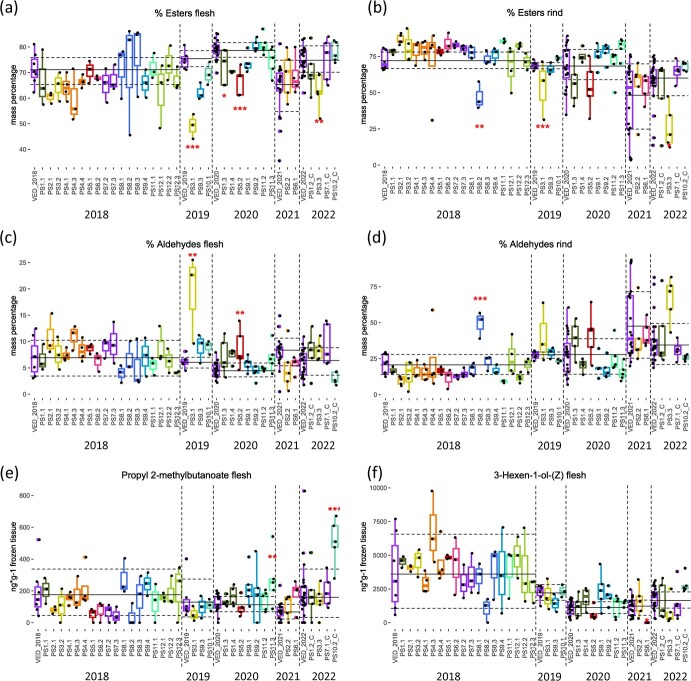
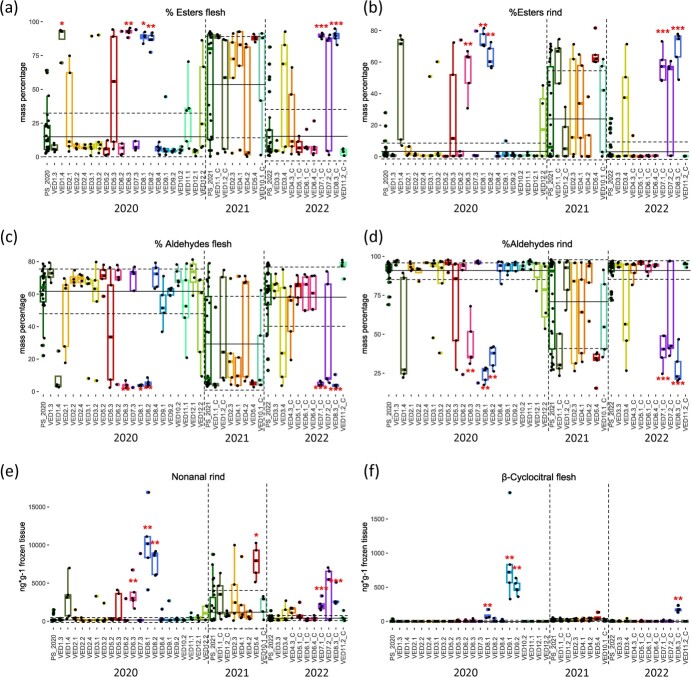
The importance of melon aroma in determining fruit quality has been highlighted in recent years. The fruit volatile profile is influenced by the type of fruit ripening. Non-climacteric fruits contain predominantly aldehydes, while climacteric fruits mainly produce esters. Several genes have been described to participate in volatile organic compounds (VOCs) biosynthesis pathways, but knowledge in this area is still incomplete. In this work we analysed the volatile profile of two reciprocal Introgression Line (IL) collections generated from a cross between 'Piel de Sapo' (PS) and 'Védrantais' (VED) melons, differing in their aroma profile and ripening behaviour. SPME GC-MS was performed to identify genes responsible for VOCs formation. More than 1000 QTLs for many volatiles were detected taken together both populations. Introgressions on chromosomes 3, 5, 6, 7 and 8 modified ester-aldehyde balance and were correlated to ripening changes in both genetic backgrounds. Some previously identified QTLs for fruit ripening might be involved in these phenotypes, such as on chromosome 8 and on chromosome 6. PS alleles on chromosomes 2, 6, 10 and 11 were found to increase ester content when introgressed in VED melons. Terpenes showed to be affected by several genomic regions not related to ripening. In addition, several candidate genes have been hypothesized to be responsible for some of the QTLs detected. The analysis of volatile compounds in two reciprocal IL collections has increased our understanding of the relationship between ripening and aroma and offers valuable plant material to improve food quality in melon breeding programs.
近年来,甜瓜香气在决定果实品质方面的重要性已得到凸显。果实挥发性成分受果实成熟类型的影响。非跃变型果实主要含有醛类,而跃变型果实主要产生酯类。已有多个基因被描述参与挥发性有机化合物(VOCs)的生物合成途径,但该领域的知识仍不完整。在这项研究中,我们分析了由‘Piel de Sapo’(PS)和‘Védrantais’(VED)甜瓜杂交产生的两个相互渗入系(IL)群体的挥发性成分,这两个群体在香气特征和成熟行为上存在差异。采用固相微萃取气相色谱 - 质谱联用(SPME GC - MS)技术来鉴定负责VOCs形成的基因。两个群体总共检测到了1000多个与多种挥发性物质相关的数量性状位点(QTLs)。第3、5、6、7和8号染色体上的渗入改变了酯 - 醛平衡,并且与两种遗传背景下的成熟变化相关。一些先前鉴定出的与果实成熟相关的QTLs可能参与了这些表型,例如位于第8号染色体和第6号染色体上的QTLs。当将第2、6、10和11号染色体上的PS等位基因导入VED甜瓜时,发现酯含量增加。萜类物质显示受到几个与成熟无关的基因组区域的影响。此外,已经推测有几个候选基因负责一些检测到的QTLs。对两个相互渗入系群体中挥发性化合物的分析增进了我们对成熟与香气之间关系的理解,并为甜瓜育种计划中改善食品品质提供了有价值的植物材料。