Jiménez-Jiménez Carlos, Grobe Kay, Guerrero Isabel
Centro de Biología Molecular Severo Ochoa (CSIC-UAM), Universidad Autónoma de Madrid, Nicolás Cabrera 1, E-28049 Madrid, Spain.
Institute of Physiological Chemistry and Pathobiochemistry, University of Münster, Waldeyerstrasse 15, 48149 Münster, Germany.
Cells. 2024 Feb 27;13(5):418. doi: 10.3390/cells13050418.
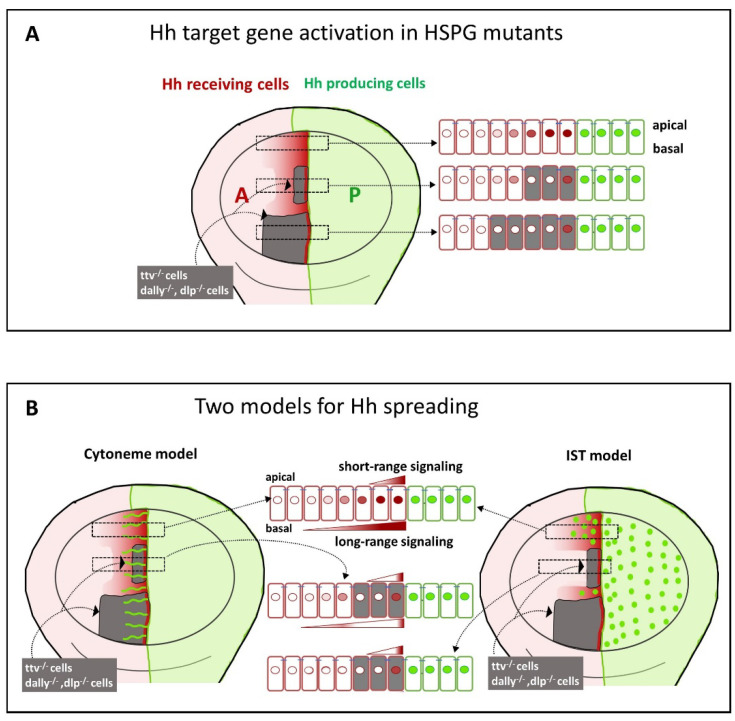
Glypicans (Glps) are a family of heparan sulphate proteoglycans that are attached to the outer plasma membrane leaflet of the producing cell by a glycosylphosphatidylinositol anchor. Glps are involved in the regulation of many signalling pathways, including those that regulate the activities of Wnts, Hedgehog (Hh), Fibroblast Growth Factors (FGFs), and Bone Morphogenetic Proteins (BMPs), among others. In the Hh-signalling pathway, Glps have been shown to be essential for ligand transport and the formation of Hh gradients over long distances, for the maintenance of Hh levels in the extracellular matrix, and for unimpaired ligand reception in distant recipient cells. Recently, two mechanistic models have been proposed to explain how Hh can form the signalling gradient and how Glps may contribute to it. In this review, we describe the structure, biochemistry, and metabolism of Glps and their interactions with different components of the Hh-signalling pathway that are important for the release, transport, and reception of Hh.
磷脂酰肌醇蛋白聚糖(Glypicans,Glps)是一类硫酸乙酰肝素蛋白聚糖,通过糖基磷脂酰肌醇锚定连接到产生细胞的外质膜小叶上。Glps参与多种信号通路的调节,包括调节Wnt、刺猬蛋白(Hh)、成纤维细胞生长因子(FGFs)和骨形态发生蛋白(BMPs)等的活性的信号通路。在Hh信号通路中,已证明Glps对于配体运输和长距离Hh梯度的形成、细胞外基质中Hh水平的维持以及远处受体细胞中未受损的配体接收至关重要。最近,有人提出了两种机制模型来解释Hh如何形成信号梯度以及Glps可能如何促成这一过程。在本综述中,我们描述了Glps的结构、生物化学和代谢,以及它们与Hh信号通路中不同成分的相互作用,这些相互作用对于Hh的释放、运输和接收很重要。