El-Khlifi Abdelilah, Zouhair Fatima Zahrae, Al-Hadeethi Mustafa R, Lgaz Hassane, Lee Han-Seung, Salghi Rachid, Hammouti Belkheir, Erramli Hamid
Team of Materials, Electrochemistry and Environment, Laboratory of Organic Chemistry, Catalysis, and Environment, Faculty of Sciences, Ibn Tofail University, BP 133, Kenitra 14000, Morocco.
Laboratory of Plant, Animal and Agro Industry Productions, Faculty of Sciences, Ibn Tofail University, B.P. 133, Kenitra 14000, Morocco.
Molecules. 2024 Feb 23;29(5):985. doi: 10.3390/molecules29050985.
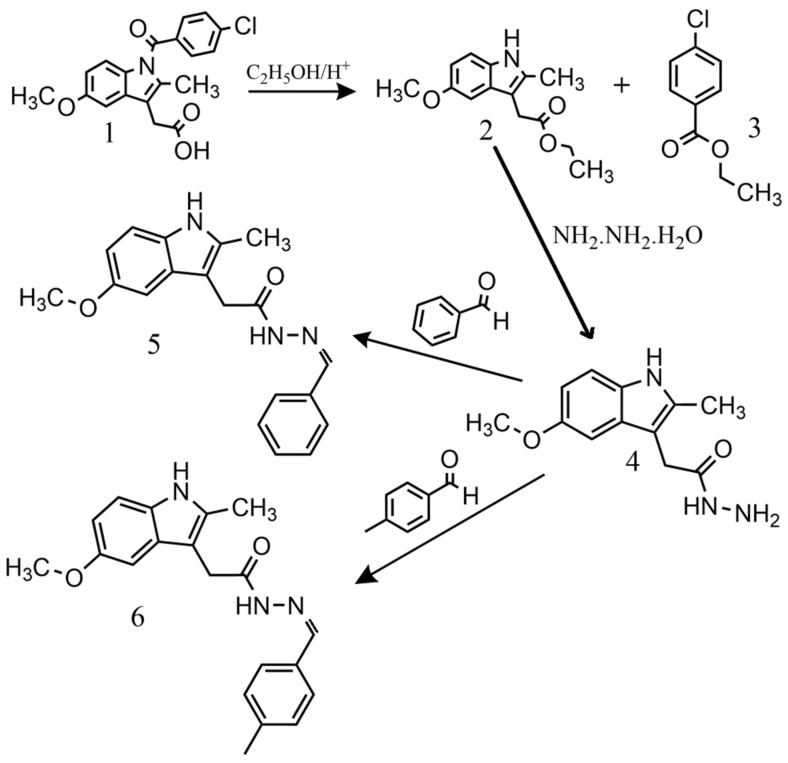
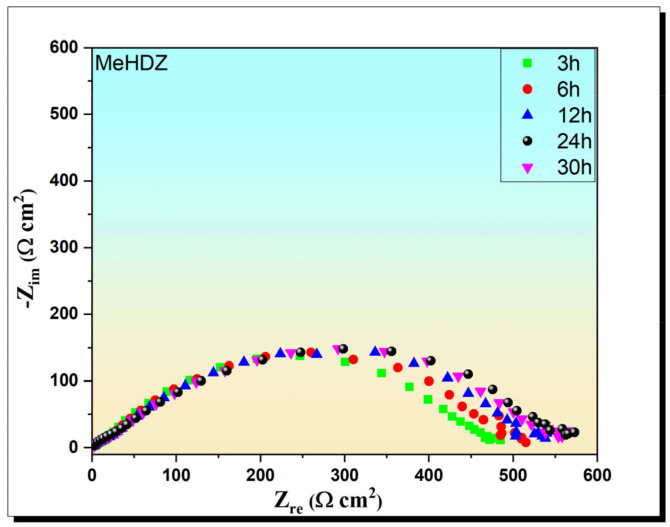
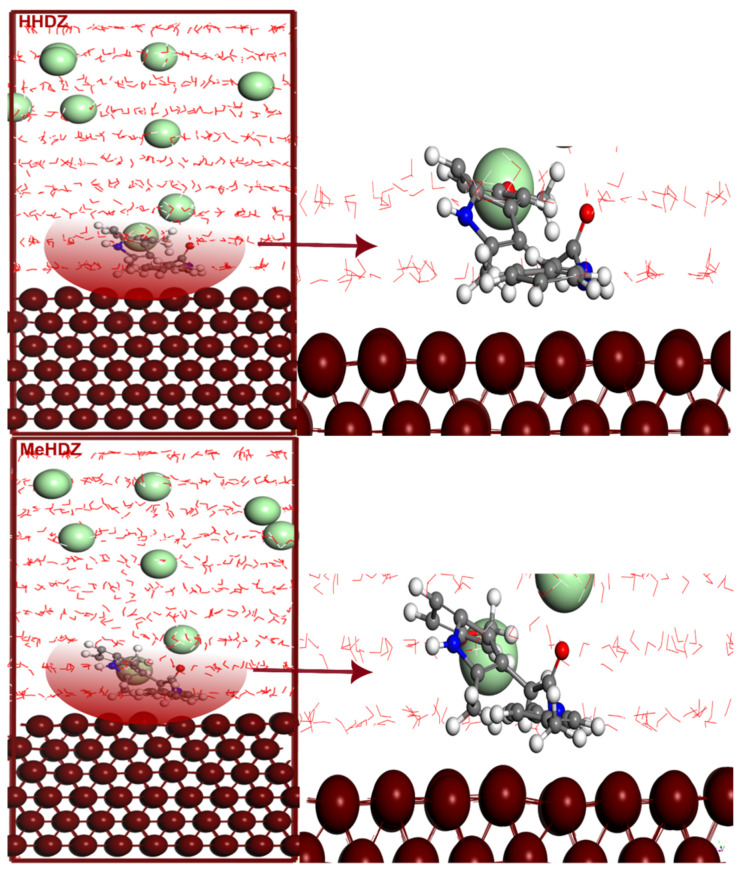
This study evaluates the corrosion inhibition capabilities of two novel hydrazone derivatives, (E)-2-(5-methoxy-2-methyl-1H-indol-3-yl)-N'-(4-methylbenzylidene)acetohydrazide (MeHDZ) and (E)-N'-benzylidene-2-(5-methoxy-2-methyl-1H-indol-3-yl)acetohydrazide (HHDZ), on carbon steel in a 15 wt.% HCl solution. A comprehensive suite of analytical techniques, including gravimetric analysis, potentiodynamic polarization (PDP), electrochemical impedance spectroscopy (EIS), and scanning electron microscopy (SEM), demonstrates their significant inhibition efficiency. At an optimal concentration of 5 × 10 mol/L, MeHDZ and HHDZ achieve remarkable inhibition efficiencies of 98% and 94%, respectively. EIS measurements reveal a dramatic reduction in effective double-layer capacitance (from 236.2 to 52.8 and 75.3 µF/cm), strongly suggesting inhibitor adsorption on the steel surface. This effect is further corroborated by an increase in polarization resistance and a significant decrease in corrosion current density at optimal concentrations. Moreover, these inhibitors demonstrate sustained corrosion mitigation over extended exposure durations and maintain effectiveness even under elevated temperatures, highlighting their potential for diverse operational conditions. The adsorption process of these inhibitors aligns well with the Langmuir adsorption isotherm, implying physicochemical interactions at the carbon steel surface. Density functional tight-binding (DFTB) calculations and molecular dynamics simulations provide insights into the inhibitor-surface interaction mechanism, further elucidating the potential of these hydrazone derivatives as highly effective corrosion inhibitors in acidic environments.
本研究评估了两种新型腙衍生物,即(E)-2-(5-甲氧基-2-甲基-1H-吲哚-3-基)-N'-(4-甲基亚苄基)乙酰肼(MeHDZ)和(E)-N'-亚苄基-2-(5-甲氧基-2-甲基-1H-吲哚-3-基)乙酰肼(HHDZ)在15 wt.% HCl溶液中对碳钢的缓蚀能力。包括重量分析、动电位极化(PDP)、电化学阻抗谱(EIS)和扫描电子显微镜(SEM)在内的一套综合分析技术证明了它们具有显著的缓蚀效率。在最佳浓度5×10⁻³ mol/L时,MeHDZ和HHDZ的缓蚀效率分别达到98%和94%。EIS测量显示有效双层电容显著降低(从236.2降至52.8和75.3 μF/cm²),强烈表明抑制剂吸附在钢表面。在最佳浓度下极化电阻增加和腐蚀电流密度显著降低进一步证实了这一效果。此外,这些抑制剂在长时间暴露下能持续减轻腐蚀,即使在高温下也能保持有效性,突出了它们在不同操作条件下的潜力。这些抑制剂的吸附过程与朗缪尔吸附等温线吻合良好,这意味着在碳钢表面存在物理化学相互作用。密度泛函紧束缚(DFTB)计算和分子动力学模拟为抑制剂-表面相互作用机制提供了见解,进一步阐明了这些腙衍生物作为酸性环境中高效腐蚀抑制剂的潜力。