Clinic and Department of Rheumatology and Systemic Diseases of Connective Tissue, University Hospital No. 2. Bydgoszcz, CM UMK, 85-168 Bydgoszcz, KP, Poland.
Medical Plus, s.r.o., 68601 Uherske Hradiste, ZL, Czech Republic.
J Bone Miner Res. 2024 Apr 19;39(3):202-210. doi: 10.1093/jbmr/zjae016.
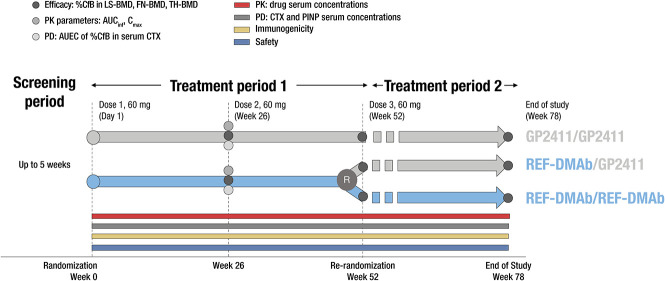
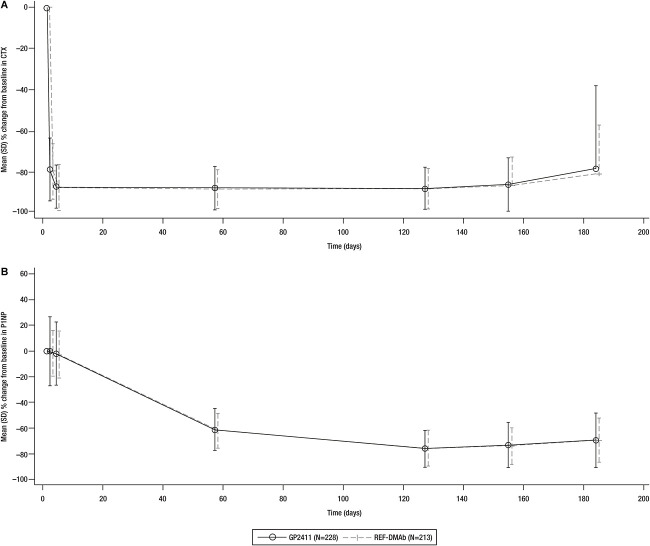
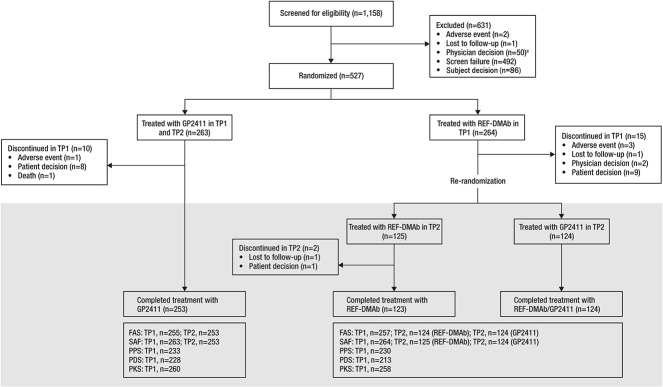
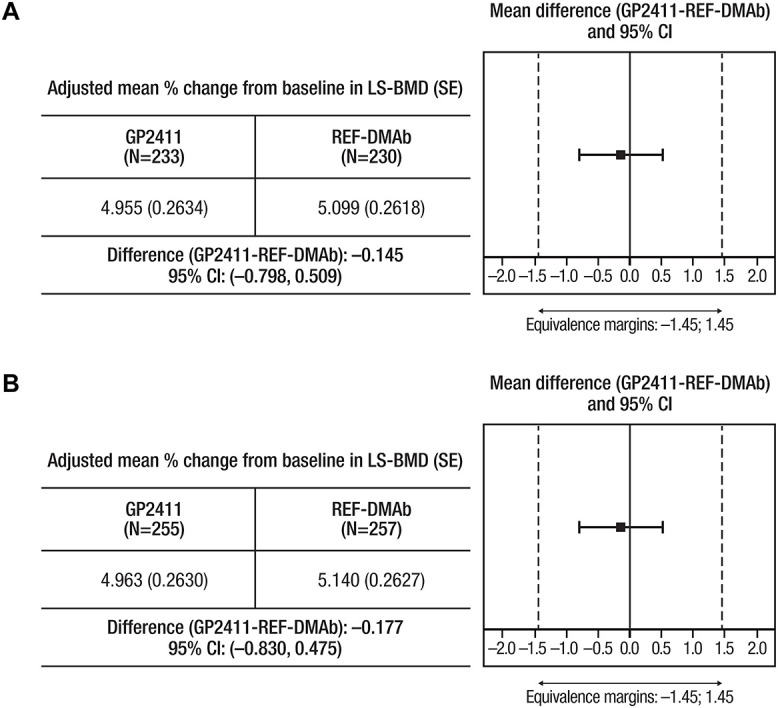
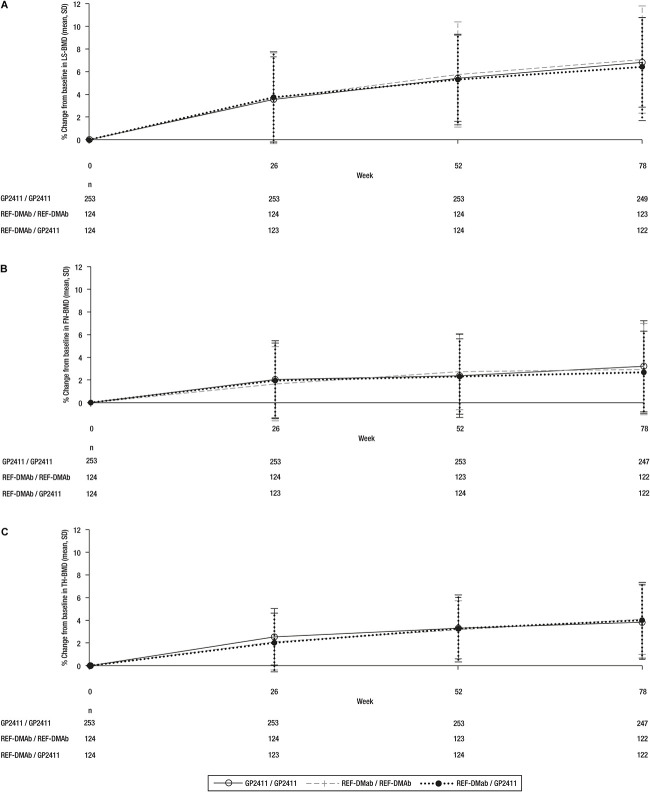
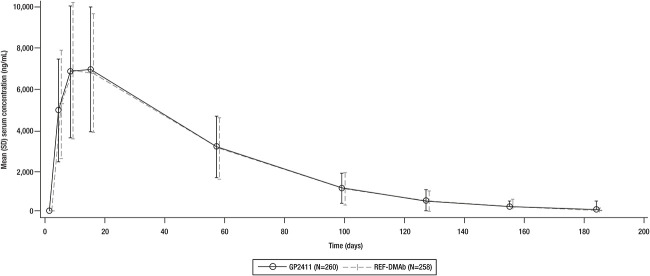
Denosumab is a monoclonal antibody used to reduce risk of fractures in osteoporosis. ROSALIA was a multicenter, double-blind, randomized, integrated phase I/phase III study comparing the efficacy, pharmacokinetics (PK), pharmacodynamics (PD), immunogenicity, and safety of proposed biosimilar denosumab GP2411 with reference denosumab (REF-DMAb) (Prolia®; Amgen). Postmenopausal women with osteoporosis were randomized 1:1 to 2 60-mg doses of GP2411 or REF-DMAb, one at study start and one at week 26. At week 52, the REF-DMAb group was re-randomized 1:1 to a third dose of REF-DMAb or switch to GP2411. The primary efficacy endpoint was percentage change from baseline (%CfB) in LS-BMD at week 52. Secondary efficacy endpoints were %CfB in LS-BMD, FN-BMD, and TH-BMD at weeks 26 and 78 (and week 52 for FN-BMD and TH-BMD). Primary PK and PD endpoints were the area under the serum concentration-time curve extrapolated to infinity and maximum drug serum concentration at week 26, and the area under the effect-time curve of the %CfB in serum CTX at week 26. Secondary PK and PD endpoints included drug serum concentrations and %CfB in serum CTX and P1NP during the study period. Similar efficacy was demonstrated at week 52, with 95% CIs of the difference in %CfB in LS-BMD between treatment groups fully contained within prespecified equivalence margins. Similarity in PK and PD was demonstrated at week 26. Immunogenicity was similar between groups and was not impacted by treatment switch. The rate of new vertebral fractures was comparable. Treatment-emergent adverse events were comparable between groups (63.6% [GP2411/GP2411]; 76.0% [REF-DMAb/REF-DMAb]; 76.6% [REF-DMAb/GP2411]). In conclusion, ROSALIA showed similar efficacy, PK and PD, and comparable safety and immunogenicity of GP2411 to REF-DMAb in postmenopausal osteoporosis.
地舒单抗是一种单克隆抗体,用于降低骨质疏松症患者骨折风险。ROSALIA 是一项多中心、双盲、随机、Ⅰ期/Ⅲ期整合研究,旨在比较 GP2411(一种提议的生物类似药地舒单抗)与参照药物地舒单抗(REF-DMAb)(普罗力;安进)的疗效、药代动力学(PK)、药效动力学(PD)、免疫原性和安全性。绝经后骨质疏松症女性按 1:1 随机分为 GP2411 或 REF-DMAb 组,每组 60mg,分别在研究开始时和第 26 周给药。第 52 周时,REF-DMAb 组再随机分为 REF-DMAb 组(第 3 剂)或 GP2411 组(第 3 剂)。主要疗效终点为第 52 周时 LS-BMD 的基线变化百分比(%CfB)。次要疗效终点为第 26、78 周时 LS-BMD、FN-BMD 和 TH-BMD 的%CfB(FN-BMD 和 TH-BMD 为第 52 周时)。主要 PK 和 PD 终点为第 26 周时血清浓度-时间曲线下面积(AUC)和最大药物血清浓度(AUC),以及第 26 周时血清 CTX 中 %CfB 的效应时间曲线下面积。次要 PK 和 PD 终点包括研究期间的药物血清浓度和血清 CTX、P1NP 中的%CfB。第 52 周时,两组间 LS-BMD 的%CfB 差值的 95%置信区间完全包含在预先指定的等效区间内,表明疗效相似。第 26 周时,PK 和 PD 相似。两组间的免疫原性相似,且不受治疗方案的影响。新发椎体骨折率相当。两组间治疗出现的不良事件相当(GP2411/GP2411:63.6%;REF-DMAb/REF-DMAb:76.0%;REF-DMAb/GP2411:76.6%)。结论:在绝经后骨质疏松症患者中,ROSALIA 研究结果表明,GP2411 与 REF-DMAb 的疗效、PK 和 PD 相似,安全性和免疫原性相当。