Division of Infectious Diseases and Geographic Medicine, Department of Medicine, Stanford University School of Medicine, Stanford, California, USA
Division of Pulmonary, Allergy, Critical Care, and Sleep Medicine, Department of Medicine, Emory University School of Medicine, Atlanta, Georgia, USA.
BMJ Open. 2024 Mar 12;14(3):e075176. doi: 10.1136/bmjopen-2023-075176.
Tuberculosis infection (TBI) is marked by dynamic host-pathogen interactions with persistent low-grade inflammation and is associated with increased risk of cardiovascular diseases (CVD) including acute coronary syndrome, myocardial infarction and stroke. However, few studies assess the relationship between TBI and hypertension, an intermediate of CVD. We sought to determine the association between TBI and hypertension using data representative of the adult US population.
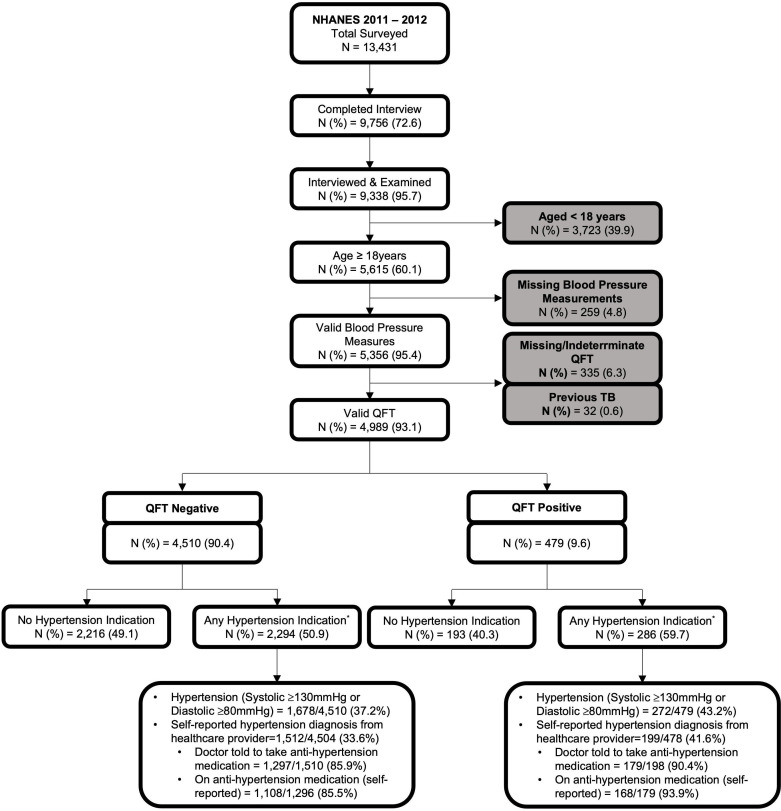
We performed cross-sectional analyses using data from the 2011-2012 US National Health and Nutrition Examination Survey (NHANES). Eligible participants included adults with valid QuantiFERON-TB Gold In-Tube (QFT-GIT) test results who also had blood pressure measures and no history of TB disease. TBI was defined by a positive QFT-GIT. We defined hypertension by either elevated measured blood pressure levels (ie, systolic ≥130 mm Hg or diastolic ≥80 mm Hg) or known hypertension indications (ie, self-reported previous diagnosis or use of antihypertensive medications). Analyses were performed using robust quasi-Poisson regressions and accounted for the stratified probability sampling design of NHANES.
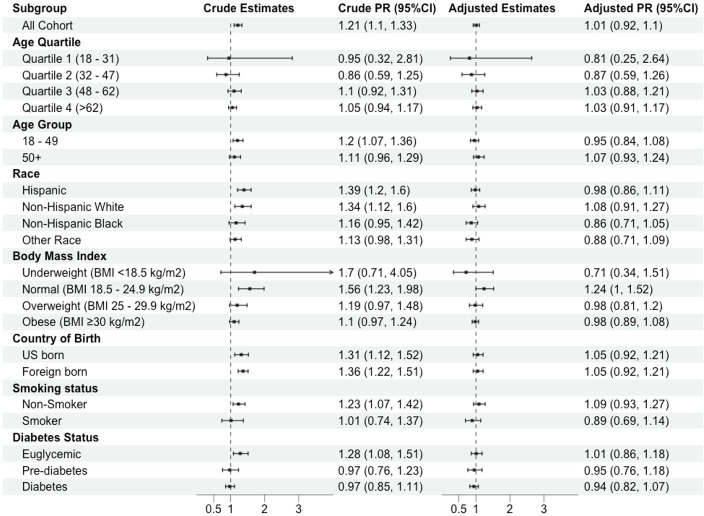
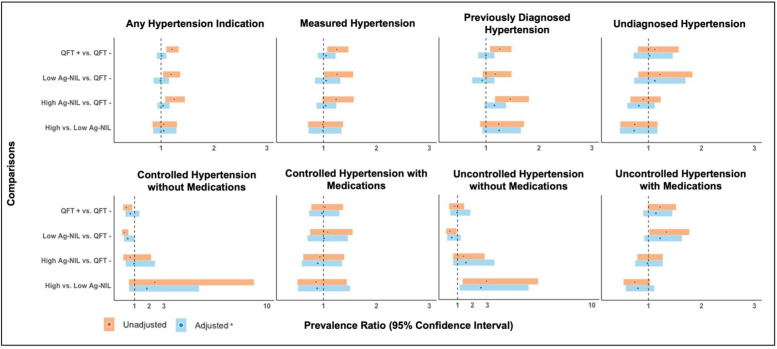
The overall prevalence of TBI was 5.7% (95% CI 4.7% to 6.7%) and hypertension was present among 48.9% (95% CI 45.2% to 52.7%) of participants. The prevalence of hypertension was higher among those with TBI (58.5%, 95% CI 52.4% to 64.5%) than those without TBI (48.3%, 95% CI 44.5% to 52.1%) (prevalence ratio (PR) 1.2, 95% CI 1.1 to 1.3). However, after adjusting for confounders, the prevalence of hypertension was similar for those with and without TBI (adjusted PR 1.0, 95% CI 1.0 to 1.1). The unadjusted prevalence of hypertension was higher among those with TBI versus no TBI, especially among individuals without CVD risk factors including those with normal body mass index (PR 1.6, 95% CI 1.2 to 2.0), euglycaemia (PR 1.3, 95% CI 1.1 to 1.5) or non-smokers (PR 1.2, 95% CI 1.1 to 1.4).
More than half of adults with TBI in the USA had hypertension. Importantly, we observed a relationship between TBI and hypertension among those without established CVD risk factors.
The prevalence of hypertension was high (59%) among adults with TBI in the USA. In addition, we found that the prevalence of hypertension was significantly higher among adults with positive QFT without established hypertension risk factors.
结核病感染(TBI)的特点是宿主-病原体之间存在动态相互作用,伴有持续低度炎症,并与心血管疾病(CVD)风险增加有关,包括急性冠状动脉综合征、心肌梗死和中风。然而,很少有研究评估 TBI 与高血压之间的关系,高血压是 CVD 的中间环节。我们试图使用代表美国成年人口的数据分析 TBI 和高血压之间的关系。
我们使用 2011-2012 年美国国家健康和营养检查调查(NHANES)的数据进行了横断面分析。合格的参与者包括有有效 QuantiFERON-TB Gold In-Tube(QFT-GIT)检测结果的成年人,他们还接受了血压测量,且没有结核病病史。TBI 通过 QFT-GIT 阳性来定义。我们通过升高的血压水平(即收缩压≥130mmHg 或舒张压≥80mmHg)或已知的高血压指标(即自我报告的既往诊断或使用抗高血压药物)来定义高血压。分析使用稳健的拟泊松回归进行,并考虑了 NHANES 的分层概率抽样设计。
TBI 的总体患病率为 5.7%(95%CI 4.7%至 6.7%),参与者中有 48.9%(95%CI 45.2%至 52.7%)存在高血压。与无 TBI 者相比,TBI 者的高血压患病率更高(58.5%,95%CI 52.4%至 64.5%)(患病率比(PR)1.2,95%CI 1.1 至 1.3)。然而,在调整混杂因素后,有和无 TBI 者的高血压患病率相似(调整后的 PR 1.0,95%CI 1.0 至 1.1)。与无 TBI 者相比,TBI 者的高血压患病率更高,且未经调整,尤其是在无 CVD 危险因素的个体中,包括体重指数正常(PR 1.6,95%CI 1.2 至 2.0)、血糖正常(PR 1.3,95%CI 1.1 至 1.5)或不吸烟(PR 1.2,95%CI 1.1 至 1.4)的个体中。
美国超过一半的 TBI 成年人患有高血压。重要的是,我们观察到在无明确 CVD 危险因素的个体中,TBI 与高血压之间存在关联。
在美国,TBI 成年人中高血压的患病率很高(59%)。此外,我们发现,在没有既定高血压风险因素的情况下,QFT 阳性成年人的高血压患病率显著更高。