
探索应力对用于先进光电子应用的石墨炔纳米带的电子结构和光学性质的影响。
Exploring the impact of stress on the electronic structure and optical properties of graphdiyne nanoribbons for advanced optoelectronic applications.
作者信息
Liu Qiaohan, Feng Naixing, Zou Yi, Fan Chuanqiang, Wang Jingang
机构信息
College of Science, Liaoning Petrochemical University, Fushun, 113001, China.
Key Laboratory of Intelligent Computing and Signal Processing, and School of Electronic and Information Engineering, Anhui University, Hefei, 230601, China.
出版信息
Sci Rep. 2024 Mar 13;14(1):6051. doi: 10.1038/s41598-024-56380-z.
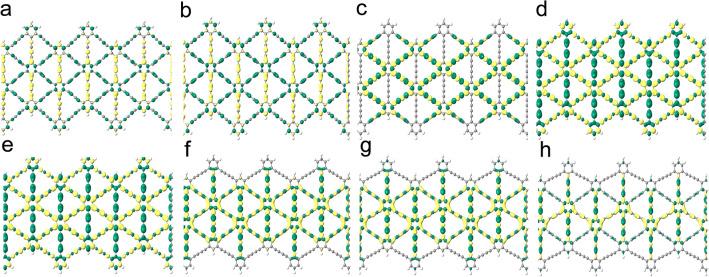
Graphdiyne (GDY), a two-dimensional carbon material with sp- and sp-hybridization, is recognized for its unique electronic properties and well-dispersed porosity. Its versatility has led to its use in a variety of applications. The precise control of this material's properties is paramount for its effective utilization in nano-optical devices. One effective method of regulation, which circumvents the need for additional disturbances, involves the application of external stress. This technique provides a direct means of eliciting changes in the electronic characteristics of the material. For instance, when subjected to uniaxial stress, electron transfer occurs at the triple bond. This results in an armchair-edged graphdiyne nanoribbon (A(3)-GDYNR) with a planar width of 2.07 nm, which exhibits a subtle plasmon effect at 500 nm. Conversely, a zigzag-edged graphdiyne nanoribbon (Z(3)-GDYNR) with a planar width of 2.86 nm demonstrates a pronounced plasmon effect within the 250-1200 nm range. This finding suggests that the zigzag nanoribbon surpasses the armchair nanoribbon in terms of its plasmon effect. First principles calculations and ab initio molecular dynamics further confirmed that under applied stress Z(3)-GDYNR exhibits less deformation than A(3)-GDYNR, indicating superior stability. This work provides the necessary theoretical basis for understanding graphene nanoribbons (GDYNRs).
石墨炔(GDY)是一种具有sp和sp杂化的二维碳材料,因其独特的电子特性和分布均匀的孔隙率而受到认可。其多功能性使其在各种应用中得到了应用。精确控制这种材料的性能对于其在纳米光学器件中的有效利用至关重要。一种有效的调节方法,避免了额外干扰的需要,涉及施加外部应力。该技术提供了一种直接的手段来引发材料电子特性的变化。例如,当受到单轴应力时,电子在三键处转移。这导致了一种平面宽度为2.07纳米的扶手椅边缘石墨炔纳米带(A(3)-GDYNR),它在500纳米处表现出微妙的等离子体效应。相反,一种平面宽度为2.86纳米的锯齿边缘石墨炔纳米带(Z(3)-GDYNR)在250-1200纳米范围内表现出明显的等离子体效应。这一发现表明,锯齿形纳米带在等离子体效应方面优于扶手椅形纳米带。第一性原理计算和从头算分子动力学进一步证实,在施加应力的情况下,Z(3)-GDYNR的变形比A(3)-GDYNR小,表明其具有更高的稳定性。这项工作为理解石墨烯纳米带(GDYNRs)提供了必要的理论基础。




 Zotero 插件