Balán Iván C, Marone Ruben O, Barreda Victoria, Naar Sylvie, Wang Yuxia
Center for Translational Behavioral Science, Department of Behavioral Science and Social Medicine, Florida State University College of Medicine, Tallahassee, FL, United States.
Nexo Asociacion Civil, Buenos Aires, Argentina.
JMIR Res Protoc. 2024 Mar 14;13:e56683. doi: 10.2196/56683.
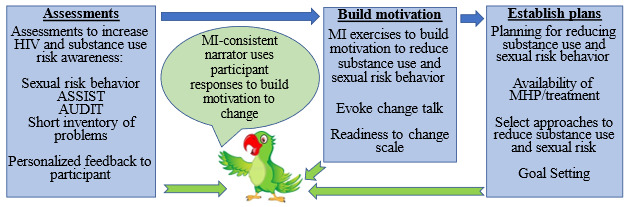
Men who have sex with men (MSM) are disproportionally affected by HIV and drug and alcohol use; however, few effective HIV prevention interventions for MSM who use substances exist. Screening, Brief Intervention, and Referral to Treatment is an early intervention for non-treatment-seeking individuals with problematic substance use and for timely referral to treatment for those with substance use disorders. Electronic screening and brief interventions (e-SBIs) reduce implementation challenges. An e-SBI tailored for MSM at the time of HIV testing might be particularly opportune to strengthen their motivation to reduce substance use and HIV risk behavior.
This study aims to develop a tailored e-SBI program to reduce substance use and HIV risk behavior among MSM seeking HIV testing at Nexo Asociación Civil, our community partners in Argentina (primary); assess the feasibility and acceptability of integrating the e-SBI into the Nexo HIV testing program (primary); assess the feasibility and acceptability of implementing an adapted Men's Health Project (MHP) at Nexo (secondary); and finally, explore preliminary findings on substance use and sexual risk reduction outcomes (exploratory).
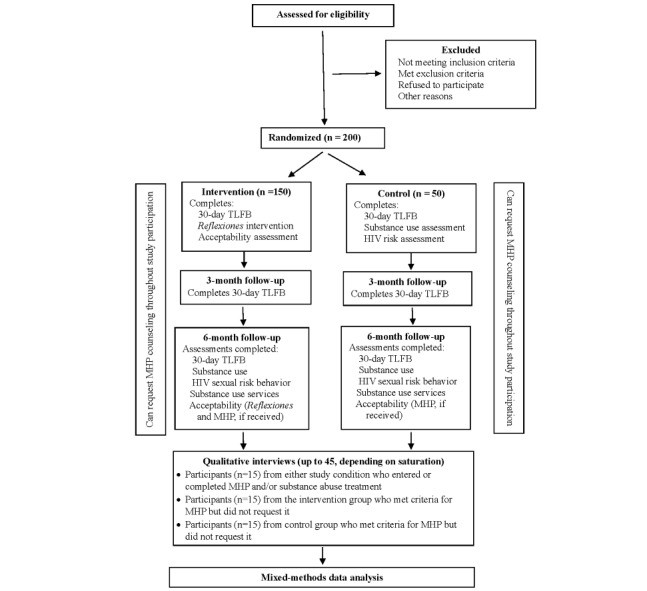
This mixed methods study has 2 stages. During stage 1 (development), we will use the User Centered Rapid App Design process consisting of focus groups (n=16), individual interviews (n=24), and a pilot deployment of the e-SBI (n=50) to iteratively develop the e-SBI. Quantitative and qualitative assessments at each step will inform the revision of the e-SBI. Furthermore, we will use the assessment, decision, administration, production, topic experts, integration, training, testing framework to adapt MHP. During stage 2 (pilot randomized controlled trial [RCT]), we will randomize 200 MSM coming to Nexo for HIV testing. They will complete a baseline assessment and then their assigned intervention (e-SBI vs screening only) and will be followed-up for 6 months. We will also conduct in-depth interviews with up to 45 participants: 15 participants from either study condition who entered or completed MHP or other substance abuse treatment and 15 from each arm who met the criteria for MHP but did not request it.
The study began recruitment in October 2022, and the stage-1 pilot study is near completion. Preliminary findings from stage 1 show high e-SBI acceptability. Data analysis of the stage-1 pilot is now beginning. The stage-2 pilot RCT will be launched in March 2024, with all data collection completed by May 2025.
This study will allow us to assess the acceptability and feasibility of e-SBI implementation during HIV testing encounters. We will also build the necessary research infrastructure for a subsequent RCT to assess the efficacy of e-SBIs in reducing substance use and HIV sexual risk behavior among MSM in this setting.
ClinicalTrials.gov NCT05542914; https://tinyurl.com/yyjj64dm.
INTERNATIONAL REGISTERED REPORT IDENTIFIER (IRRID): DERR1-10.2196/56683.
男男性行为者(MSM)受艾滋病毒以及药物和酒精使用的影响尤为严重;然而,针对使用毒品的男男性行为者,几乎没有有效的艾滋病毒预防干预措施。筛查、简短干预和转介治疗是针对有物质使用问题且未寻求治疗的个人的早期干预措施,也是为患有物质使用障碍的人及时转介治疗的措施。电子筛查和简短干预(e-SBI)减少了实施方面的挑战。在艾滋病毒检测时为男男性行为者量身定制的e-SBI可能特别适合加强他们减少物质使用和艾滋病毒风险行为的动机。
本研究旨在制定一个量身定制的e-SBI项目,以减少在阿根廷的社区合作伙伴Nexo Asociación Civil寻求艾滋病毒检测的男男性行为者的物质使用和艾滋病毒风险行为(主要目的);评估将e-SBI纳入Nexo艾滋病毒检测项目的可行性和可接受性(主要目的);评估在Nexo实施改编后的男性健康项目(MHP)的可行性和可接受性(次要目的);最后,探索关于物质使用和性风险降低结果的初步发现(探索性目的)。
这项混合方法研究有两个阶段。在第1阶段(开发阶段),我们将使用以用户为中心的快速应用程序设计流程,包括焦点小组(n = 16)、个人访谈(n = 24)以及e-SBI的试点部署(n = 50),以迭代方式开发e-SBI。每个步骤的定量和定性评估将为e-SBI的修订提供信息。此外,我们将使用评估、决策、管理、生产、主题专家、整合、培训、测试框架来改编MHP。在第2阶段(试点随机对照试验[RCT]),我们将把200名前来Nexo进行艾滋病毒检测的男男性行为者随机分组。他们将完成基线评估,然后接受指定的干预措施(e-SBI与仅筛查),并进行6个月的随访。我们还将对多达45名参与者进行深入访谈:来自进入或完成MHP或其他药物滥用治疗的任何一种研究条件的15名参与者,以及来自符合MHP标准但未要求参加的每组中的15名参与者。
该研究于2022年10月开始招募,第1阶段的试点研究接近完成。第1阶段的初步结果显示e-SBI具有很高的可接受性。第1阶段试点的数据分析目前正在进行。第2阶段的试点RCT将于2024年3月启动,所有数据收集将于2025年5月完成。
本研究将使我们能够评估在艾滋病毒检测过程中实施e-SBI的可接受性和可行性。我们还将为后续的RCT建立必要的研究基础设施,以评估e-SBI在此环境中减少男男性行为者物质使用和艾滋病毒性风险行为的效果。
ClinicalTrials.gov NCT05542914;https://tinyurl.com/yyjj64dm。
国际注册报告识别码(IRRID):DERR1-10.2196/56683。