Department of Human Anatomy and Histoembryology, Nanjing University of Chinese Medicine, Nanjing, 210023, China.
Affiliated Hospital of Nanjing University of Chinese Medicine, Nanjing, 210023, China.
Cell Mol Biol Lett. 2024 Mar 14;29(1):37. doi: 10.1186/s11658-024-00547-z.
DNA mismatch repair (MMR) is a highly conserved pathway that corrects DNA replication errors, the loss of which is attributed to the development of various types of cancers. Although well characterized, MMR factors remain to be identified. As a 3'-5' exonuclease and endonuclease, meiotic recombination 11 homolog A (MRE11A) is implicated in multiple DNA repair pathways. However, the role of MRE11A in MMR is unclear.
Initially, short-term and long-term survival assays were used to measure the cells' sensitivity to N-methyl-N'-nitro-N-nitrosoguanidine (MNNG). Meanwhile, the level of apoptosis was also determined by flow cytometry after MNNG treatment. Western blotting and immunofluorescence assays were used to evaluate the DNA damage within one cell cycle after MNNG treatment. Next, a GFP-heteroduplex repair assay and microsatellite stability test were used to measure the MMR activities in cells. To investigate the mechanisms, western blotting, the GFP-heteroduplex repair assay, and chromatin immunoprecipitation were used.
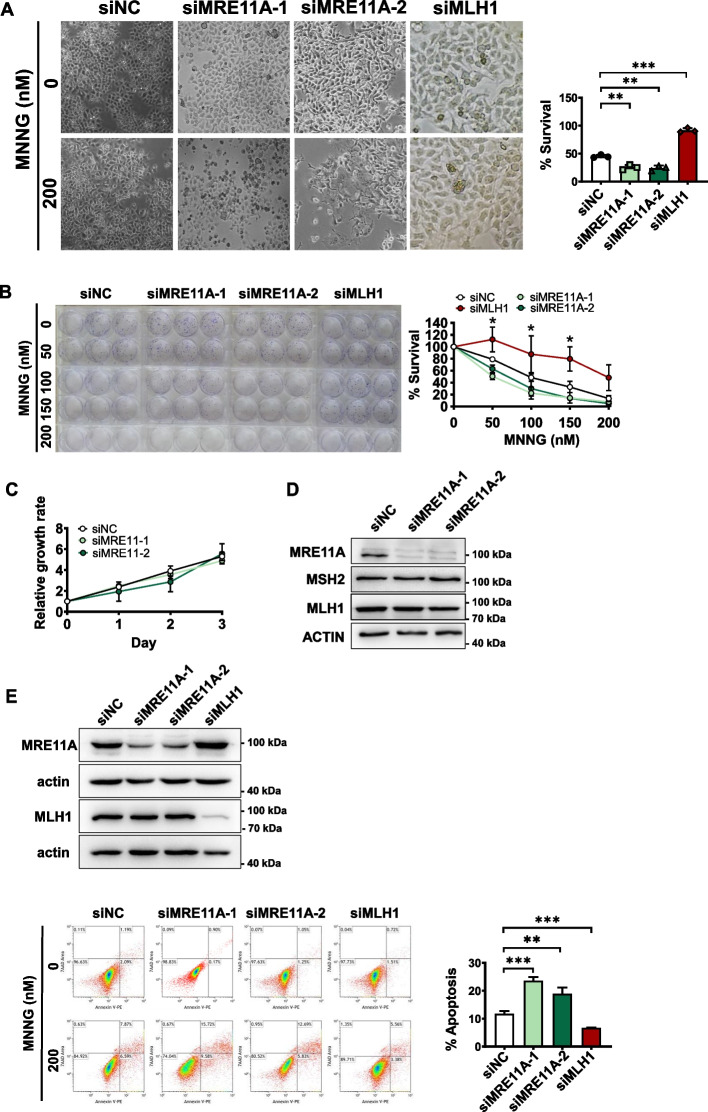
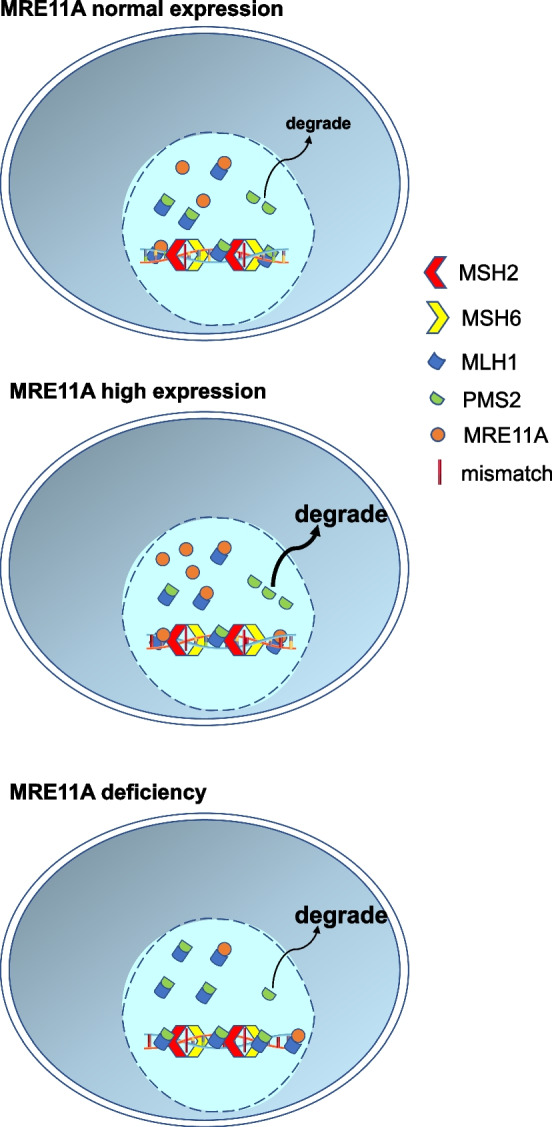
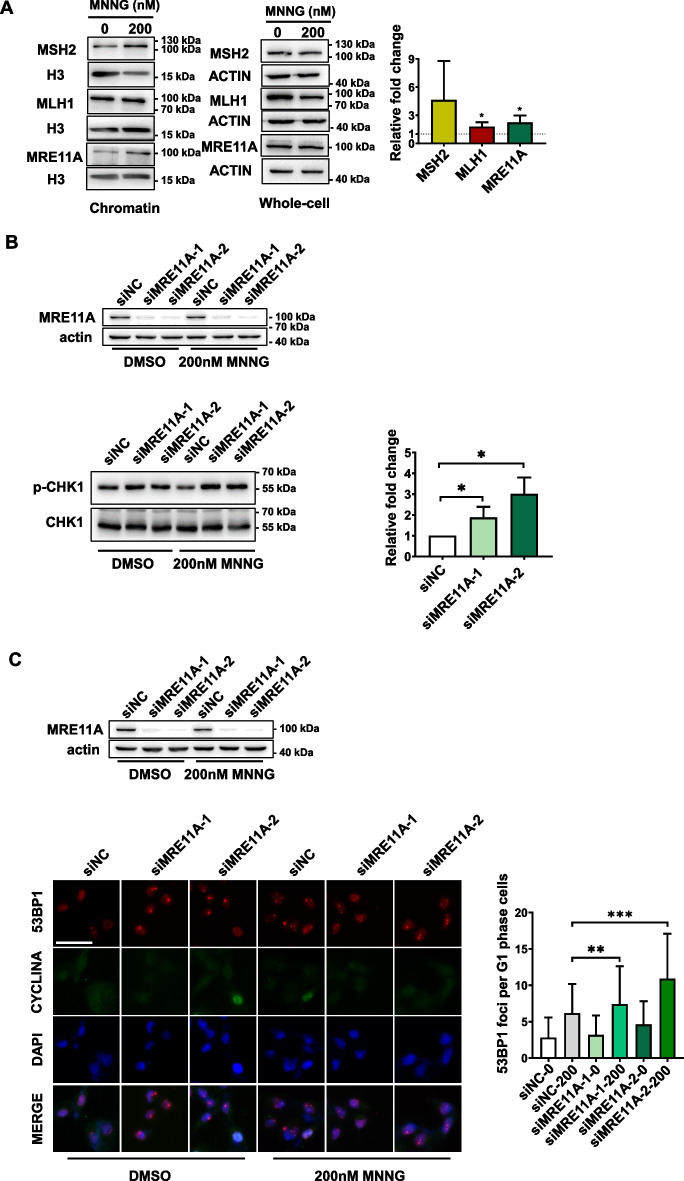
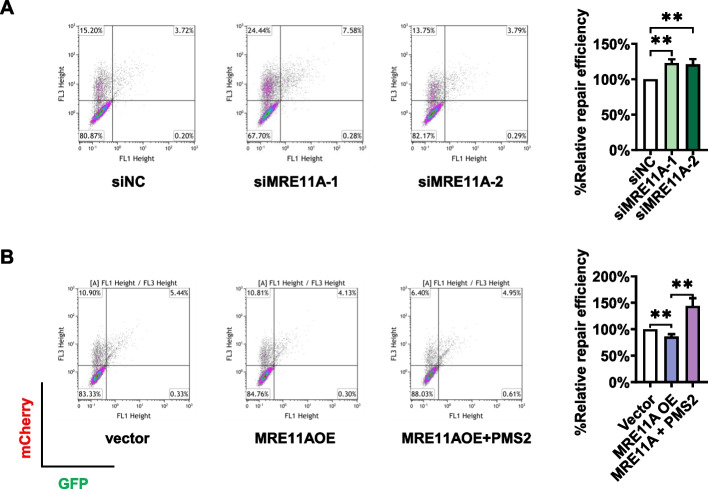
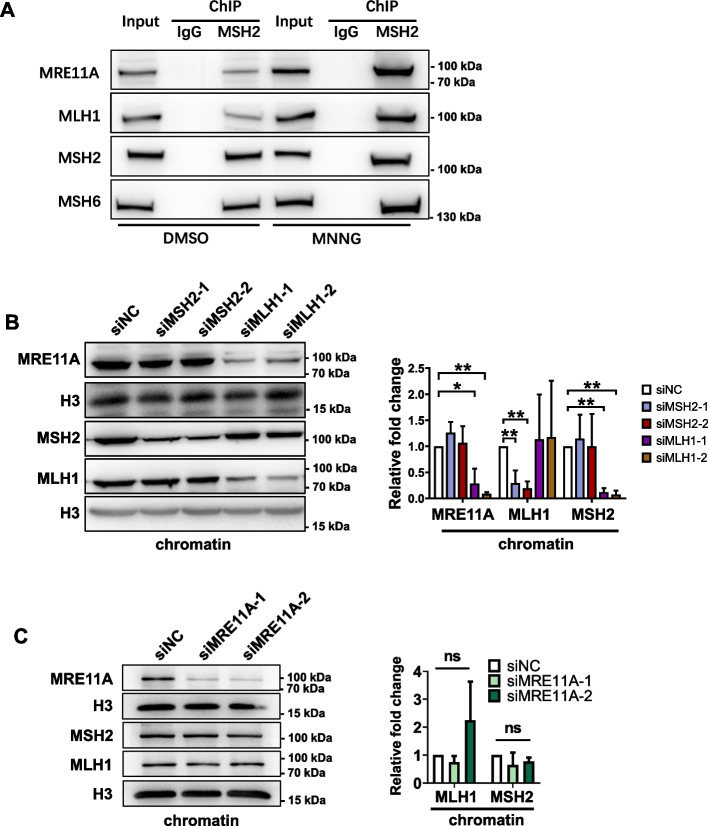
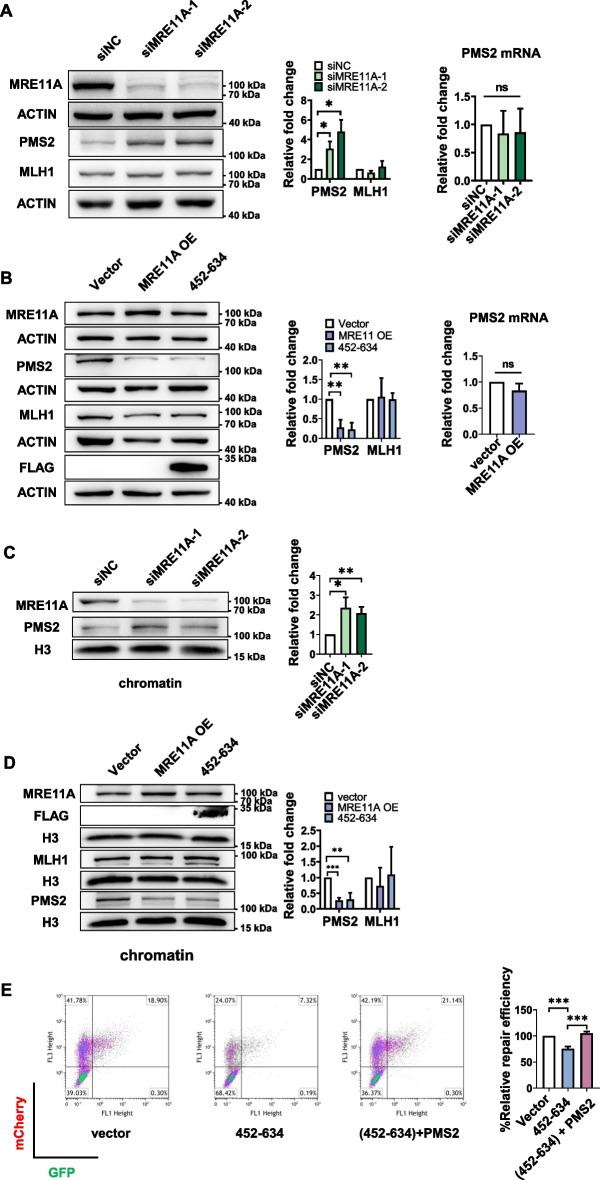
We show that knockdown of MRE11A increased the sensitivity of HeLa cells to MNNG treatment, as well as the MNNG-induced DNA damage and apoptosis, implying a potential role of MRE11 in MMR. Moreover, we found that MRE11A was largely recruited to chromatin and negatively regulated the DNA damage signals within the first cell cycle after MNNG treatment. We also showed that knockdown of MRE11A increased, while overexpressing MRE11A decreased, MMR activity in HeLa cells, suggesting that MRE11A negatively regulates MMR activity. Furthermore, we show that recruitment of MRE11A to chromatin requires MLH1 and that MRE11A competes with PMS2 for binding to MLH1. This decreases PMS2 levels in whole cells and on chromatin, and consequently comprises MMR activity.
Our findings reveal that MRE11A is a negative regulator of human MMR.
DNA 错配修复(MMR)是一种高度保守的途径,可纠正 DNA 复制错误,其丢失归因于各种类型癌症的发展。尽管 MMR 因子已得到很好的描述,但仍有待鉴定。作为 3'-5'外切酶和内切酶,减数分裂重组 11 同源物 A(MRE11A)参与多种 DNA 修复途径。然而,MRE11A 在 MMR 中的作用尚不清楚。
最初,使用短期和长期生存测定来测量细胞对 N-甲基-N'-硝基-N-亚硝基胍(MNNG)的敏感性。同时,在用 MNNG 处理后通过流式细胞术也测定了细胞凋亡的水平。使用 Western blot 和免疫荧光测定来评估 MNNG 处理后一个细胞周期内的 DNA 损伤。接下来,使用 GFP-异源双链修复测定和微卫星不稳定性测试来测量细胞中的 MMR 活性。为了研究机制,使用 Western blot、GFP-异源双链修复测定和染色质免疫沉淀。
我们表明,MRE11A 的敲低增加了 HeLa 细胞对 MNNG 处理的敏感性,以及 MNNG 诱导的 DNA 损伤和细胞凋亡,这表明 MRE11A 在 MMR 中具有潜在作用。此外,我们发现 MRE11A 主要募集到染色质上,并负调控 MNNG 处理后第一个细胞周期内的 DNA 损伤信号。我们还表明,MRE11A 的敲低增加,而过表达 MRE11A 降低,HeLa 细胞中的 MMR 活性,表明 MRE11A 负调控 MMR 活性。此外,我们表明,MRE11A 向染色质的募集需要 MLH1,并且 MRE11A 与 PMS2 竞争结合 MLH1。这降低了整个细胞和染色质上的 PMS2 水平,并因此构成 MMR 活性。
我们的发现揭示了 MRE11A 是人类 MMR 的负调节剂。