Li Ning, Fratalocchi Andrea
PRIMALIGHT, Faculty of Electrical and Computer Engineering, Applied Mathematics and Computational Science King Abdullah University of Science and Technology Thuwal 23955-6900 Saudi Arabia.
Glob Chall. 2024 Feb 8;8(3):2300306. doi: 10.1002/gch2.202300306. eCollection 2024 Mar.
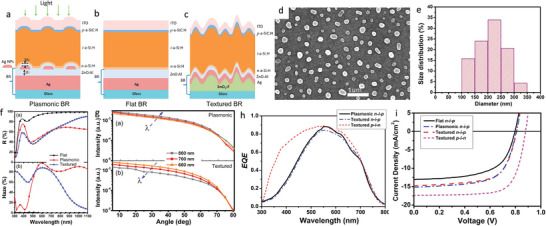
Silicon (Si), the eighth most common element in the known universe by mass and widely applied in the industry of electronics chips and solar cells, rarely emerges as a pure element in the Earth's crust. Optimizing its manufacturing can be crucial in the global challenge of reducing the cost of renewable energy modules and implementing sustainable development goals in the future. In the industry of solar cells, this challenge is stimulating studies of ultrathin Si-based architectures, which are rapidly attracting broad attention. Ultrathin solar cells require up to two orders of magnitude less Si than conventional solar cells, and owning to a flexible nature, they are opening applications in different industries that conventional cells do not yet serve. Despite these attractive factors, a difficulty in ultrathin Si solar cells is overcoming the weak light absorption at near-infrared wavelengths. The primary goal in addressing this problem is scaling up cost-effective and innovative textures for anti-reflection and light-trapping with shallower depth junctions, which can offer similar performances to traditional thick modules. This review provides an overview of this area of research, discussing this field both as science and engineering and highlighting present progress and future outlooks.
硅(Si)是已知宇宙中按质量计第八常见的元素,广泛应用于电子芯片和太阳能电池行业,但在地壳中很少以纯元素形式出现。优化其制造对于降低可再生能源模块成本和实现未来可持续发展目标的全球挑战至关重要。在太阳能电池行业,这一挑战正在推动对超薄硅基架构的研究,这类架构正迅速吸引广泛关注。超薄太阳能电池所需的硅比传统太阳能电池少两个数量级,并且由于其柔韧性,它们正在开拓传统电池尚未涉足的不同行业的应用。尽管有这些吸引人的因素,但超薄硅太阳能电池的一个难题是克服近红外波长下的弱光吸收。解决这个问题的主要目标是扩大具有成本效益且创新的纹理,用于减反射和浅深度结的光捕获,这可以提供与传统厚模块类似的性能。本综述概述了这一研究领域,从科学和工程两方面讨论了该领域,并突出了当前进展和未来展望。