
一维有机-无机杂化晶体中的激子亲铜相互作用
Excitonic cuprophilic interactions in one-dimensional hybrid organic-inorganic crystals.
作者信息
Hassan Nahid, Nagaraja Suneetha, Saha Sauvik, Tarafder Kartick, Ballav Nirmalya
机构信息
Department of Chemistry, Indian Institute of Science Education and Research Dr. Homi Bhabha Road Pune 411 008 India
Department of Physics, National Institute of Technology Karnataka Surathkal Mangalore 575 025 India.
出版信息
Chem Sci. 2024 Feb 5;15(11):4075-4085. doi: 10.1039/d3sc06255d. eCollection 2024 Mar 13.
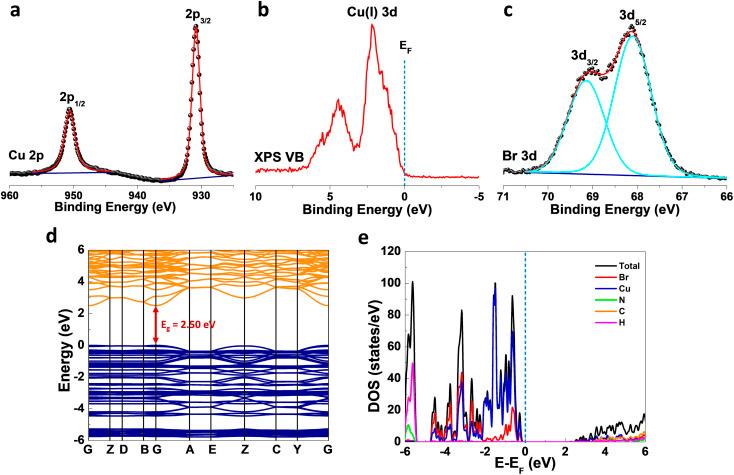
The everlasting pursuit of hybrid organic-inorganic lead-free semiconductors has directed the focus towards eco-friendly copper-based systems, perhaps because of the diversity in chemistry, controlling the structure-property relationship. In this work, we report single crystals of a Cu(i) halide-based perovskite-like organic-inorganic hybrid, (TMA)CuBr, (TMA = tetramethylammonium), consisting of unusual one-dimensional inorganic anionic chains of -(CuBr)-, electrostatically stabilized by organic cations, and the Cu(i)-Cu(i) distance of 2.775 Å indicates the possibility of cuprophilic interactions. X-ray photoelectron spectroscopy measurements further confirmed the presence of exclusive Cu(i) in (TMA)CuBr and electronic structure calculations based on density functional theory suggested a direct bandgap value of 2.50 eV. The crystal device demonstrated an impressive bulk photovoltaic effect due to the emergence of excitonic Cu(i)-Cu(i) interactions, as was clearly visualized in the charge-density plot as well as in the Raman spectroscopic analysis. The single crystals of a silver analogue, (TMA)AgBr, have also been synthesized revealing a Ag(i)-Ag(i) distance of 3.048 Å (signature of an argentophilic interaction). Unlike (TMA)CuBr, where more density of states from Cu compared to Br near the Fermi level was observed, (TMA)AgBr exhibited the opposite trend, possibly due to variation in the ionic potential influencing the overall bonding scenario.
对有机-无机无铅混合半导体的不懈追求使人们将焦点转向了环保型铜基体系,这或许是因为其化学性质的多样性有助于控制结构-性能关系。在这项工作中,我们报道了一种基于卤化亚铜的类钙钛矿有机-无机杂化单晶,(TMA)CuBr(TMA = 四甲基铵),它由不寻常的一维无机阴离子链-(CuBr)-组成,通过有机阳离子实现静电稳定,且Cu(i)-Cu(i)距离为2.775 Å,这表明存在亲铜相互作用的可能性。X射线光电子能谱测量进一步证实了(TMA)CuBr中仅存在Cu(i),基于密度泛函理论的电子结构计算表明其直接带隙值为2.50 eV。晶体器件由于激子Cu(i)-Cu(i)相互作用的出现而展现出令人印象深刻的体光伏效应,这在电荷密度图以及拉曼光谱分析中都清晰可见。银类似物(TMA)AgBr的单晶也已合成,其Ag(i)-Ag(i)距离为3.048 Å(亲银相互作用的特征)。与(TMA)CuBr不同,在(TMA)CuBr中费米能级附近观察到Cu的态密度比Br更多,而(TMA)AgBr呈现出相反的趋势,这可能是由于离子势的变化影响了整体的键合情况。




 Zotero 插件