Department of Child and Adolescent Psychiatry, Institute of Psychiatry, Psychology & Neuroscience, King's College London, London, UK.
Department of Psychosis Studies, Early Psychosis: Interventions and Clinical-detection (EPIC) Lab, Institute of Psychiatry, Psychology & Neuroscience, King's College London, London, UK.
Schizophr Bull. 2024 Jul 27;50(4):771-783. doi: 10.1093/schbul/sbae017.
The role of duration of untreated psychosis (DUP) as an early detection and intervention target to improve outcomes for individuals with first-episode psychosis is unknown.
PRISMA/MOOSE-compliant systematic review to identify studies until February 1, 2023, with an intervention and a control group, reporting DUP in both groups. Random effects meta-analysis to evaluate (1) differences in DUP in early detection/intervention services vs the control group, (2) the efficacy of early detection strategies regarding eight real-world outcomes at baseline (service entry), and (3) the efficacy of early intervention strategies on ten real-world outcomes at follow-up. We conducted quality assessment, heterogeneity, publication bias, and meta-regression analyses (PROSPERO: CRD42020163640).
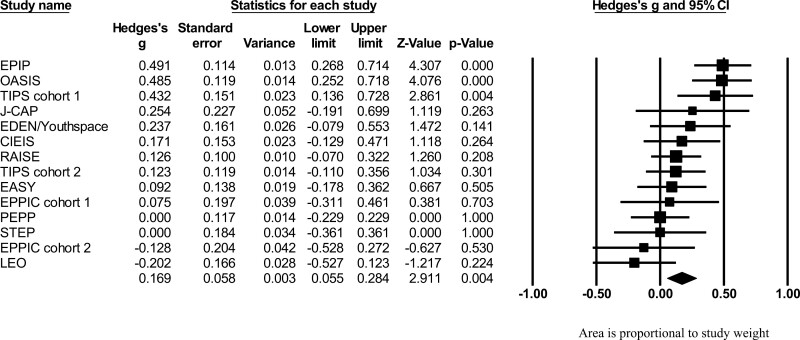
From 6229 citations, 33 intervention studies were retrieved. The intervention group achieved a small DUP reduction (Hedges' g = 0.168, 95% CI = 0.055-0.283) vs the control group. The early detection group had better functioning levels (g = 0.281, 95% CI = 0.073-0.488) at baseline. Both groups did not differ regarding total psychopathology, admission rates, quality of life, positive/negative/depressive symptoms, and employment rates (P > .05). Early interventions improved quality of life (g = 0.600, 95% CI = 0.408-0.791), employment rates (g = 0.427, 95% CI = 0.135-0.718), negative symptoms (g = 0.417, 95% CI = 0.153-0.682), relapse rates (g = 0.364, 95% CI = 0.117-0.612), admissions rates (g = 0.335, 95% CI = 0.198-0.468), total psychopathology (g = 0.298, 95% CI = 0.014-0.582), depressive symptoms (g = 0.268, 95% CI = 0.008-0.528), and functioning (g = 0.180, 95% CI = 0.065-0.295) at follow-up but not positive symptoms or remission (P > .05).
Comparing interventions targeting DUP and control groups, the impact of early detection strategies on DUP and other correlates is limited. However, the impact of early intervention was significant regarding relevant outcomes, underscoring the importance of supporting early intervention services worldwide.
持续未治疗的精神病(DUP)作为改善首发精神病患者结局的早期检测和干预目标的作用尚不清楚。
符合 PRISMA/MOOSE 标准的系统评价,旨在确定截至 2023 年 2 月 1 日的研究,这些研究有干预组和对照组,报告两组的 DUP。采用随机效应荟萃分析评估(1)早期检测/干预服务与对照组相比,DUP 差异,(2)基线时八项真实世界结局的早期检测策略的疗效,(3)随访时十个真实世界结局的早期干预策略的疗效。我们进行了质量评估、异质性、发表偏倚和荟萃回归分析(PROSPERO:CRD42020163640)。
从 6229 条引文,检索到 33 项干预研究。干预组与对照组相比,DUP 减少幅度较小(Hedges' g=0.168,95% CI=0.055-0.283)。早期检测组在基线时具有更好的功能水平(g=0.281,95% CI=0.073-0.488)。两组在总精神病学、入院率、生活质量、阳性/阴性/抑郁症状和就业率方面均无差异(P>.05)。早期干预改善了生活质量(g=0.600,95% CI=0.408-0.791)、就业率(g=0.427,95% CI=0.135-0.718)、负性症状(g=0.417,95% CI=0.153-0.682)、复发率(g=0.364,95% CI=0.117-0.612)、入院率(g=0.335,95% CI=0.198-0.468)、总精神病学(g=0.298,95% CI=0.014-0.582)、抑郁症状(g=0.268,95% CI=0.008-0.528)和功能(g=0.180,95% CI=0.065-0.295),但在随访时阳性症状或缓解率无差异(P>.05)。
比较针对 DUP 的干预措施和对照组,早期检测策略对 DUP 和其他相关因素的影响是有限的。然而,早期干预的影响在相关结局方面是显著的,这强调了在全球范围内支持早期干预服务的重要性。