Center of Alcohol & Substance Use Studies, Rutgers University, New Brunswick, New Jersey, United States of America; Department of Psychiatry & Behavioral Sciences, Medical University of South Carolina, Charleston, South Carolina, United States of America.
Department of Psychiatry & Behavioral Sciences, Medical University of South Carolina, Charleston, South Carolina, United States of America; George Washington University, Washington D.C.
J Subst Use Addict Treat. 2024 Jun;161:209344. doi: 10.1016/j.josat.2024.209344. Epub 2024 Mar 15.
Women show a gender-specific risk for co-occurring opioid use disorder (OUD) and posttraumatic stress disorder (PTSD). Expert groups have called for the development of integrated treatments for women with OUD/PTSD, but there remains limited information on such interventions.
This mixed-methods study interviewed and surveyed 10 women with current or past OUD and co-occurring posttraumatic stress symptoms (PTSS) and 16 providers who work with these women. Interviews and surveys queried patient participants' and providers' experiences of OUD/PTSS and how to best design an integrated, trauma-focused treatment for OUD/PTSD.
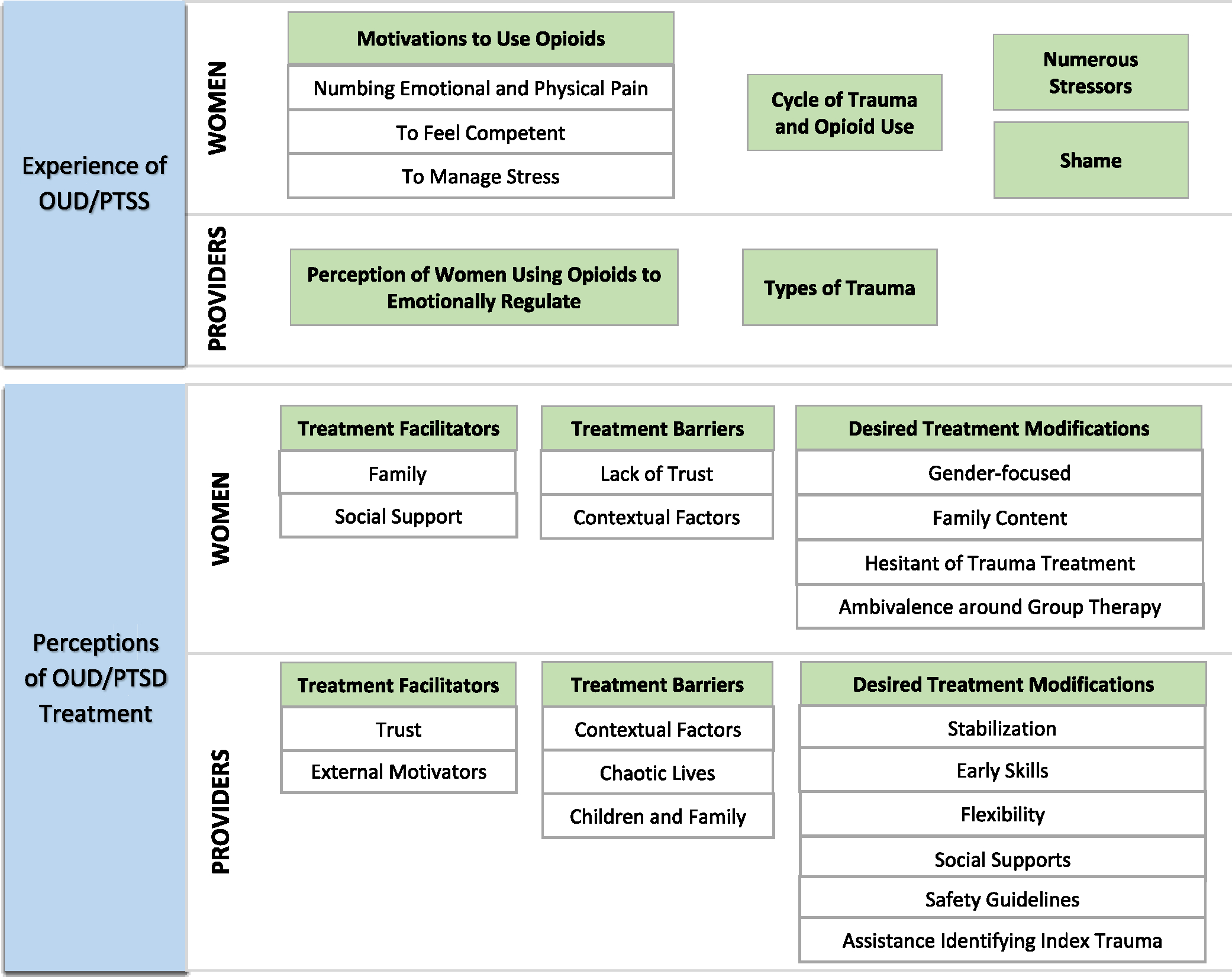
Patient participants (90 % white, 90 % mothers, M = 45.70) met criteria for severe, lifetime OUD and 40 % met a provisional diagnosis for PTSD. Four themes emerged for participants' experiences of OUD/PTSS: 1) numerous stressors; 2) shame; 3) multiple motivations to use opioids; and 4) a cycle of trauma and opioid use. Four themes emerged regarding patient participants' perceptions on the development of an OUD/PTSD treatment: 1) mixed attitudes towards medications for OUD; 2) barriers to treatment (e.g., insufficient treatments and contextual factors); 3) treatment facilitators (e.g., social support); and 4) preferences in treatment (e.g., trauma-focused, gender-focused, family content, ambivalence around group therapy). Providers (M = 38.94) were primarily white women (76.5 %). Two themes emerged from their experiences working with women with OUD/PTSS: 1) perceiving women to use opioids to regulate emotions and 2) gender differences in trauma types. Three themes emerged for providers' perceptions on the development of an OUD/PTSD treatment: 1) barriers to treatment (e.g., chaotic lives, contextual factors, family); 2) treatment facilitators (e.g., trust and external motivations); and 3) desired treatment modifications (e.g., stabilization, early skills in therapy, flexibility in therapy, social supports, safety guidelines, and assistance in identifying an index trauma). Most participants (90.0 %) and providers (93.5 %) preferred working on OUD/PTSD symptoms simultaneously rather than separately.
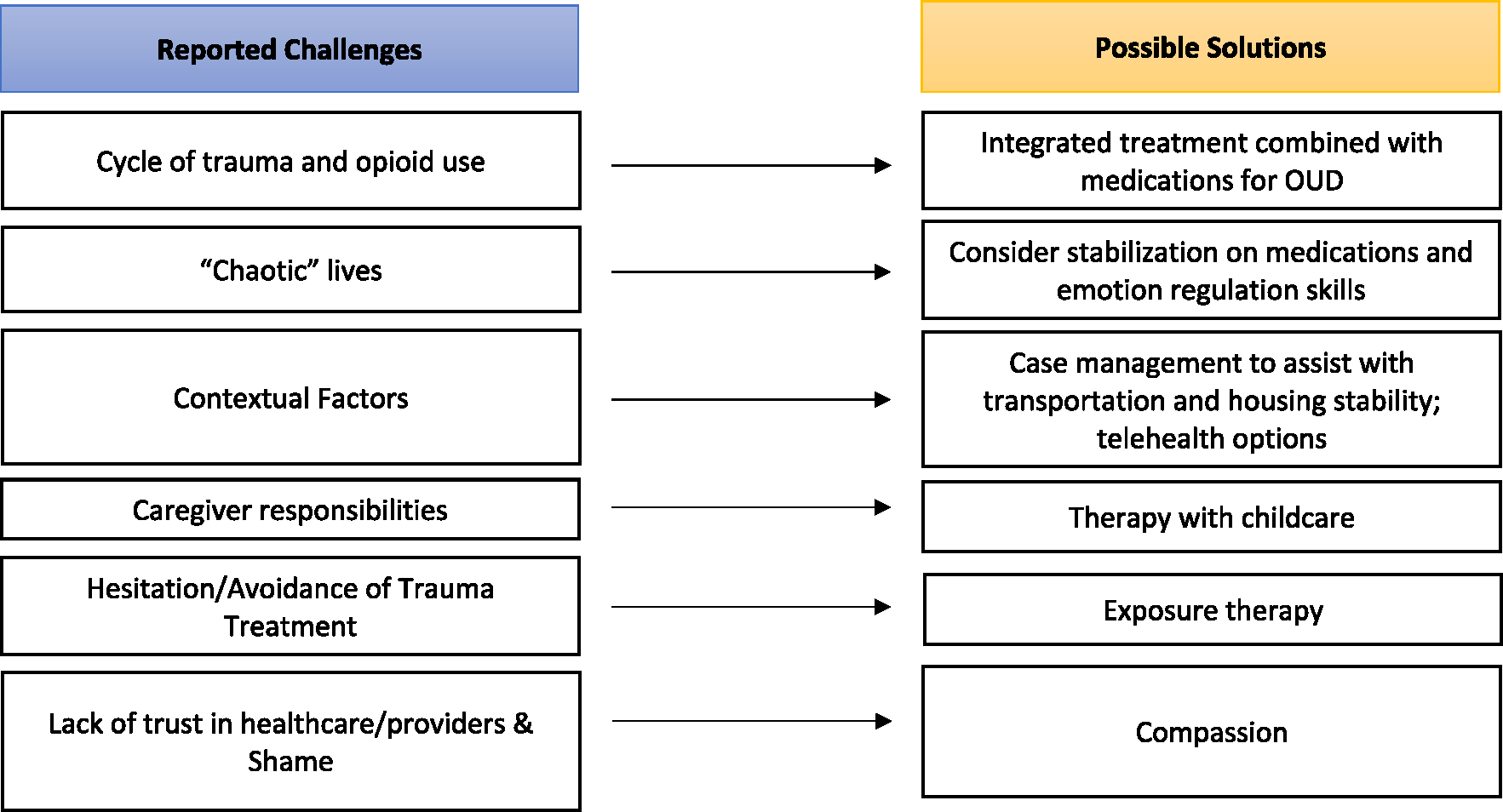
Findings demonstrate the need to modify integrated treatments to meet the preferences of providers and women with OUD/PTSS and OUD/PTSD. Treatments should consider therapeutic content, structure, contextual factors, social support, and PTSD severity to enhance uptake and reach.
女性表现出特定于性别的阿片类药物使用障碍(OUD)和创伤后应激障碍(PTSD)共病风险。专家组呼吁为 OUD/PTSD 女性开发综合治疗方法,但有关此类干预措施的信息仍然有限。
本混合方法研究对 10 名目前或过去患有 OUD 和共患创伤后应激症状(PTSS)的女性和 16 名与这些女性合作的提供者进行了访谈和调查。访谈和调查询问了患者参与者和提供者对 OUD/PTSS 的体验,以及如何最好地设计针对 OUD/PTSD 的综合、以创伤为重点的治疗方法。
患者参与者(90%为白人,90%为母亲,M=45.70)符合严重、终身 OUD 的标准,40%符合暂定 PTSD 诊断。参与者 OUD/PTSS 经历的四个主题出现:1)许多压力源;2)羞耻感;3)使用阿片类药物的多种动机;4)创伤和阿片类药物使用的循环。关于患者参与者对 OUD/PTSD 治疗发展的看法出现了四个主题:1)对 OUD 药物治疗的混合态度;2)治疗障碍(例如,治疗不足和环境因素);3)治疗促进因素(例如,社会支持);4)治疗偏好(例如,以创伤为重点、以性别为重点、包含家庭内容、对团体治疗的矛盾态度)。提供者(M=38.94)主要是白人女性(76.5%)。从他们与患有 OUD/PTSS 的女性合作的经验中出现了两个主题:1)认为女性使用阿片类药物来调节情绪;2)创伤类型的性别差异。提供者对 OUD/PTSD 治疗发展的看法出现了三个主题:1)治疗障碍(例如,混乱的生活、环境因素、家庭);2)治疗促进因素(例如,信任和外部动机);3)治疗修改的期望(例如,稳定、早期治疗技能、治疗灵活性、社会支持、安全准则以及协助确定主要创伤)。大多数参与者(90.0%)和提供者(93.5%)更喜欢同时而不是分别处理 OUD/PTSD 症状。
研究结果表明,需要修改综合治疗方法,以满足 OUD/PTSS 和 OUD/PTSD 女性和提供者的偏好。治疗应考虑治疗内容、结构、环境因素、社会支持和 PTSD 严重程度,以提高接受度和覆盖率。