Kaushik Sonia, Rameshwari Rashmi, Chapadgaonkar Shilpa S
Department of Biotechnology, School of Engineering and Technology, Manav Rachna International Institute of Research and Studies, Faridabad, Haryana, India.
Department of Biotechnology, School of Engineering and Technology, Manav Rachna International Institute of Research and Studies, Faridabad, Haryana, India.
J Genet Eng Biotechnol. 2024 Mar;22(1):100348. doi: 10.1016/j.jgeb.2023.100348. Epub 2024 Jan 22.
Choline oxidase, a flavoprotein, is an enzyme that catalyzes the reaction which converts choline into glycine betaine. Choline oxidase started its journey way back in 1933. However, the impact of the high temperature on its structure has not been explored despite the long history and availability of its crystal structure. Both choline oxidase and its product, glycine betaine, have enormous applications spanning across multiple industries. Understanding how the 3D structure of the enzyme will change with the temperature change can open new ways to make it more stable and useful for industry.
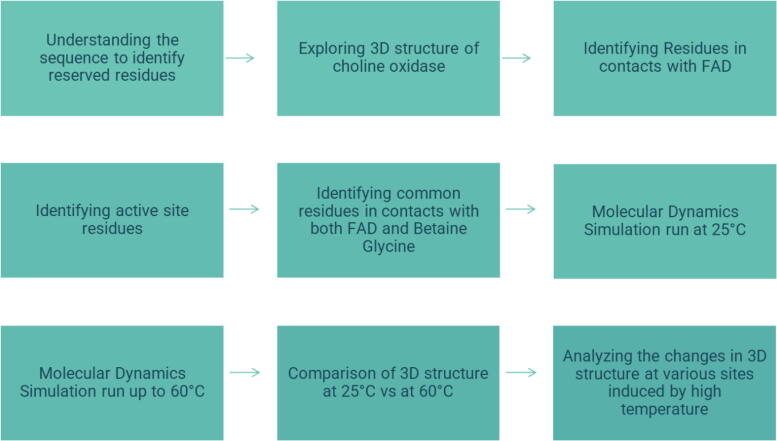
This research paper presents the in-silico study and analysis of the structural changes of A. globiformis choline oxidase at temperatures from 25 °C to 60 °C. A step-wise process is depicted in Fig. 1.
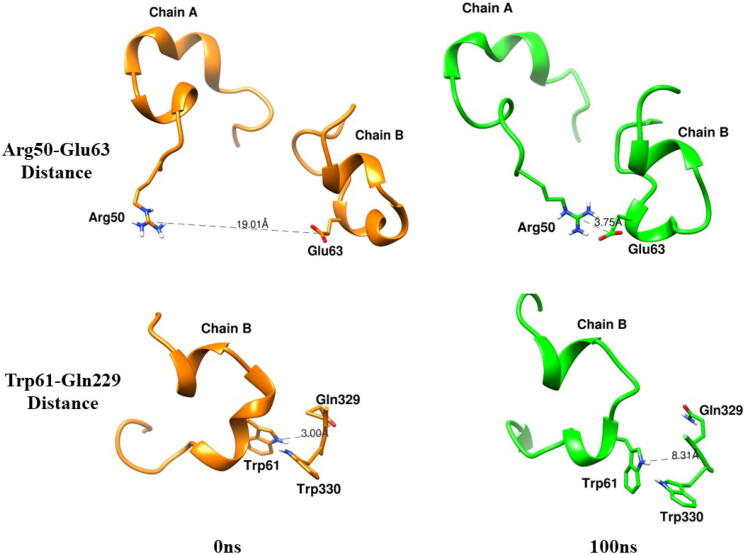
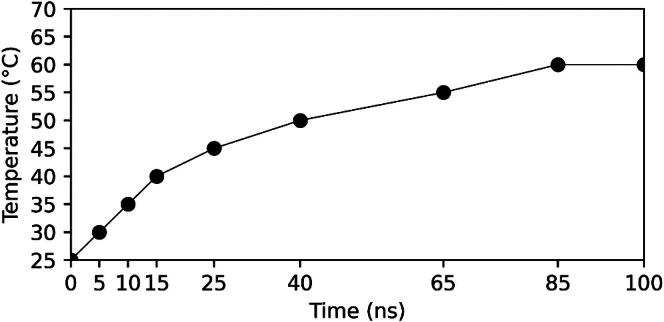
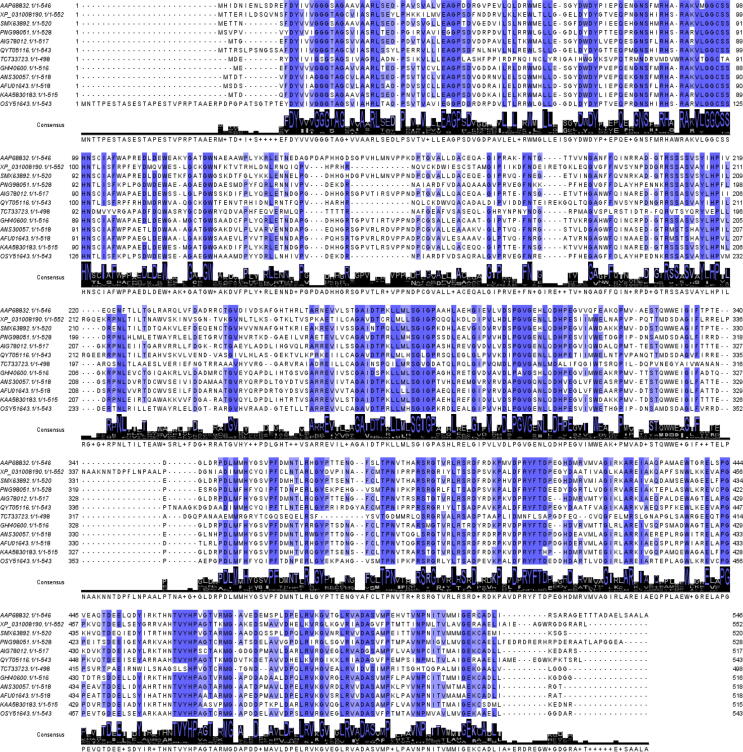
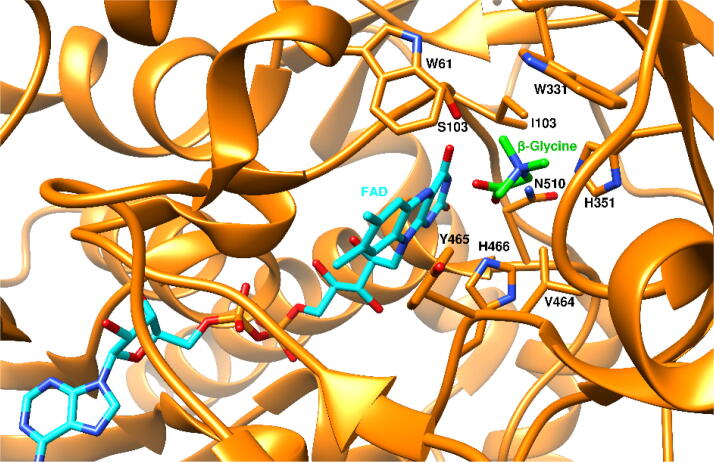
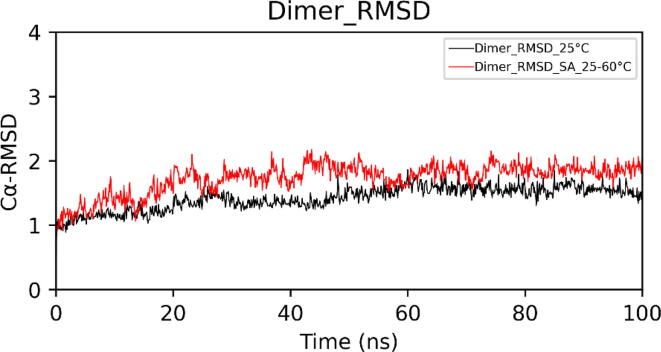
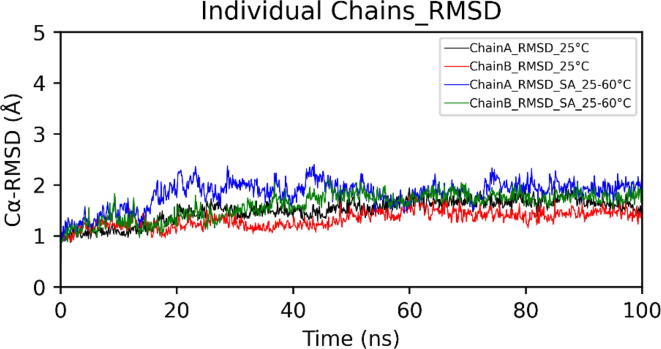
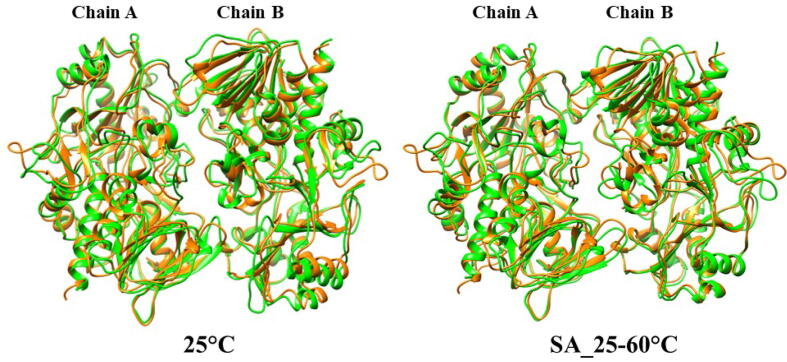
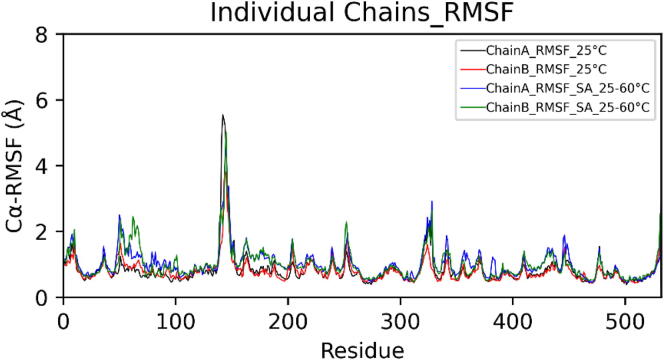
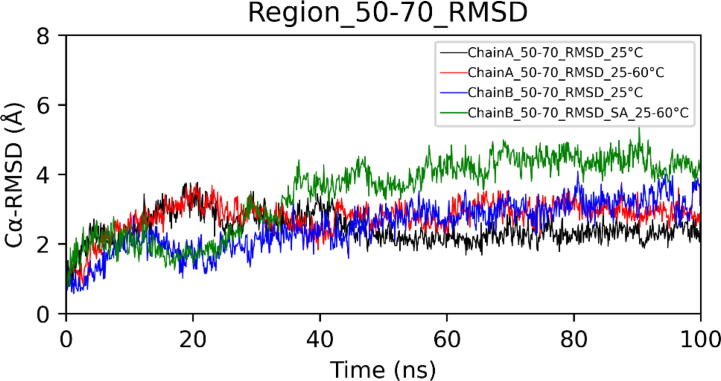
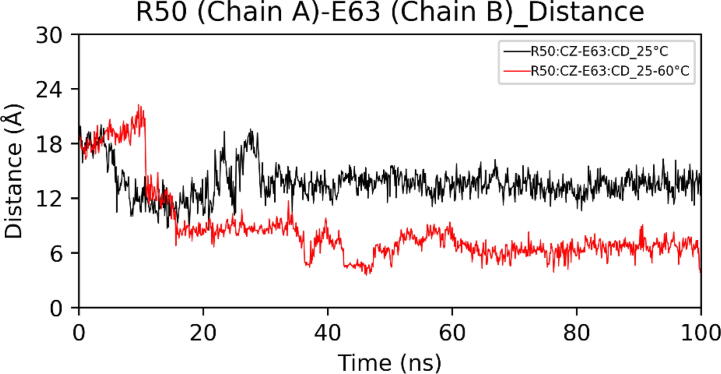
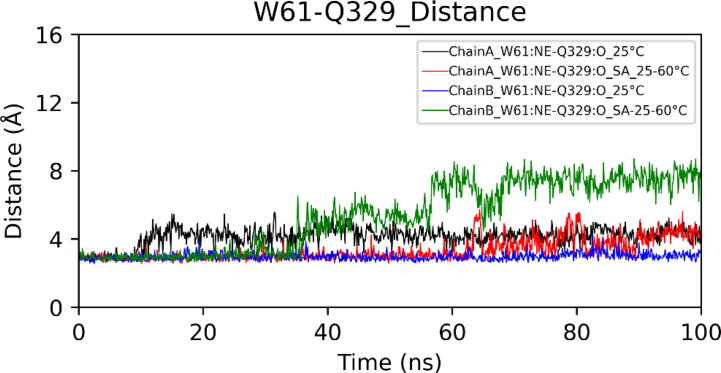
Multiple sequence alignment (MSA) of 11 choline oxidase sequences from different bacteria vs Arthrobacter globiformis choline oxidase showed that active site residues are highly conserved. The available crystal structure of A. globiformis choline oxidase with cofactor Flavin Adenine Dinucleotide (FAD) in the dimeric state (PDB ID: 4MJW) was considered for molecular dynamics simulations. A simulated annealing option was used to gradually increase the temperature of the system from 25 °C to 60 °C. Analysis of the conserved residues, as well as residues involved in Flavin Adenine Dinucleotide (FAD) binding, substrate binding, substate gating, and dimer formationwas done. At high temperatures, the formation of the inter-chain salt bridge between Arg50 and Glu63 was a significant observation near the active site of choline oxidase.
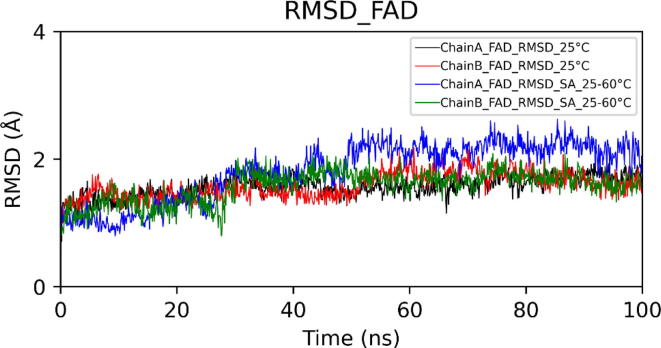
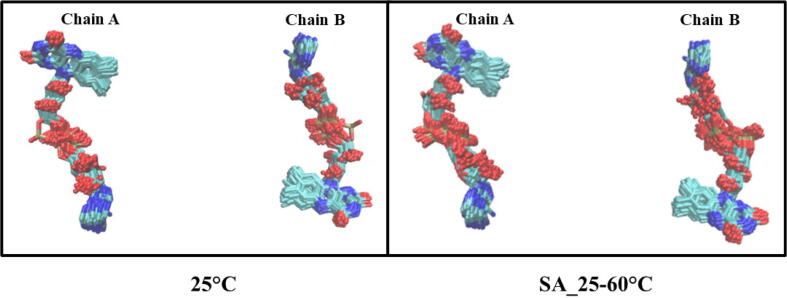
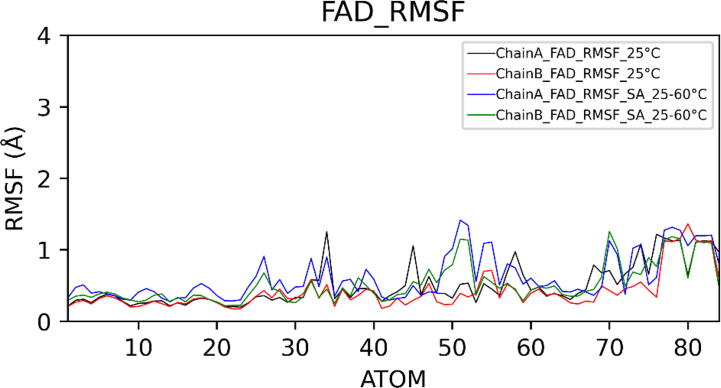
Molecular dynamics studies suggest that an increase in temperature has a significant impact on the extended Flavin Adenine Dinucleotide (FAD) binding region. These changes interfere with the entry of substrate to the active site of the enzyme and make the enzyme inactive.
胆碱氧化酶是一种黄素蛋白,是一种催化胆碱转化为甘氨酸甜菜碱反应的酶。胆碱氧化酶早在1933年就已被发现。然而,尽管其历史悠久且有晶体结构,但高温对其结构的影响尚未得到研究。胆碱氧化酶及其产物甘氨酸甜菜碱在多个行业都有广泛应用。了解该酶的三维结构如何随温度变化而改变,可为使其更稳定并在工业上更有用开辟新途径。
本研究论文展示了对球形节杆菌胆碱氧化酶在25℃至60℃温度下结构变化的计算机模拟研究与分析。图1描绘了一个逐步过程。
对来自不同细菌的11条胆碱氧化酶序列与球形节杆菌胆碱氧化酶进行的多序列比对(MSA)表明,活性位点残基高度保守。将处于二聚体状态且含有辅因子黄素腺嘌呤二核苷酸(FAD)的球形节杆菌胆碱氧化酶的现有晶体结构(PDB ID:4MJW)用于分子动力学模拟。使用模拟退火选项将系统温度从25℃逐步升高至60℃。对保守残基以及参与黄素腺嘌呤二核苷酸(FAD)结合、底物结合、亚基门控和二聚体形成的残基进行了分析。在高温下,胆碱氧化酶活性位点附近的Arg50和Glu63之间形成链间盐桥是一个重要发现。
分子动力学研究表明,温度升高对扩展的黄素腺嘌呤二核苷酸(FAD)结合区域有显著影响。这些变化干扰了底物进入酶的活性位点,使酶失活。