Department of General Practice, Amsterdam UMC, Amsterdam, The Netherlands.
Department Research, PHARMO Institute for Drug Outcomes Research, Utrecht, The Netherlands.
Osteoporos Int. 2024 May;35(5):911-918. doi: 10.1007/s00198-024-07042-3. Epub 2024 Mar 18.
This study evaluated the yield of routine laboratory examination in a large population of older women in primary care. The prevalence of laboratory abnormalities was low and the clinical consequences in follow-up were limited. There was a weak association of laboratory abnormalities with osteoporosis but no association with vertebral fractures and recent fractures.
Most osteoporosis guidelines advice routine laboratory examination. We have investigated the yield of laboratory examinations in facture risk evaluation of elderly women in primary care.
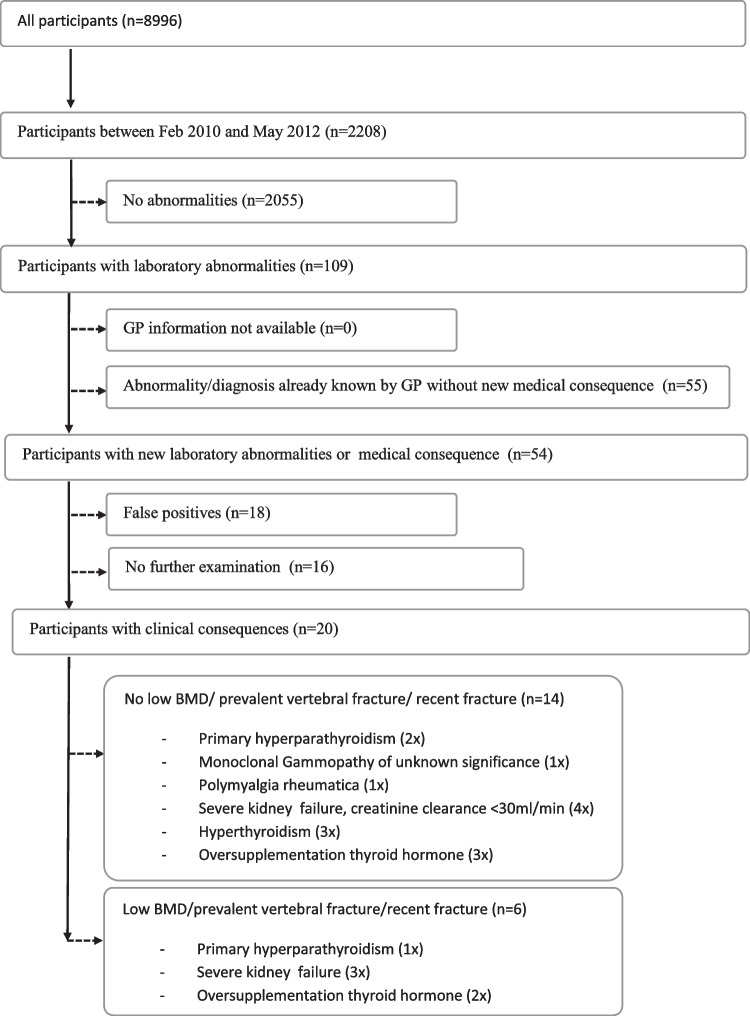
We assessed the prevalence of laboratory abnormalities and their association with risk factors for fractures, recent fractures, low bone mineral density (BMD), and prevalent vertebral fracture in 8996 women ≥ 65 years of age participating in a primary care fracture risk screening study. In a sample of 2208 of these participants, we also evaluated the medical consequences in the medical records during a follow-up period of ≥ 1 year.
Vitamin D deficiency (< 30 nmol/L) was present in 13% and insufficiency (< 50 nmol/L) in 43% of the study sample. The prevalence of other laboratory abnormalities (ESR, calcium, creatinine, FT4) was 4.6% in women with risk factors for fractures, 6.1% in women with low BMD (T-score ≤ - 2.5), 6.0% after a prevalent vertebral fracture, 5.2% after a recent fracture and 2.6% in the absence of important risk factors for fractures. Laboratory abnormalities other than vitamin D were associated with low BMD (OR 1.4, 95%CI 1.1-1.8) but not with prevalent vertebral fractures nor recent fractures. Low BMD was associated with renal failure (OR 2.0, 95%CI 1.3-3.4), vitamin D insufficiency (OR 1.2, 95%CI 1.0-1.3) and deficiency (OR 1.3, 95%CI 1.1-.5). In the follow-up period, 82% of the laboratory abnormalities did not result in a new diagnosis or treatment reported in the medical records.
We identified a low prevalence of laboratory abnormalities in a primary care population of older women and the majority of these findings had no medical consequences.
本研究评估了在初级保健中老年女性中进行常规实验室检查的效果。实验室异常的发生率较低,随访中的临床后果有限。实验室异常与骨质疏松症有弱相关性,但与椎体骨折和近期骨折无关。
大多数骨质疏松症指南建议进行常规实验室检查。我们研究了初级保健中评估老年女性骨折风险时实验室检查的效果。
我们评估了 8996 名年龄≥65 岁的女性参与的初级保健骨折风险筛查研究中实验室异常的发生率及其与骨折危险因素、近期骨折、低骨密度(BMD)和常见椎体骨折的相关性。在其中 2208 名参与者的样本中,我们还评估了在随访期≥1 年内的医疗记录中的医疗后果。
研究样本中维生素 D 缺乏(<30nmol/L)的发生率为 13%,不足(<50nmol/L)的发生率为 43%。有骨折危险因素的女性中其他实验室异常(ESR、钙、肌酐、FT4)的发生率为 4.6%,BMD 低(T 评分≤-2.5)的女性为 6.1%,有常见椎体骨折的女性为 6.0%,有近期骨折的女性为 6.0%,无重要骨折危险因素的女性为 5.2%。除维生素 D 外的实验室异常与低 BMD 相关(OR 1.4,95%CI 1.1-1.8),但与常见椎体骨折或近期骨折无关。低 BMD 与肾衰竭(OR 2.0,95%CI 1.3-3.4)、维生素 D 不足(OR 1.2,95%CI 1.0-1.3)和缺乏(OR 1.3,95%CI 1.1-.5)相关。在随访期间,82%的实验室异常并未导致医疗记录中报告新的诊断或治疗。
我们发现初级保健中老年女性中实验室异常的发生率较低,大多数实验室异常的结果没有医学后果。