
用于预测北美黑腿蜱丰度和分布的模型与数据:一项综述
Models and data used to predict the abundance and distribution of (blacklegged tick) in North America: a scoping review.
作者信息
Sharma Yogita, Laison Elda K E, Philippsen Tanya, Ma Junling, Kong Jude, Ghaemi Sajjad, Liu Juxin, Hu François, Nasri Bouchra
机构信息
Department of Mathematics and Statistics, University of Victoria, Victoria, Canada.
Département de Médecine Préventive et Sociale, University of Montréal, Montréal, Canada.
出版信息
Lancet Reg Health Am. 2024 Mar 7;32:100706. doi: 10.1016/j.lana.2024.100706. eCollection 2024 Apr.
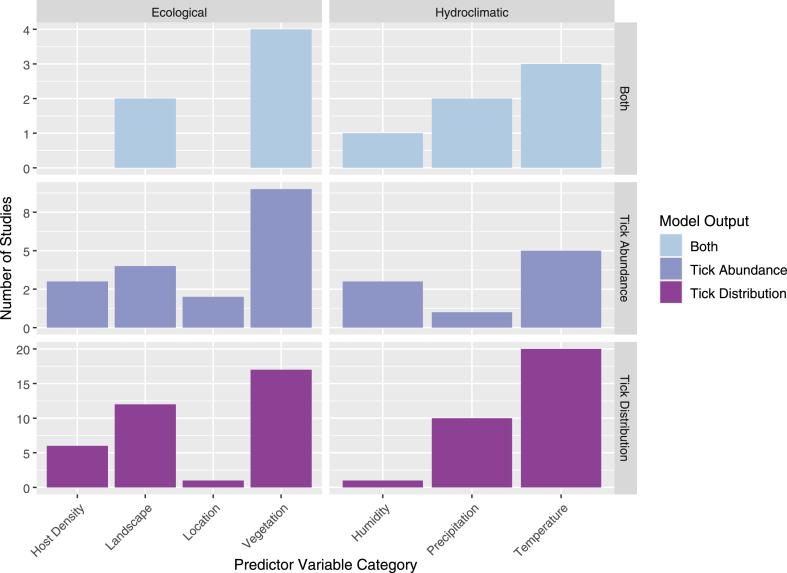
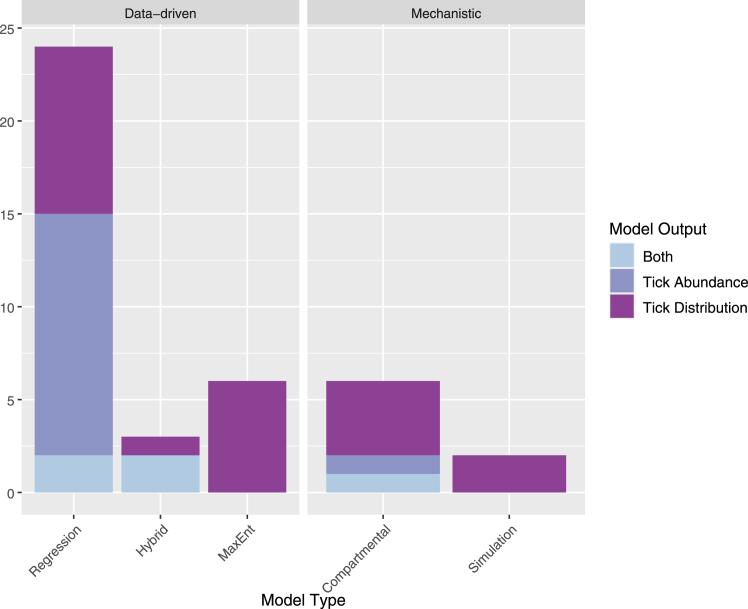
Tick-borne diseases (TBD) remain prevalent worldwide, and risk assessment of tick habitat suitability is crucial to prevent or reduce their burden. This scoping review provides a comprehensive survey of models and data used to predict distribution and abundance in North America. We identified 4661 relevant primary research articles published in English between January 1st, 2012, and July 18th, 2022, and selected 41 articles following full-text review. Models used data-driven and mechanistic modelling frameworks informed by diverse tick, hydroclimatic, and ecological variables. Predictions captured tick abundance (n = 14, 34.1%), distribution (n = 22, 53.6%) and both (n = 5, 12.1%). All studies used tick data, and many incorporated both hydroclimatic and ecological variables. Minimal host- and human-specific data were utilized. Biases related to data collection, protocols, and tick data quality affect completeness and representativeness of prediction models. Further research and collaboration are needed to improve prediction accuracy and develop effective strategies to reduce TBD.
蜱传疾病(TBD)在全球范围内仍然普遍存在,蜱栖息地适宜性的风险评估对于预防或减轻其负担至关重要。本综述全面调查了用于预测北美蜱分布和丰度的模型及数据。我们检索了2012年1月1日至2022年7月18日期间发表的4661篇英文相关原创研究文章,经全文审查后筛选出41篇文章。这些模型采用了数据驱动和机理建模框架,并依据多种蜱、水文气候和生态变量构建。预测内容涵盖蜱的丰度(n = 14,34.1%)、分布(n = 22,53.6%)以及两者兼有(n = 5,12.1%)。所有研究都使用了蜱的数据,许多研究还纳入了水文气候和生态变量。宿主和人类特异性数据使用较少。与数据收集、方案以及蜱数据质量相关的偏差会影响预测模型的完整性和代表性。需要进一步开展研究与合作,以提高预测准确性并制定有效的策略来减少蜱传疾病。



 Zotero 插件