Stadler Christina, Gramatzki Dorothee, Le Rhun Emilie, Hottinger Andreas F, Hundsberger Thomas, Roelcke Ulrich, Läubli Heinz, Hofer Silvia, Seystahl Katharina, Wirsching Hans-Georg, Weller Michael, Roth Patrick
Department of Neurology and Brain Tumor Center, University Hospital Zurich and University of Zurich, Zurich, Switzerland.
Department of Neurosurgery, Clinical Neuroscience Center, University Hospital and University of Zurich, Zurich, Zurich.
Neurooncol Pract. 2023 Oct 20;11(2):132-141. doi: 10.1093/nop/npad070. eCollection 2024 Apr.
Incidence rates of glioblastoma in very old patients are rising. The standard of care for this cohort is only partially defined and survival remains poor. The aims of this study were to reveal current practice of tumor-specific therapy and supportive care, and to identify predictors for survival in this cohort.
Patients aged 80 years or older at the time of glioblastoma diagnosis were retrospectively identified in 6 clinical centers in Switzerland and France. Demographics, clinical parameters, and survival outcomes were annotated from patient charts. Cox proportional hazards modeling was performed to identify parameters associated with survival.
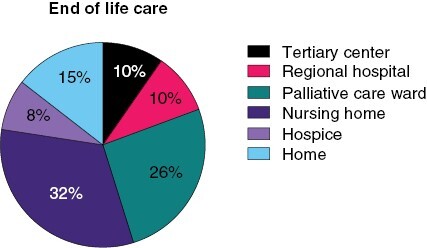
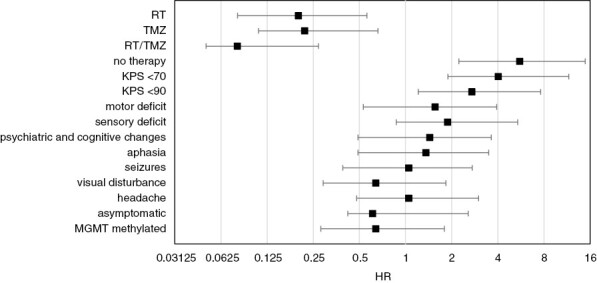
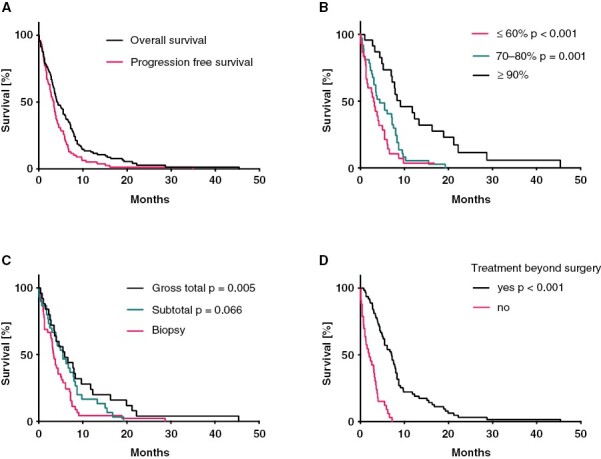
Of 107 patients, 45 were diagnosed by biopsy, 30 underwent subtotal resection, and 25 had gross total resection. In 7 patients, the extent of resection was not specified. Postoperatively, 34 patients did not receive further tumor-specific treatment. Twelve patients received radiotherapy with concomitant temozolomide, but only 2 patients had maintenance temozolomide therapy. Fourteen patients received temozolomide alone, 35 patients received radiotherapy alone, 1 patient received bevacizumab, and 1 took part in a clinical trial. Median progression-free survival (PFS) was 3.3 months and median overall survival (OS) was 4.2 months. Among patients who received any postoperative treatment, median PFS was 3.9 months and median OS was 7.2 months. Karnofsky performance status (KPS) ≥70%, gross total resection, and combination therapy were associated with better outcomes. The median time spent hospitalized was 30 days, accounting for 23% of the median OS. End-of-life care was mostly provided by nursing homes ( = 20; 32%) and palliative care wards ( = 16; 26%).
In this cohort of very old patients diagnosed with glioblastoma, a large proportion was treated with best supportive care. Treatment beyond surgery and, in particular, combined modality treatment were associated with longer OS and may be considered for selected patients even at higher ages.
老年患者中胶质母细胞瘤的发病率正在上升。该队列患者的护理标准仅部分明确,生存率仍然很低。本研究的目的是揭示肿瘤特异性治疗和支持性护理的当前实践,并确定该队列患者生存的预测因素。
在瑞士和法国的6个临床中心对胶质母细胞瘤诊断时年龄在80岁及以上的患者进行回顾性识别。从患者病历中记录人口统计学、临床参数和生存结果。进行Cox比例风险模型分析以确定与生存相关的参数。
107例患者中,45例通过活检确诊,30例行次全切除,25例行全切除。7例患者的切除范围未明确。术后,34例患者未接受进一步的肿瘤特异性治疗。12例患者接受了同步替莫唑胺放疗,但只有2例患者接受了替莫唑胺维持治疗。14例患者仅接受替莫唑胺治疗,35例患者仅接受放疗,1例患者接受贝伐单抗治疗,1例患者参加了临床试验。中位无进展生存期(PFS)为3.3个月,中位总生存期(OS)为4.2个月。在接受任何术后治疗的患者中,中位PFS为3.9个月,中位OS为7.2个月。卡诺夫斯基功能状态(KPS)≥70%、全切除和联合治疗与更好的预后相关。中位住院时间为30天,占中位OS的23%。临终关怀主要由养老院(n = 20;32%)和姑息治疗病房(n = 16;26%)提供。
在这个诊断为胶质母细胞瘤的老年患者队列中,很大一部分患者接受了最佳支持性护理。手术以外的治疗,特别是联合治疗与更长的总生存期相关,即使是高龄患者,对于选定的患者也可考虑采用。