
电厂烟气贫煤吸附预测模型
Prediction Model of Lean Coal Adsorption of Power Plant Flue Gas.
作者信息
Cheng Miaoxin, Bai Gang, Zhao Hongbao, Li Jinyu, Su Jun, Wang Jue, Zhang Xun
机构信息
College of Safety Science & Engineering, Liaoning Technical University, Huludao, Liaoning 125105, China.
Key Laboratory of Mine Thermodynamic Disasters & Control of Ministry of Education, Huludao, Liaoning 125105, China.
出版信息
ACS Omega. 2024 Feb 27;9(10):12101-12115. doi: 10.1021/acsomega.3c10005. eCollection 2024 Mar 12.
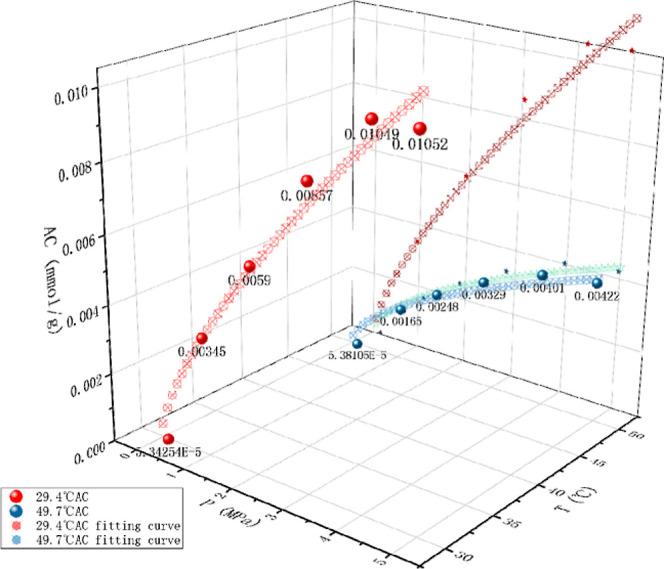
To minimize errors in calculating coal flue gas adsorption capacity due to gas compressibility and to preclude prediction inaccuracies in abandoned mine flue gas storage capacity for power plants, it is imperative to account for the influence of compression factor calculation accuracy while selecting the optimal theoretical adsorption model. In this paper, the flue gas adsorption experiment of a power plant with coal samples gradually pressurized to close to 5 MPa at two different temperatures is carried out, and the temperature and pressure data obtained from the experiment are substituted into five different compression factor calculation methods to calculate different absolute adsorption amounts. The calculated adsorption capacities were fitted into six theoretical adsorption models to establish a predictive model suitable for estimating the coal adsorption capacity in power plant flue gas. Results reveal significant disparities in the absolute adsorption capacity determined by different compression factors, with an error range of 0.001278-7.8262 (cm/kg). The Redlich-Kwong equation of state emerged as the most suitable for the flue gas of the selected experimental coal sample and the chosen composition ratio among the five compression factors. Among the six theoretical adsorption models, the Brunauer-Emmett-Teller model with three parameters demonstrated the highest suitability for predicting the adsorption capacity of coal samples in power plant smoke, achieving a fitting accuracy as high as 0.9922 at 49.7 °C.
为了将由于气体可压缩性导致的计算煤烟气吸附容量的误差降至最低,并避免预测发电厂废弃矿井烟气存储容量时的不准确情况,在选择最佳理论吸附模型时,必须考虑压缩因子计算精度的影响。本文进行了某发电厂煤样在两种不同温度下逐步加压至接近5MPa的烟气吸附实验,并将实验获得的温度和压力数据代入五种不同的压缩因子计算方法,以计算不同的绝对吸附量。将计算得到的吸附容量拟合到六个理论吸附模型中,建立一个适用于估算发电厂烟气中煤吸附容量的预测模型。结果显示,不同压缩因子确定的绝对吸附容量存在显著差异,误差范围为0.001278 - 7.8262(cm/kg)。在五个压缩因子中,Redlich-Kwong状态方程最适合所选实验煤样的烟气和选定的组成比。在六个理论吸附模型中,三参数的Brunauer-Emmett-Teller模型对预测发电厂烟气中煤样的吸附容量显示出最高的适用性,在49.7℃时拟合精度高达0.9922。




 Zotero 插件