Department of Chemistry, The University of Western Ontario, London, Ontario N6A 5B7, Canada.
Metallomics. 2024 Apr 5;16(4). doi: 10.1093/mtomcs/mfae015.
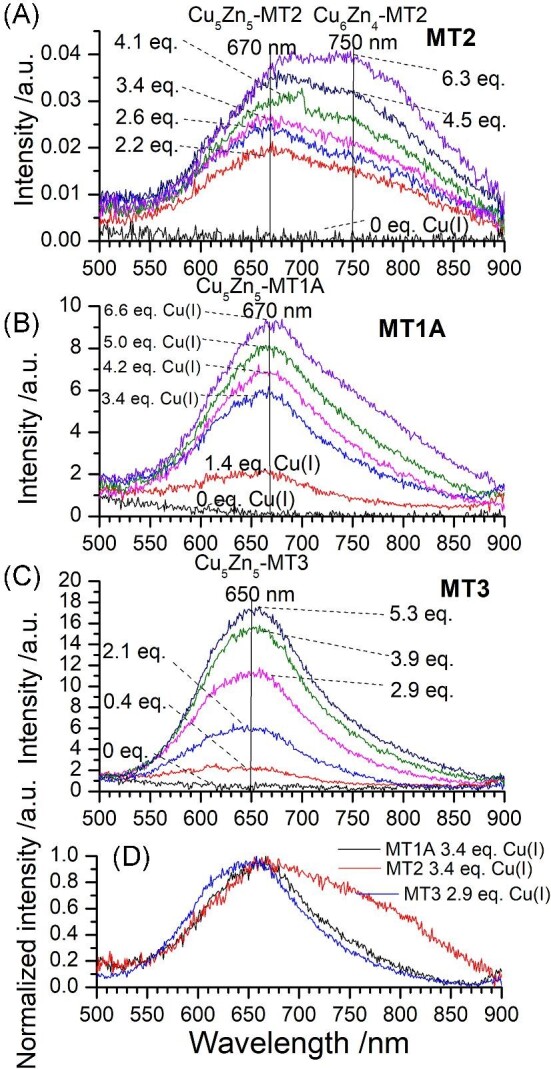
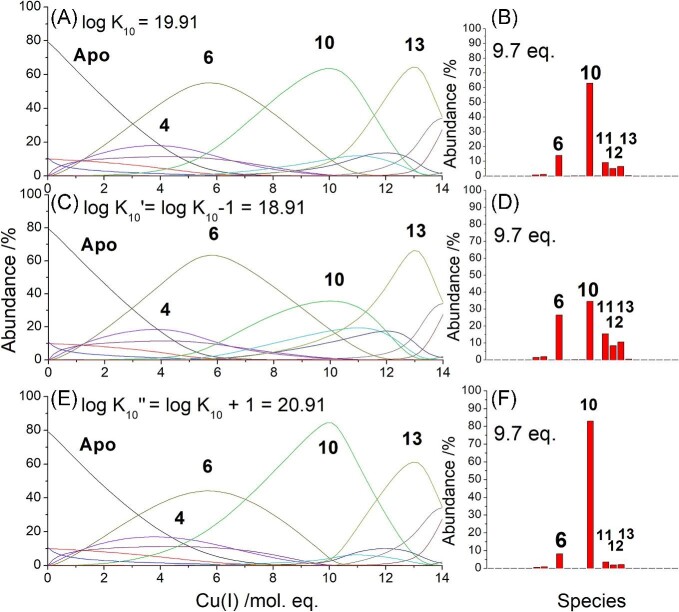
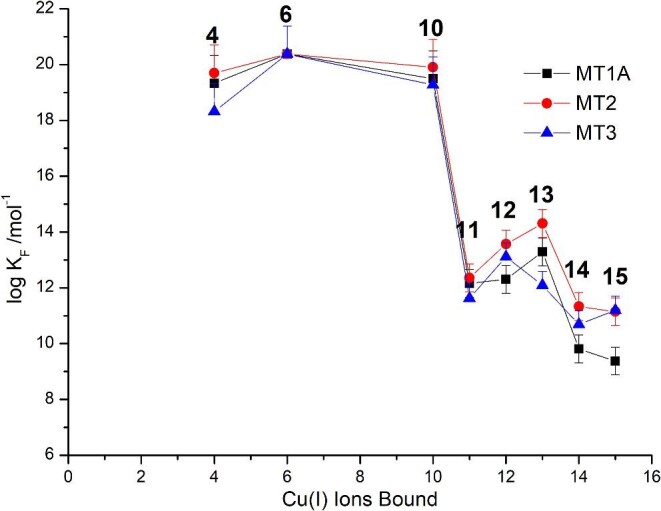
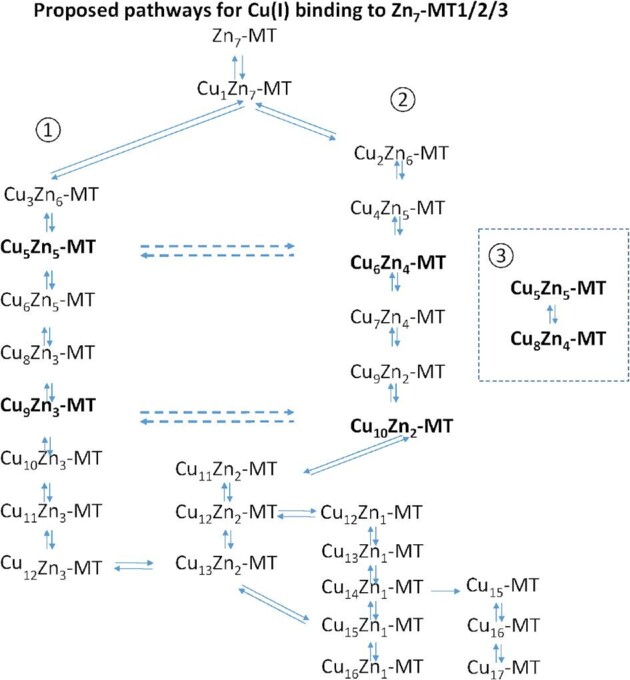
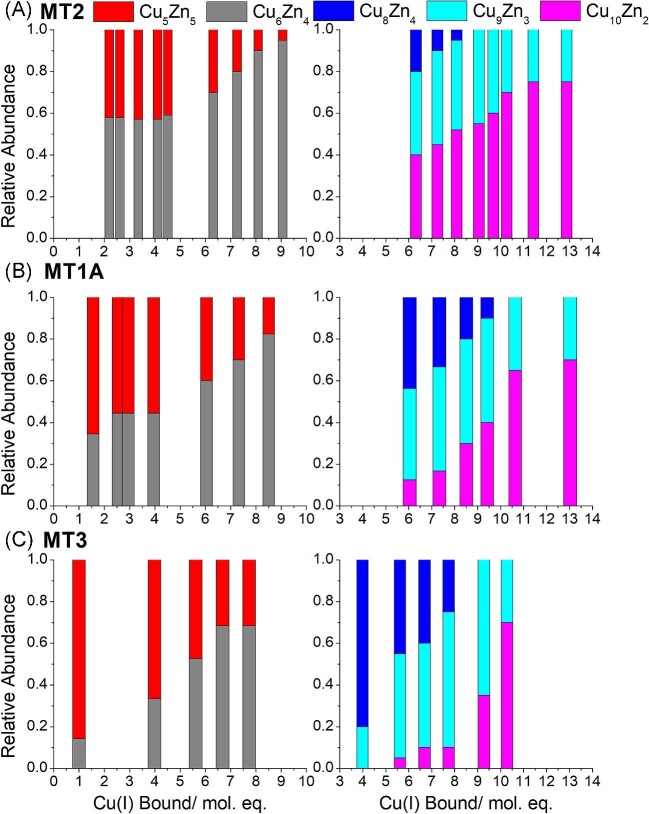
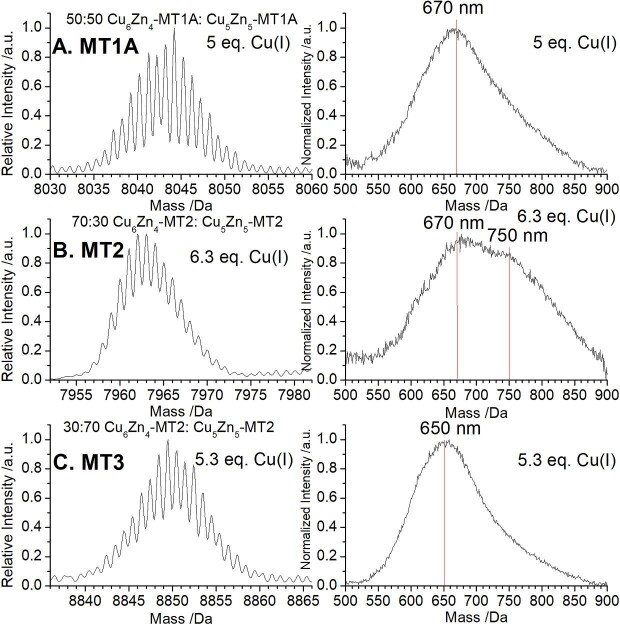
Metallothioneins (MTs) are cysteine-rich proteins involved in metal homeostasis, heavy metal detoxification, and protection against oxidative stress. Whether the four mammalian MT isoforms exhibit different metal binding properties is not clear. In this paper, the Cu(I) binding properties of the apo MT1A, apo MT2, and apo MT3 are compared and the relative Cu(I) binding affinities are reported. In all three isoforms, Cu4, Cu6, and Cu10 species form cooperatively, and MT1A and MT2 also form a Cu13 species. The Cu(I) binding properties of Zn7-MT1A, Zn7-MT2, and Zn7-MT3 are compared systematically using isotopically pure 63Cu(I) and 68Zn(II). The species formed in each MT isoform were detected through electrospray ionization-mass spectrometry and further characterized using room temperature phosphorescence spectroscopy. The mixed metal Cu, Zn species forming in MT1A, MT2, and MT3 have similar stoichiometries and their emission spectral properties indicate that analogous clusters form in the three isoforms. Three parallel metallation pathways have been proposed through analysis of the detailed Cu, Zn speciation in MT1A, MT2, and MT3. Pathway ① results in Cu5Zn5-MT and Cu9Zn3-MT. Pathway ② involves Cu6Zn4-MT and Cu10Zn2-MT. Pathway ③ includes Cu8Zn4-MT. Speciation analysis indicates that Pathway ② is the preferred pathway for MT2. This is also evident in the phosphorescence spectra with the 750 nm emission from Cu6Zn4-MT being most prominent in MT2. We see no evidence for different MT isoforms being optimized or exhibiting preferences for certain metals. We discuss the probable stoichiometry for MTs in vivo based on the in vitro determined binding constants.
金属硫蛋白(MTs)是富含半胱氨酸的蛋白质,参与金属动态平衡、重金属解毒和抵抗氧化应激。目前尚不清楚这四种哺乳动物 MT 同工型是否具有不同的金属结合特性。本文比较了 apo MT1A、apo MT2 和 apo MT3 的 Cu(I)结合特性,并报告了相对 Cu(I)的结合亲和力。在所有三种同工型中,Cu4、Cu6 和 Cu10 物种协同形成,MT1A 和 MT2 还形成 Cu13 物种。使用同位素纯 63Cu(I)和 68Zn(II)系统比较了 Zn7-MT1A、Zn7-MT2 和 Zn7-MT3 的 Cu(I)结合特性。通过电喷雾电离-质谱法检测每种 MT 同工型中形成的物种,并使用室温磷光光谱法进一步表征。MT1A、MT2 和 MT3 中形成的混合金属 Cu、Zn 物种具有相似的化学计量比,其发射光谱特性表明在这三种同工型中形成了类似的簇。通过分析 MT1A、MT2 和 MT3 中详细的 Cu、Zn 形态,提出了三种平行的金属化途径。途径 ① 导致 Cu5Zn5-MT 和 Cu9Zn3-MT 的形成。途径 ② 涉及 Cu6Zn4-MT 和 Cu10Zn2-MT。途径 ③ 包括 Cu8Zn4-MT。物种分析表明途径 ② 是 MT2 的首选途径。这在磷光光谱中也很明显,来自 Cu6Zn4-MT 的 750nm 发射在 MT2 中最为突出。我们没有证据表明不同的 MT 同工型被优化或对某些金属表现出偏好。我们根据体外测定的结合常数讨论了 MTs 在体内的可能化学计量比。