Vaccine and Infectious Disease Division, Fred Hutchinson Cancer Center, Seattle, WA, USA.
Data Core, Shared Resources, Fred Hutchinson Cancer Center, Seattle, WA, USA.
Nature. 2024 Apr;628(8007):424-432. doi: 10.1038/s41586-024-07182-w. Epub 2024 Mar 20.
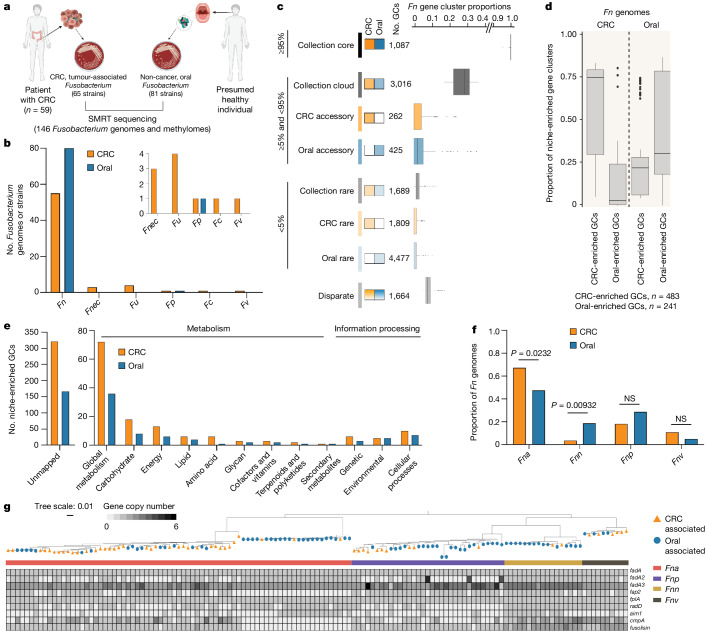
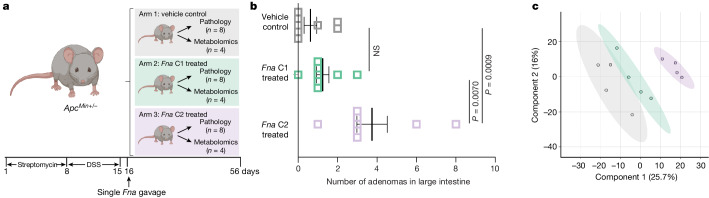
Fusobacterium nucleatum (Fn), a bacterium present in the human oral cavity and rarely found in the lower gastrointestinal tract of healthy individuals, is enriched in human colorectal cancer (CRC) tumours. High intratumoural Fn loads are associated with recurrence, metastases and poorer patient prognosis. Here, to delineate Fn genetic factors facilitating tumour colonization, we generated closed genomes for 135 Fn strains; 80 oral strains from individuals without cancer and 55 unique cancer strains cultured from tumours from 51 patients with CRC. Pangenomic analyses identified 483 CRC-enriched genetic factors. Tumour-isolated strains predominantly belong to Fn subspecies animalis (Fna). However, genomic analyses reveal that Fna, considered a single subspecies, is instead composed of two distinct clades (Fna C1 and Fna C2). Of these, only Fna C2 dominates the CRC tumour niche. Inter-Fna analyses identified 195 Fna C2-associated genetic factors consistent with increased metabolic potential and colonization of the gastrointestinal tract. In support of this, Fna C2-treated mice had an increased number of intestinal adenomas and altered metabolites. Microbiome analysis of human tumour tissue from 116 patients with CRC demonstrated Fna C2 enrichment. Comparison of 62 paired specimens showed that only Fna C2 is tumour enriched compared to normal adjacent tissue. This was further supported by metagenomic analysis of stool samples from 627 patients with CRC and 619 healthy individuals. Collectively, our results identify the Fna clade bifurcation, show that specifically Fna C2 drives the reported Fn enrichment in human CRC and reveal the genetic underpinnings of pathoadaptation of Fna C2 to the CRC niche.
具核梭杆菌(Fn)是一种存在于人类口腔中、很少在健康个体的下消化道中发现的细菌,在人类结直肠癌(CRC)肿瘤中富集。肿瘤内 Fn 负荷高与复发、转移和患者预后不良相关。在这里,为了描绘有利于肿瘤定植的 Fn 遗传因素,我们为 135 株 Fn 菌株生成了封闭基因组;其中 80 株来自无癌症个体的口腔菌株和 55 株从 51 名 CRC 患者肿瘤中培养的独特癌症菌株。泛基因组分析确定了 483 个 CRC 富集的遗传因素。肿瘤分离株主要属于具核梭杆菌亚种动物(Fna)。然而,基因组分析表明,被认为是单一亚种的 Fna 实际上由两个不同的分支(Fna C1 和 Fna C2)组成。其中,只有 Fna C2 主导 CRC 肿瘤生态位。Fna 之间的分析确定了 195 个与代谢潜力增加和胃肠道定植相关的 Fna C2 相关遗传因素。支持这一点的是,Fna C2 处理的小鼠肠道腺瘤数量增加,代谢物发生改变。对 116 名 CRC 患者的人类肿瘤组织的微生物组分析表明 Fna C2 富集。对 62 对配对标本的比较表明,与正常相邻组织相比,只有 Fna C2 是肿瘤富集的。这进一步得到了对 627 名 CRC 患者和 619 名健康个体的粪便样本进行的宏基因组分析的支持。总的来说,我们的研究结果确定了 Fna 分支分叉,表明 Fna C2 特异性地驱动了报道的 Fn 在人类 CRC 中的富集,并揭示了 Fna C2 对 CRC 生态位的病理适应的遗传基础。