
短期内,新建草原可促进授粉,但对附近耕地的生物害虫防治却无促进作用。
New grasslands promote pollination but not biological pest control in nearby arable fields in the short term.
作者信息
Bürgler Manuela, Hussain Raja Imran, Maas Bea, Walcher Ronnie, Rabl Dominik, Krautzer Bernhard, Moser Dietmar, Frank Thomas
机构信息
Institute of Zoology, Department of Integrative Biology and Biodiversity Research (DIBB), University of Natural Resources and Life Sciences, Gregor-Mendel-Straße 33, 1180 Vienna, Austria.
Applied Ecology Unit, School of Natural Sciences, University of Galway, Galway, Ireland.
出版信息
Arthropod Plant Interact. 2024;18(2):327-338. doi: 10.1007/s11829-023-10034-5. Epub 2024 Jan 31.
UNLABELLED
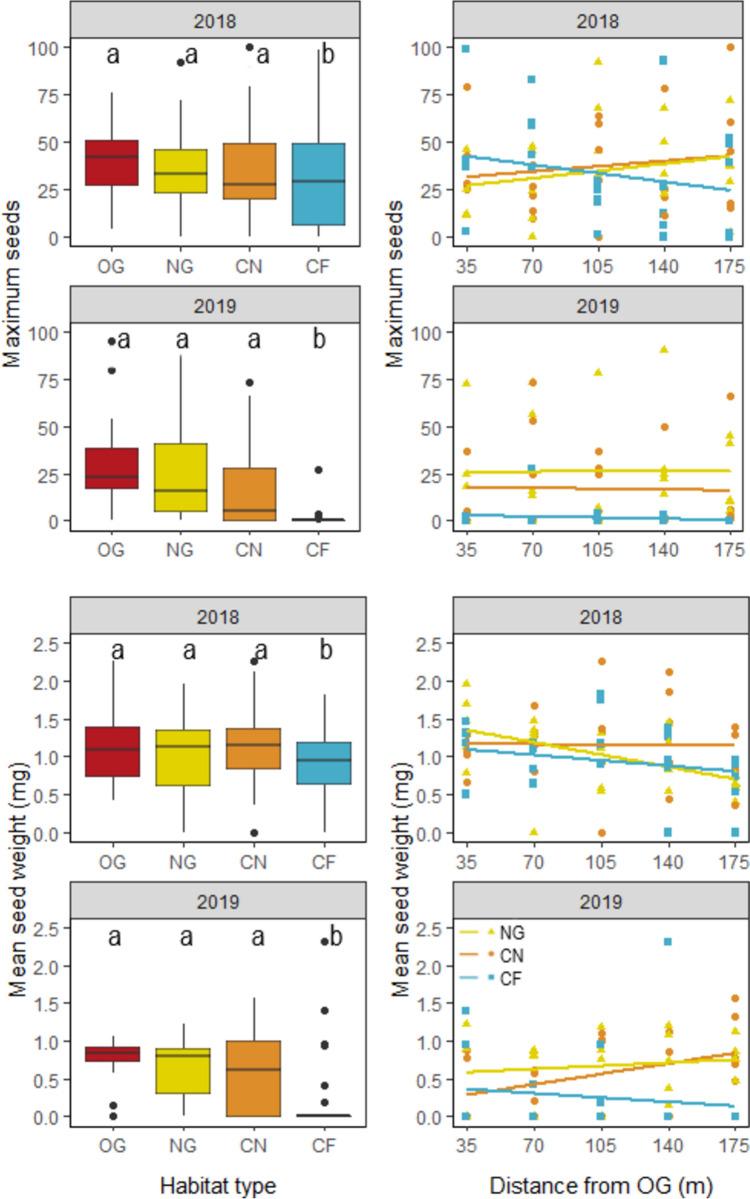
Agricultural intensification is a major threat to farmland biodiversity and associated ecosystem services. Semi-natural habitats are integral to the preservation of farmland biodiversity and ecosystem services, however, the extent in which they contribute to specific services is largely unclear. We studied predation rates of ground-dwelling predatory arthropods, and pollination success within old permanent grasslands, newly established grasslands and arable fields near and far from new grasslands. We evaluated whether grassland restoration can enhance pollination and biological control in crop fields. For this purpose, we established new grassland strips within cereal fields, which directly bordered existing permanent grasslands. We evaluated if the distance to these old and new grasslands affects the delivery of the two ecosystem services within crop fields. We found significantly higher seed numbers and seed weight in sentinel plants placed in old grasslands, new grasslands and nearby arable fields compared to distant arable fields. We also found significantly decreasing seed numbers and seed weight in sentinel plants placed in distant arable fields with increasing distance from old grasslands, while pollination success was not affected by distance in nearby arable fields. Contrary, we did not find any significant effects of new grasslands on biological control. Our study showed that 3 years after establishing grasslands arable fields benefited from the proximity of flower-rich new grasslands through increased pollination success though not regarding biological control. This indicates that, on a short term, establishing new grasslands can support beneficial arthropods in providing ecosystem services such as pollination. Predators, in contrast, might take longer to establish effective populations that denote higher predation rates. Our study provides a baseline for future long-term studies to better evaluate pollination and pest control patterns within arable fields.
SUPPLEMENTARY INFORMATION
The online version contains supplementary material available at 10.1007/s11829-023-10034-5.
未标注
农业集约化是对农田生物多样性及相关生态系统服务的重大威胁。半自然栖息地对于农田生物多样性和生态系统服务的保护至关重要,然而,它们对特定服务的贡献程度在很大程度上尚不清楚。我们研究了地面捕食性节肢动物的捕食率,以及在旧的永久性草地、新建立的草地和距离新草地远近不同的农田中的授粉成功率。我们评估了草地恢复是否能增强农田中的授粉和生物防治。为此,我们在与现有永久性草地直接接壤的麦田内建立了新的草地条带。我们评估了与这些新旧草地的距离是否会影响农田中这两种生态系统服务的提供。我们发现,与远处的农田相比,放置在旧草地、新草地和附近农田中的哨兵植物的种子数量和种子重量显著更高。我们还发现,随着与旧草地距离的增加,放置在远处农田中的哨兵植物的种子数量和种子重量显著减少,而附近农田中的授粉成功率不受距离影响。相反,我们没有发现新草地对生物防治有任何显著影响。我们的研究表明,在建立草地3年后,农田因靠近富含花朵的新草地而受益,授粉成功率提高,但生物防治方面并非如此。这表明,短期内,建立新草地可以支持有益节肢动物提供授粉等生态系统服务。相比之下,捕食者可能需要更长时间来建立表示更高捕食率的有效种群。我们的研究为未来更好地评估农田中的授粉和害虫控制模式的长期研究提供了基线。
补充信息
在线版本包含可在10.1007/s11829-023-10034-5获取的补充材料。


 Zotero 插件