Institute for Alpine Environment, Eurac Research, Viale Druso 1, 39100 Bozen/Bolzano, Italy.
Department of Animal Ecology and Tropical Biology, Biocenter, University of Würzburg, Am Hubland, 97074 Würzburg, Germany.
Sci Adv. 2019 Oct 16;5(10):eaax0121. doi: 10.1126/sciadv.aax0121. eCollection 2019 Oct.
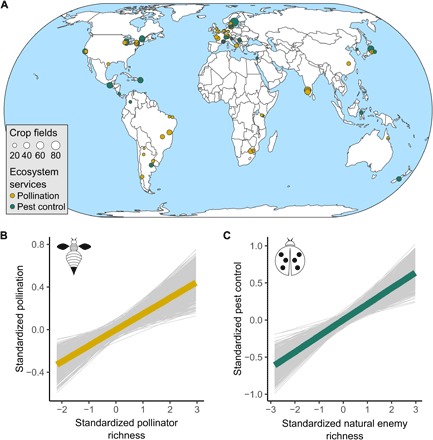
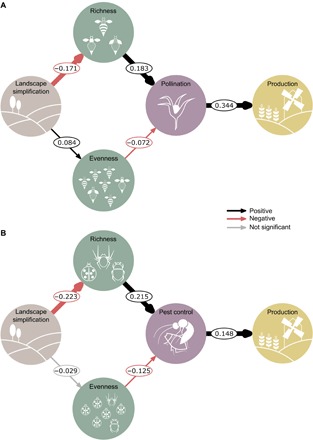
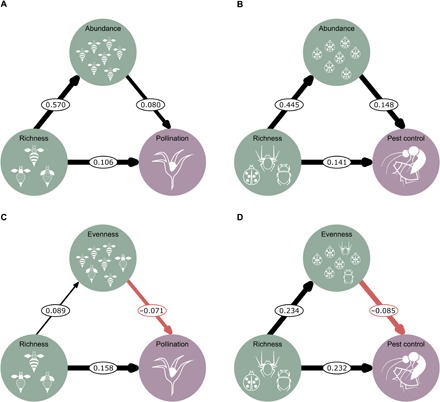
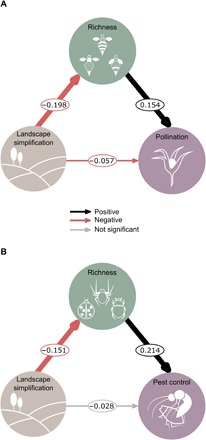
Human land use threatens global biodiversity and compromises multiple ecosystem functions critical to food production. Whether crop yield-related ecosystem services can be maintained by a few dominant species or rely on high richness remains unclear. Using a global database from 89 studies (with 1475 locations), we partition the relative importance of species richness, abundance, and dominance for pollination; biological pest control; and final yields in the context of ongoing land-use change. Pollinator and enemy richness directly supported ecosystem services in addition to and independent of abundance and dominance. Up to 50% of the negative effects of landscape simplification on ecosystem services was due to richness losses of service-providing organisms, with negative consequences for crop yields. Maintaining the biodiversity of ecosystem service providers is therefore vital to sustain the flow of key agroecosystem benefits to society.
人类土地利用活动威胁着全球生物多样性,并损害了对粮食生产至关重要的多种生态系统功能。作物产量相关的生态系统服务是可以由少数优势物种来维持,还是依赖于较高的物种丰富度,目前尚不清楚。本研究利用来自 89 项研究(涉及 1475 个地点)的全球数据库,根据正在进行的土地利用变化情况,将物种丰富度、丰度和优势度对传粉、生物防治和最终产量的相对重要性进行了划分。传粉者和天敌的丰富度除了与丰度和优势度有关外,还直接支持着生态系统服务。景观简化对生态系统服务的负面影响中,高达 50%是由于提供服务的生物多样性丧失所致,这对作物产量产生了负面影响。因此,维持生态系统服务提供者的生物多样性对于维持农业生态系统关键效益向社会的持续流动至关重要。