School of Biological Sciences, The University of Utah, Salt Lake City, UT 84112, USA.
Developmental Biology Unit, European Molecular Biology Laboratory (EMBL), 69117 Heidelberg, Germany.
Genetics. 2024 May 7;227(1). doi: 10.1093/genetics/iyae041.
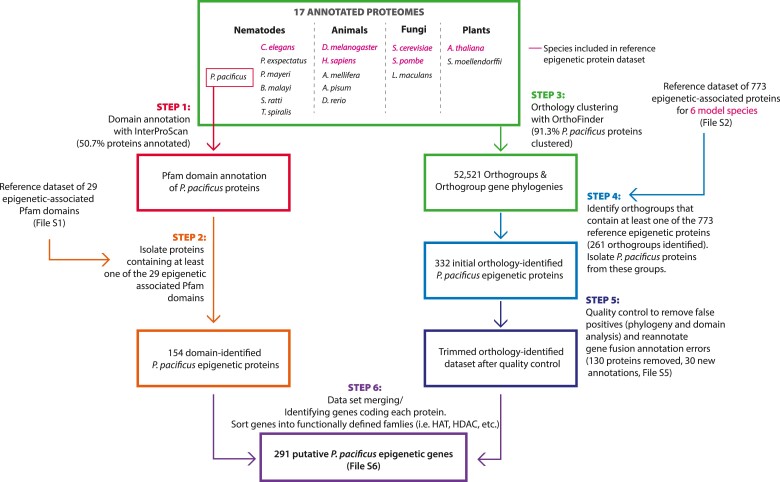
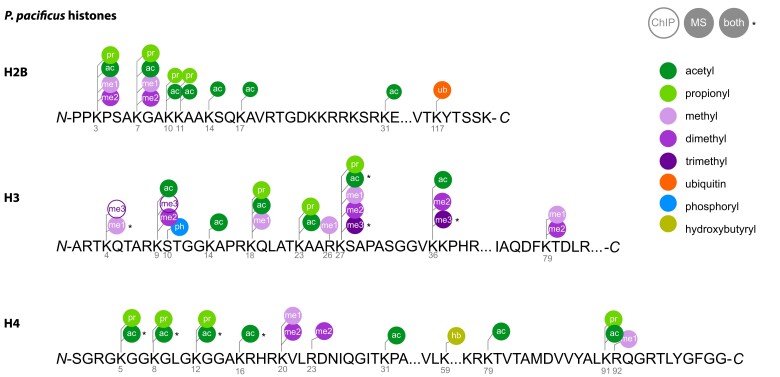
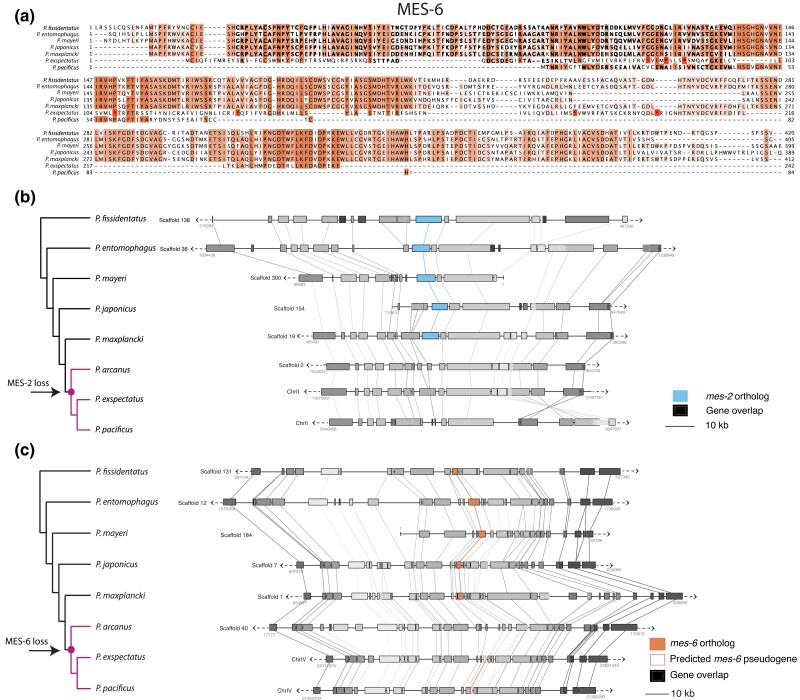
Comparative approaches have revealed both divergent and convergent paths to achieving shared developmental outcomes. Thus, only through assembling multiple case studies can we understand biological principles. Yet, despite appreciating the conservation-or lack thereof-of developmental networks, the conservation of epigenetic mechanisms regulating these networks is poorly understood. The nematode Pristionchus pacificus has emerged as a model system of plasticity and epigenetic regulation as it exhibits a bacterivorous or omnivorous morph depending on its environment. Here, we determined the "epigenetic toolkit" available to P. pacificus as a resource for future functional work on plasticity, and as a comparison with Caenorhabditis elegans to investigate the conservation of epigenetic mechanisms. Broadly, we observed a similar cast of genes with putative epigenetic function between C. elegans and P. pacificus. However, we also found striking differences. Most notably, the histone methyltransferase complex PRC2 appears to be missing in P. pacificus. We described the deletion/pseudogenization of the PRC2 genes mes-2 and mes-6 and concluded that both were lost in the last common ancestor of P. pacificus and a related species P. arcanus. Interestingly, we observed the enzymatic product of PRC2 (H3K27me3) by mass spectrometry and immunofluorescence, suggesting that a currently unknown methyltransferase has been co-opted for heterochromatin silencing. Altogether, we have provided an inventory of epigenetic genes in P. pacificus to compare with C. elegans. This inventory will enable reverse-genetic experiments related to plasticity and has revealed the first loss of PRC2 in a multicellular organism.
比较方法揭示了实现共同发育结果的分歧和趋同途径。因此,只有通过汇集多个案例研究,我们才能理解生物学原理。然而,尽管我们意识到发育网络的保守性(或缺乏),但调节这些网络的表观遗传机制的保守性却知之甚少。秀丽隐杆线虫(Caenorhabditis elegans)已经成为可塑性和表观遗传调控的模型系统,因为它根据环境表现出细菌食性或杂食性形态。在这里,我们确定了太平洋多刺水蚤(Pristionchus pacificus)可用的“表观遗传工具包”,作为未来可塑性功能研究的资源,以及与秀丽隐杆线虫(Caenorhabditis elegans)的比较,以研究表观遗传机制的保守性。广泛地说,我们观察到秀丽隐杆线虫(Caenorhabditis elegans)和太平洋多刺水蚤(Pristionchus pacificus)之间具有潜在表观遗传功能的相似基因。然而,我们也发现了显著的差异。最值得注意的是,组蛋白甲基转移酶复合物 PRC2 似乎在太平洋多刺水蚤(Pristionchus pacificus)中缺失。我们描述了 PRC2 基因 mes-2 和 mes-6 的缺失/假基因化,并得出结论,这两个基因在太平洋多刺水蚤(Pristionchus pacificus)和相关物种 P. arcanus 的最后共同祖先中丢失。有趣的是,我们通过质谱和免疫荧光观察到 PRC2 的酶产物(H3K27me3),表明一种目前未知的甲基转移酶已被用于异染色质沉默的共调控。总的来说,我们提供了太平洋多刺水蚤(Pristionchus pacificus)中表观遗传基因的清单,以便与秀丽隐杆线虫(Caenorhabditis elegans)进行比较。该清单将使与可塑性相关的反向遗传实验成为可能,并揭示了 PRC2 在多细胞生物中的首次缺失。