Health Resources and Services Availability Monitoring System (HeRAMS) Initiative, World Health Organization, Geneva, Switzerland.
Geohealth Group, Institute of Global Health, University of Geneva, Geneva, Switzerland.
BMJ Open. 2024 Mar 21;14(3):e077127. doi: 10.1136/bmjopen-2023-077127.
Using health facility types as a measure of service availability is a common approach in international standards for health system policy and planning. However, this proxy may not accurately reflect the actual availability of specific health services.
This study aims to evaluate the reliability of health facility typology as an indicator of specific health service availability and explore whether certain facility types consistently provide particular services.
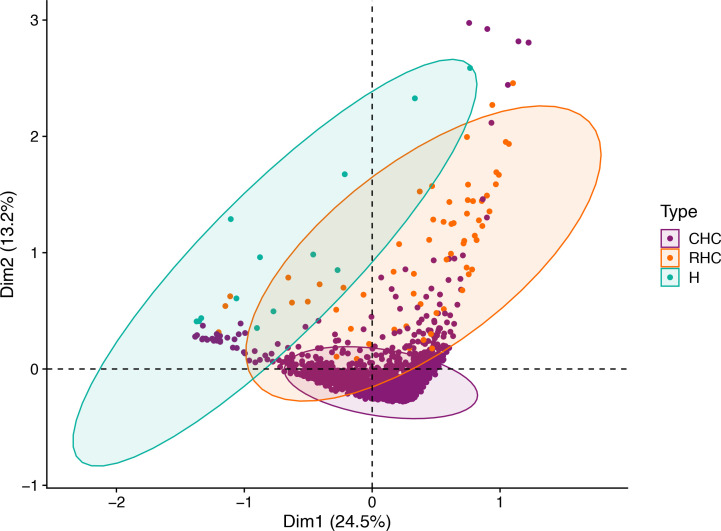
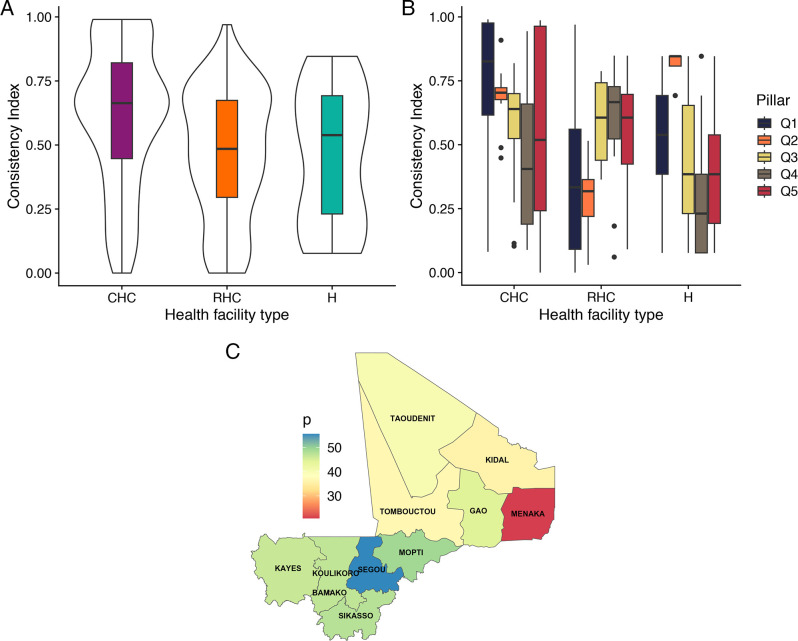
We analysed a comprehensive dataset containing information from 1725 health facilities in Mali. To uncover and visualise patterns within the dataset, we used two analytical techniques: Multiple Correspondence Analysis and Between-Class Analysis. These analyses allowed us to quantitatively measure the influence of health facility types on the variation in health service provisioning. Additionally, we developed and calculated a Consistency Index, which assesses the consistency of a health facility type in providing specific health services. By examining various health facilities and services, we sought to determine the accuracy of facility types as indicators of service availability.
The study focused on the health system in Mali as a case study.
Our findings indicate that using health facility types as a proxy for service availability in Mali is not an accurate representation. We observed that most of the variation in service provision does not stem from differences between facility types but rather within facility types. This suggests that relying solely on health facility typology may lead to an incomplete understanding of health service availability.
These results have significant implications for health policy and planning. The reliance on health facility types as indicators for health system policy and planning should be reconsidered. A more nuanced and evidence-based understanding of health service availability is crucial for effective health policy and planning, as well as for the assessment and monitoring of health systems.
使用卫生机构类型作为服务可及性的衡量标准是国际卫生系统政策和规划标准中的常用方法。然而,这种替代指标可能无法准确反映特定卫生服务的实际可及性。
本研究旨在评估卫生机构类型作为特定卫生服务可及性指标的可靠性,并探讨某些机构类型是否能持续提供特定服务。
我们分析了一个包含马里 1725 家卫生机构信息的综合数据集。为了揭示和可视化数据集中的模式,我们使用了两种分析技术:多元对应分析和类间分析。这些分析方法使我们能够定量衡量卫生机构类型对卫生服务提供变化的影响。此外,我们开发并计算了一致性指数,该指数评估了卫生机构类型提供特定卫生服务的一致性。通过检查各种卫生机构和服务,我们旨在确定机构类型作为服务可及性指标的准确性。
本研究以马里的卫生系统为案例研究。
我们的研究结果表明,在马里,使用卫生机构类型作为服务可及性的替代指标并不准确。我们观察到,服务提供的大部分差异并非源于机构类型之间的差异,而是源于机构类型内部。这表明仅依赖卫生机构类型可能会导致对卫生服务可及性的理解不完整。
这些结果对卫生政策和规划具有重要意义。应重新考虑将卫生机构类型作为卫生系统政策和规划指标的做法。更细致和基于证据的卫生服务可及性理解对于有效的卫生政策和规划以及对卫生系统的评估和监测至关重要。