University Health Network, 200 Elizabeth Street, Toronto, ON, M5G 2C4, Canada.
Albion Centre, 150 Albion Street, Surry Hills NSW 2010, Sydney, Australia.
AIDS Res Ther. 2024 Mar 21;21(1):17. doi: 10.1186/s12981-024-00604-9.
As the population of people with HIV ages, concerns over managing age-related comorbidities, polypharmacy, immune recovery, and drug-drug interactions while maintaining viral suppression have arisen. We present pooled TANGO and SALSA efficacy and safety results dichotomized by age (< 50 and ≥ 50 years).
Week 48 data from the open-label phase 3 TANGO and SALSA trials evaluating switch to once-daily dolutegravir/lamivudine (DTG/3TC) fixed-dose combination vs continuing current antiretroviral regimen (CAR) were pooled. Proportions of participants with HIV-1 RNA ≥ 50 and < 50 copies/mL (Snapshot, intention-to-treat exposed) and safety were analyzed by age category. Adjusted mean change from baseline in CD4 + cell count was assessed using mixed-models repeated-measures analysis.
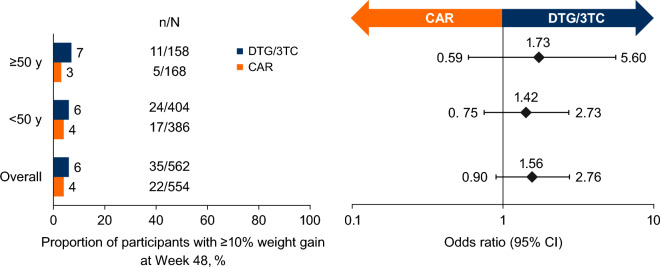
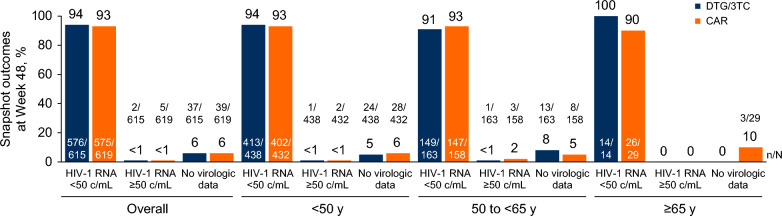
Of 1234 participants, 80% of whom were male, 29% were aged ≥ 50 years. Among those aged ≥ 50 years, 1/177 (< 1%) DTG/3TC participant and 3/187 (2%) CAR participants had HIV-1 RNA ≥ 50 copies/mL at 48 weeks; proportions with HIV-1 RNA < 50 copies/mL were high in both treatment groups (≥ 92%), consistent with overall efficacy and similar to observations in participants aged < 50 years (≥ 93%). Regardless of age category, CD4 + cell count increased or was maintained from baseline with DTG/3TC. Change from baseline in CD4 + /CD8 + ratio was similar across age groups and between treatment groups. One CAR participant aged < 50 years had confirmed virologic withdrawal, but no resistance was detected. In the DTG/3TC group, incidence of adverse events (AEs) was similar across age groups. Proportions of AEs leading to withdrawal were low and comparable between age groups. Although drug-related AEs were generally low, across age groups, drug-related AEs were more frequent in participants who switched to DTG/3TC compared with those who continued CAR. While few serious AEs were observed in both treatment groups, more were reported in participants aged ≥ 50 years vs < 50 years.
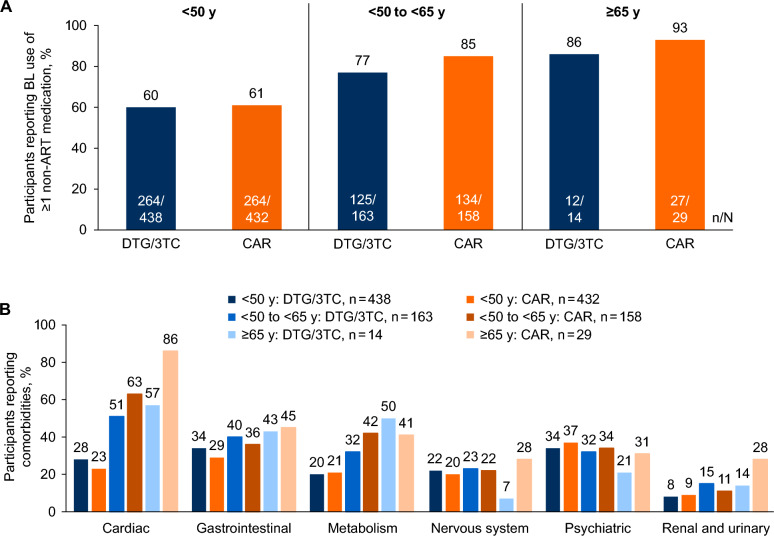
Among individuals with HIV-1, switching to DTG/3TC maintained high rates of virologic suppression and demonstrated a favorable safety profile, including in those aged ≥ 50 years despite higher prevalence of concomitant medication use and comorbidities.
TANGO, NCT03446573 (February 27, 2018); SALSA, NCT04021290 (July 16, 2019).
随着 HIV 感染者年龄的增长,人们越来越关注管理与年龄相关的合并症、多种药物治疗、免疫恢复和药物相互作用,同时保持病毒抑制。我们呈现了 TANGO 和 SALSA 疗效和安全性汇总结果,按年龄(<50 岁和≥50 岁)进行了划分。
来自开放标签、3 期 TANGO 和 SALSA 试验的第 48 周数据被汇总,这些试验评估了将每日一次的多替拉韦/拉米夫定(DTG/3TC)固定剂量复方制剂转换为继续当前抗逆转录病毒治疗方案(CAR)的效果。根据年龄类别分析了 HIV-1 RNA≥50 和<50 拷贝/mL(Snapshot,意向治疗暴露)的参与者比例和安全性。使用混合模型重复测量分析评估从基线开始 CD4+细胞计数的调整平均变化。
在 1234 名参与者中,80%为男性,29%年龄≥50 岁。在年龄≥50 岁的参与者中,1/177(<1%)DTG/3TC 组和 3/187(2%)CAR 组在 48 周时有 HIV-1 RNA≥50 拷贝/mL;两组的 HIV-1 RNA<50 拷贝/mL 比例均很高(≥92%),与总体疗效一致,与年龄<50 岁的参与者观察结果相似(≥93%)。无论年龄类别如何,DTG/3TC 治疗均可增加或维持 CD4+细胞计数从基线水平开始的水平。CD4+/CD8+比值从基线的变化在年龄组之间和治疗组之间相似。一名年龄<50 岁的 CAR 参与者出现了确认的病毒学停药,但未检测到耐药性。在 DTG/3TC 组中,不良事件(AE)的发生率在不同年龄组之间相似。AE 导致停药的比例较低,且在不同年龄组之间相当。虽然药物相关 AE 总体上较低,但与继续 CAR 治疗的参与者相比,转换为 DTG/3TC 的参与者药物相关 AE 更为常见。虽然在两个治疗组中都观察到了少数严重 AE,但在年龄≥50 岁的参与者中报告的 AE 更多。
在 HIV-1 感染者中,转换为 DTG/3TC 维持了高病毒学抑制率,并表现出良好的安全性特征,包括在≥50 岁的年龄组中,尽管合并用药和合并症的患病率较高。
TANGO,NCT03446573(2018 年 2 月 27 日);SALSA,NCT04021290(2019 年 7 月 16 日)。