Tian Bing-Qian, Wang Shu-Wen, Xu Jing-Ying, Wu San-Gang, Zhou Juan
School of Medicine, Xiamen University, Xiamen, China.
Department of Obstetrics and Gynecology, The First Affiliated Hospital of Xiamen University, School of Medicine, Xiamen University, Xiamen, China.
Front Oncol. 2024 Mar 7;14:1360663. doi: 10.3389/fonc.2024.1360663. eCollection 2024.
To analyze changes in survival outcomes in patients with ovarian clear cell carcinoma (OCCC) treated consecutively over a 16-year period using a population-based cohort.
We conducted a retrospective analysis of OCCC from 2000 to 2015 using data from the Surveillance, Epidemiology, and End Results (SEER) program. The ovarian cancer-specific survival (OCSS) and overall survival (OS) were analyzed according to the year of diagnosis. Joinpoint Regression Program, Kaplan-Meier analysis, and multivariate Cox regression analyses were used for statistical analysis.
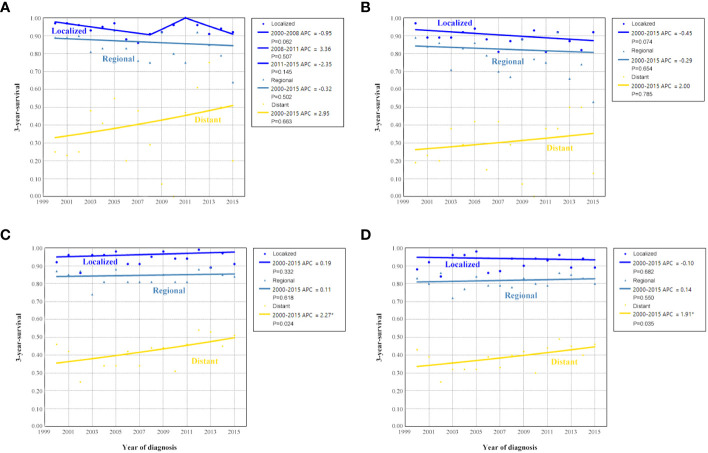
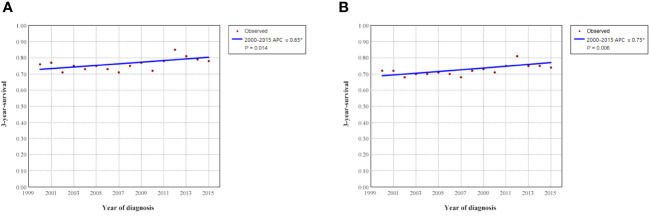
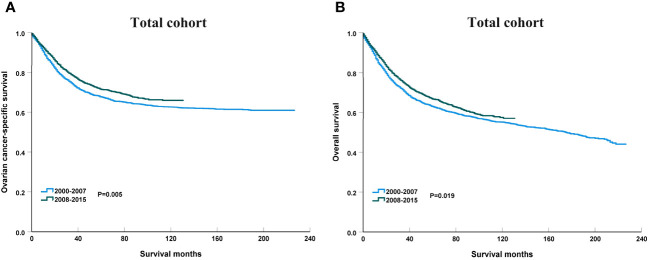
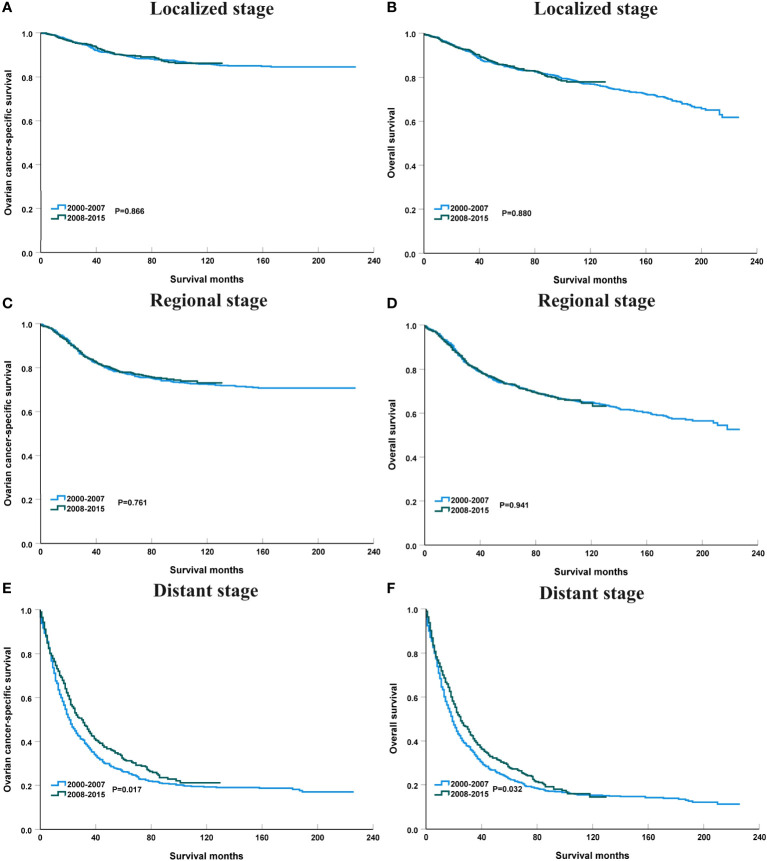
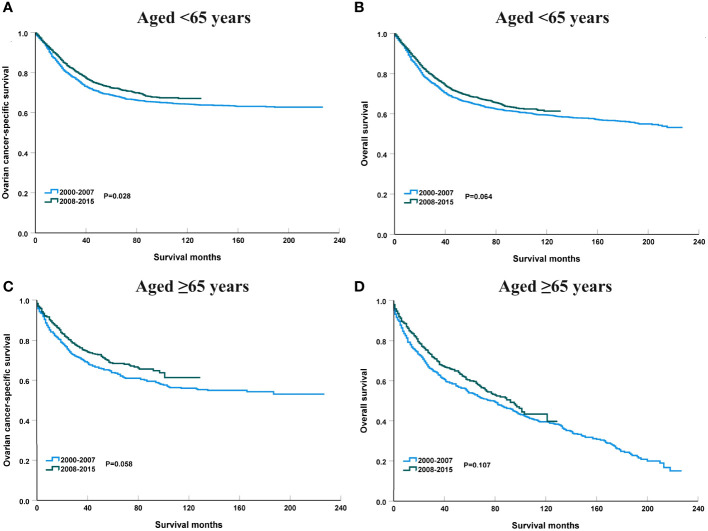
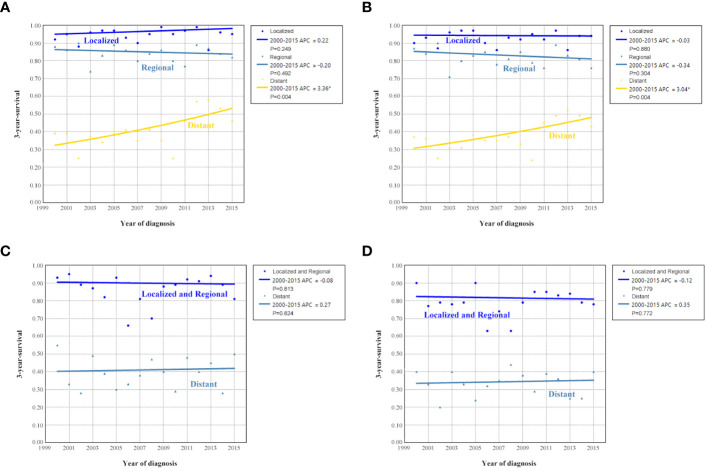
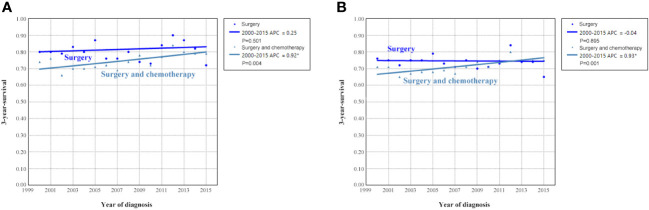
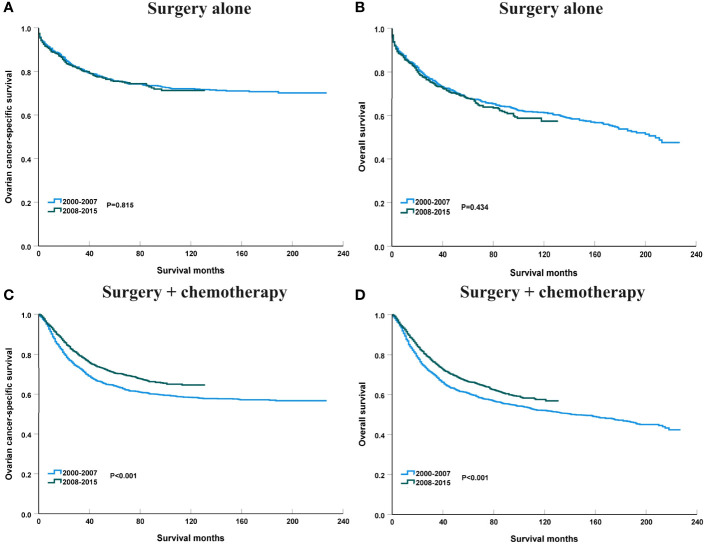
We included 4257 patients in the analysis. The analysis of annual percentage change in OCSS (P=0.014) and OS (P=0.006) showed that patients diagnosed in later years had significantly better outcomes compared to those diagnosed in early years. The results of the multivariate Cox regression analyses showed that the year of diagnosis was the independent prognostic factor associated with OCSS (P=0.004) and had a borderline effect on OS (P=0.060). Regarding the SEER staging, the OCSS (P=0.017) and OS (P=0.004) of patients with distant stage showed a significant trend toward increased, while no significant trends were found in the survival of patients with localized or regional stage diseases. Similar trends were found in those aged <65 years or those treated with surgery and chemotherapy. However, no statistically significant changes in the survival rate were found in those aged ≥65 years or those receiving surgery alone regardless of SEER stage during the study period.
Our study observed a significant increase in the survival outcomes in OCCC from 2000 to 2015, and patients aged <65 years and those with distant stage experienced a greater improvement in survival.
使用基于人群的队列分析16年间连续治疗的卵巢透明细胞癌(OCCC)患者生存结局的变化。
我们利用监测、流行病学和最终结果(SEER)计划的数据,对2000年至2015年的OCCC进行了回顾性分析。根据诊断年份分析卵巢癌特异性生存(OCSS)和总生存(OS)。采用Joinpoint回归程序、Kaplan-Meier分析和多变量Cox回归分析进行统计分析。
我们纳入了4257例患者进行分析。OCSS(P = 0.014)和OS(P = 0.006)的年度百分比变化分析表明,与早年诊断的患者相比,晚年诊断的患者结局显著更好。多变量Cox回归分析结果显示,诊断年份是与OCSS相关的独立预后因素(P = 0.004),对OS有临界影响(P = 0.060)。关于SEER分期,远处分期患者的OCSS(P = 0.017)和OS(P = 0.004)呈显著上升趋势,而局限性或区域分期疾病患者的生存无显著趋势。年龄<65岁或接受手术及化疗的患者也有类似趋势。然而,在研究期间,无论SEER分期如何,年龄≥65岁或仅接受手术的患者生存率无统计学显著变化。
我们的研究观察到2000年至2015年OCCC患者的生存结局显著改善,年龄<65岁和远处分期患者的生存改善更大。