Department of Ophthalmology, Tangdu Hospital, The Air Force Military Medical University, 1 Xinsi Rd, Xi'an, 710038, China.
Department of Ophthalmology, The 900th Hospital of Joint Logistic Support Force, PLA (Fuzong Clinical Medical College of Fujian Medical University), Fuzhou, 350025, China.
J Transl Med. 2024 Mar 22;22(1):298. doi: 10.1186/s12967-024-05097-8.
Diabetic retinopathy (DR) is the foremost cause of vision loss among the global working-age population, and statins are among the most frequently prescribed drugs for lipid management in patients with DR. The exact relationship between statins and DR has not been determined. This study sought to validate the causal association between statins usage and diabetic retinopathy.
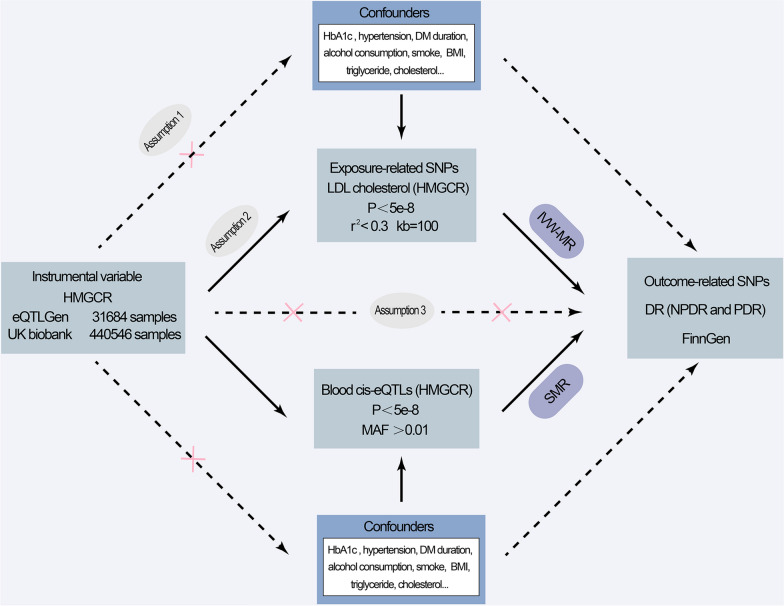
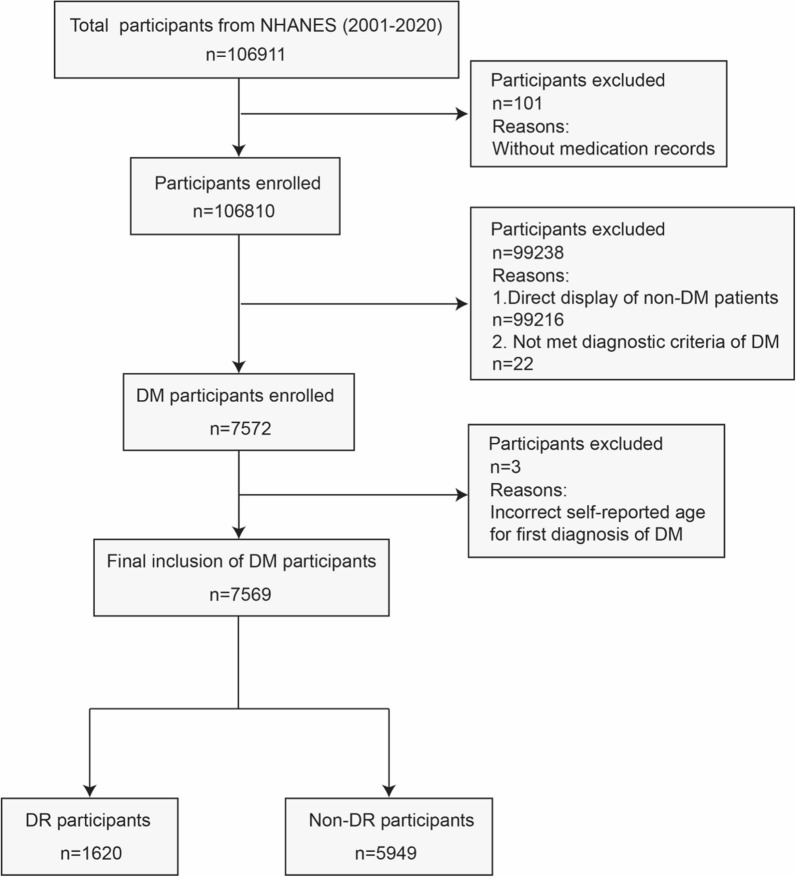
The summary-data-based Mendelian randomization (SMR) method and inverse-variance-weighted Mendelian randomization (IVW-MR) were used to identify the causal relationship between statins and DR via the use of expression quantitative trait loci (eQTL) data for 3-hydroxy-3-methylglutaryl-coenzyme A reductase (HMGCR) (31,684 blood samples), low density lipoprotein cholesterol-related GWAS data (sample size: 440,546), and DR-related GWAS data (14,584 cases and 176,010 controls). Additionally, a cross-sectional observational study based on the data from the National Health and Nutrition Examination Survey (NHANES) was conducted to supplement the association between DR and statins (sample size: 106,911). The odds ratios (ORs) with corresponding 95% confidence intervals (CIs) was employed to evaluate the results.
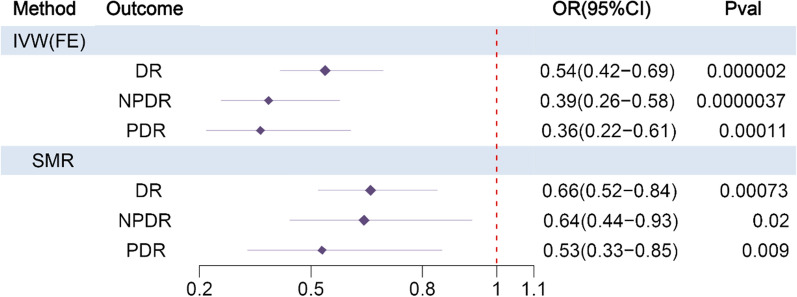
Based on the results of the MR analysis, HMGCR inhibitors were causally connected with a noticeably greater incidence of DR (IVW: OR = 0.54, 95% CI [0.42, 0.69], p = 0.000002; SMR: OR = 0.66, 95% CI [0.52, 0.84], p = 0.00073). Subgroup analysis revealed that the results were not affected by the severity of DR. The sensitivity analysis revealed the stability and reliability of the MR analysis results. The results from the cross-sectional study based on NHANES also support the association between not taking statins and a decreased risk of DR (OR = 0.54, 95% CI [0.37, 0.79], p = 0.001).
This study revealed that a significant increase in DR risk was causally related to statins use, providing novel insights into the role of statins in DR. However, further investigations are needed to verify these findings.
糖尿病视网膜病变(DR)是全球工作年龄人群视力丧失的首要原因,而他汀类药物是 DR 患者血脂管理中最常开的药物之一。他汀类药物与 DR 的确切关系尚未确定。本研究旨在通过使用 3-羟基-3-甲基戊二酰辅酶 A 还原酶(HMGCR)的表达数量性状基因座(eQTL)数据(31684 份血样)、低密度脂蛋白胆固醇相关 GWAS 数据(样本量:440546)和 DR 相关 GWAS 数据(14584 例病例和 176010 例对照),利用基于汇总数据的孟德尔随机化(SMR)方法和逆方差加权孟德尔随机化(IVW-MR)来验证他汀类药物使用与 DR 之间的因果关系。此外,还基于国家健康和营养检查调查(NHANES)的数据进行了一项横断面观察性研究,以补充 DR 与他汀类药物之间的关联(样本量:106911)。采用比值比(OR)及其 95%置信区间(CI)来评估结果。
基于 MR 分析的结果,HMGCR 抑制剂与 DR 的发生率显著增加有关(IVW:OR=0.54,95%CI[0.42,0.69],p=0.000002;SMR:OR=0.66,95%CI[0.52,0.84],p=0.00073)。亚组分析表明,结果不受 DR 严重程度的影响。敏感性分析表明 MR 分析结果稳定可靠。基于 NHANES 的横断面研究结果也支持不服用他汀类药物与 DR 风险降低之间的关联(OR=0.54,95%CI[0.37,0.79],p=0.001)。
本研究表明,DR 风险的显著增加与他汀类药物的使用有因果关系,为他汀类药物在 DR 中的作用提供了新的见解。然而,需要进一步的研究来验证这些发现。