Mareledwane Vuyokazi, Adesiyun Abiodun A, Hlokwe Tiny M
Department of Production Animal Studies, Faculty of Veterinary Science, University of Pretoria, Private Bag X04, Onderstepoort 0110, Pretoria, South Africa.
Bacteriology Section, Diagnostic Services Programme, Agricultural Research Council-Onderstepoort Veterinary Institute, Private Bag X05, Onderstepoort 0110, Pretoria, South Africa.
Int J Microbiol. 2024 Mar 15;2024:4636652. doi: 10.1155/2024/4636652. eCollection 2024.
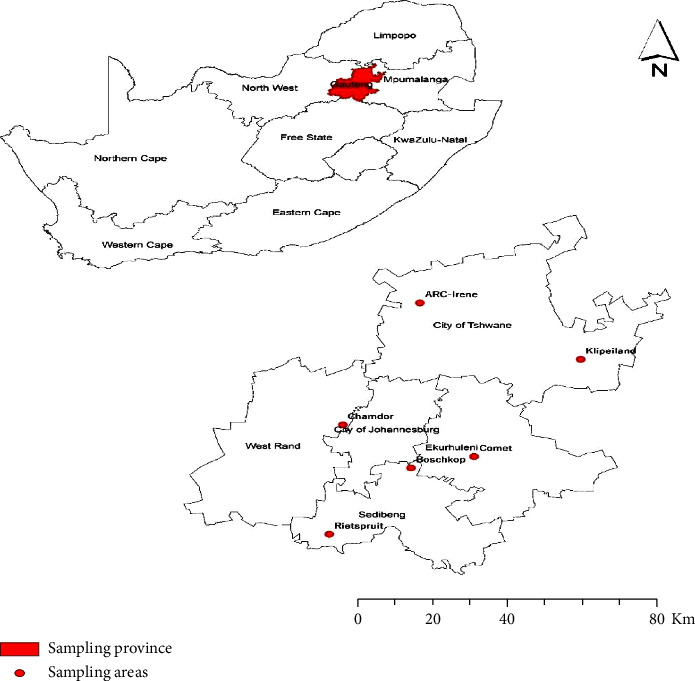
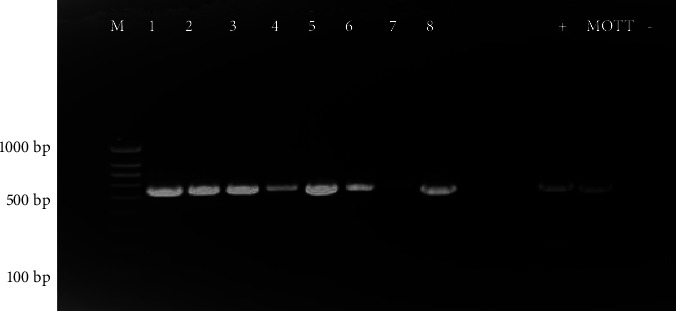
complex (MTBC) is a group of bacteria responsible for causing tuberculosis in animals and humans. In South Africa (S.A), slaughterhouses are registered by the government and closely inspected and audited for hygienic slaughter practices. Meat inspection to detect lesions has been used for passive surveillance, monitoring, and diagnosis of the disease status. Information on the current status of bovine tuberculosis (bTB) in livestock in the country is limited. Hence, we investigated the occurrence of spp. in the tissues of slaughtered livestock and environmental samples in abattoirs in Gauteng province of South Africa (S.A). The cross-sectional study employing random sampling from cattle, pigs, and sheep (with the collection of liver, lung, spleen, and different lymph nodes) irrespective of lesions was carried out in 19 red meat abattoirs. Five hundred animals were sampled, comprising cattle ( = 369), pigs ( = 90), and sheep ( = 41). Additionally, 19 environmental samples were collected from feedlots, or where animals drink water while awaiting slaughter, to identify mycobacterial species using culture, acid-fast bacteria staining, and polymerase chain reaction (PCR). The Chi-square and Fisher's Exact tests were used to detect statistically significant differences in the frequency of detection of spp. according to the variables investigated (types of tissues, livestock, abattoirs, etc.). The PCR assays detected no MTBC complex species DNA in the bacterial isolates from cattle ( = 32). Sequence analysis (16S rDNA) of the isolates from eight cattle confirmed only two species, namely (99.81% identity) and (99.42% identity). The remaining isolates were identified as members of the species. From the environmental samples, bacterial isolation was made from three samples, and two could only be identified up to the genus level ( species) while the remaining isolate was identified as (99.22% identity). The study revealed the absence of bovine tuberculosis-causing pathogens in red meat abattoirs of the Gauteng province. Although non-tuberculous have been implicated as potentially causing tuberculosis-like diseases in livestock, their occurrence in the current study was found to be low, but the potential to cause disease cannot be ignored.
结核分枝杆菌复合群(MTBC)是一组可导致动物和人类患结核病的细菌。在南非(S.A),屠宰场由政府登记注册,并接受严格检查和审计,以确保卫生屠宰操作。通过肉类检验来检测病变,已被用于被动监测、疾病状态监测和诊断。该国关于家畜牛结核病(bTB)现状的信息有限。因此,我们调查了南非豪登省(S.A)屠宰场中屠宰家畜组织和环境样本中分枝杆菌属物种的出现情况。本横断面研究采用随机抽样方法,从牛、猪和羊中(采集肝脏、肺、脾脏和不同淋巴结)随机抽样,不论有无病变,在19个红肉屠宰场进行。共对500只动物进行了采样,包括牛(n = 369)、猪(n = 90)和羊(n = 41)。此外,从饲养场或动物待宰时饮水的地方采集了19份环境样本,通过培养、抗酸菌染色和聚合酶链反应(PCR)来鉴定分枝杆菌物种。卡方检验和费舍尔精确检验用于根据所研究的变量(组织类型、家畜种类、屠宰场等)检测分枝杆菌属物种检测频率的统计学显著差异。PCR检测在来自牛的细菌分离株(n = 32)中未检测到MTBC复合群物种DNA。对来自8头牛的分离株进行的序列分析(16S rDNA)仅确认了两个物种,即嗜热栖热放线菌(99.81% 同源性)和平滑假丝酵母(99.42% 同源性)。其余分离株被鉴定为假丝酵母属物种成员。从环境样本中,有三个样本分离出了细菌,其中两个只能鉴定到属水平(假丝酵母属物种),而其余分离株被鉴定为嗜热栖热放线菌(99.22% 同源性)。该研究表明,豪登省红肉屠宰场不存在导致牛结核病的病原体。尽管非结核分枝杆菌被认为可能导致家畜患类似结核病的疾病,但在本研究中其出现频率较低,但其致病潜力不容忽视。