Diabetic Hospital, Chapai Nawabganj, Bangladesh.
Department of Population Science and Human Resource Development University of Rajshahi, Rajshahi-6205, Bangladesh.
Glob Heart. 2024 Mar 20;19(1):31. doi: 10.5334/gh.1311. eCollection 2024.
In South Asia, cardiovascular diseases (CVDs) are an increasing public health concern. One strategy for dealing with the growing CVDs epidemic is to make health facilities more ready to provide CVDs services. The study's objectives were to: (1) assess healthcare facilities' readiness to offer CVDs services; and (2) identify the variables that influence such readiness.
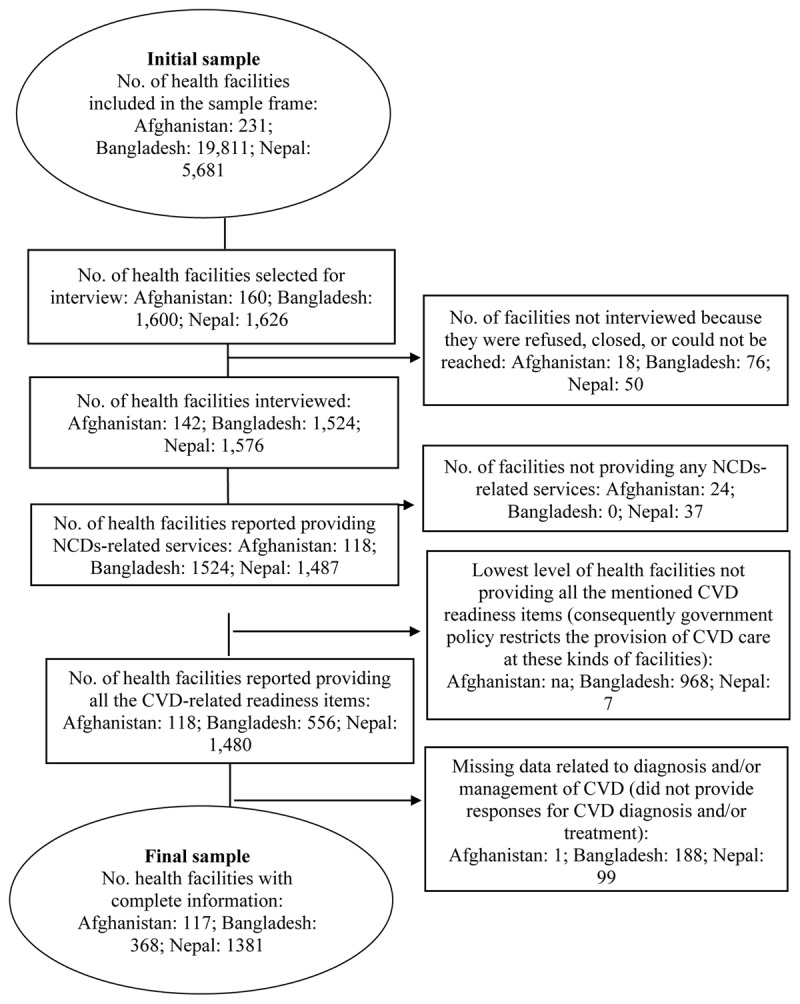
This study employed data from the Afghanistan Service Provision Assessment Survey 2018-2019, Bangladesh Health Facility Survey 2017, and Nepal Health Facility Survey 2021 that were cross-sectional and nationally representative. In Afghanistan, Bangladesh, and Nepal, 117, 368, and 1,381 health facilities, respectively, were examined. A total of 10 items/indicators were used to measure a health facility's readiness to provide CVDs services across three domains.
The mean readiness scores of managing CVDs were 6.7, 5.6, and 4.6 in Afghanistan, Bangladesh, and Nepal, respectively. Availability of trained staff for CVD services are not commonly accessible in Afghanistan (21.5%), Bangladesh (15.3%), or Nepal (12.9%), except from supplies and equipment. Afghanistan has the highest levels of medicine and other commodity availability. Among the common factors linked with readiness scores, we ought to expect a 0.02 unit rise in readiness scores for three nations for every unit increase in number of CVDs care providers. In Afghanistan, Bangladesh, and Nepal, availability of both diagnosis and treatment facilities was associated with increases in readiness scores of 27%, 9%, and 17%, respectively. Additionally, an association was observed between nation-specific facility types and the readiness scores.
Country-specific factors as well as universal factors present in all three nations must be addressed to improve a health facility's readiness to provide CVDs care. To create focused and efficient country-specific plans to raise the standard of CVD care in South Asia, more investigation is necessary to ascertain the reasons behind country-level variations in the availability of tracer items.
在南亚,心血管疾病(CVDs)是一个日益严重的公共卫生问题。应对 CVD 流行的策略之一是使卫生机构更有能力提供 CVD 服务。本研究的目的是:(1)评估医疗保健设施提供 CVD 服务的准备情况;(2)确定影响这种准备情况的变量。
本研究使用了来自 2018-2019 年阿富汗服务提供情况评估调查、2017 年孟加拉国卫生设施调查和 2021 年尼泊尔卫生设施调查的数据,这些数据是横断面和全国代表性的。在阿富汗、孟加拉国和尼泊尔,分别检查了 117、368 和 1381 个卫生设施。使用了 10 个项目/指标来衡量一个卫生设施在三个领域提供 CVD 服务的准备情况。
在阿富汗、孟加拉国和尼泊尔,管理 CVD 的准备情况平均得分分别为 6.7、5.6 和 4.6。阿富汗(21.5%)、孟加拉国(15.3%)或尼泊尔(12.9%)的卫生机构普遍没有提供 CVD 服务的培训人员,除了供应品和设备外。阿富汗的药品和其他商品供应最充足。在与准备情况得分相关的常见因素中,我们应该预计,在三个国家中,每增加一个 CVD 护理提供者,准备情况得分就会提高 0.02 个单位。在阿富汗、孟加拉国和尼泊尔,诊断和治疗设施的可用性分别与准备情况得分的提高 27%、9%和 17%相关。此外,还观察到国家特定设施类型与准备情况得分之间存在关联。
必须解决国家特定因素和所有三个国家共有的普遍因素,以提高卫生机构提供 CVD 护理的准备情况。为了制定有针对性和高效的针对南亚国家的具体计划,以提高 CVD 护理水平,需要进一步调查,以确定 tracer 项目可用性方面的国家层面差异的原因。