
动物暴露模型用于绘制克里米亚-刚果出血热病毒出现风险。
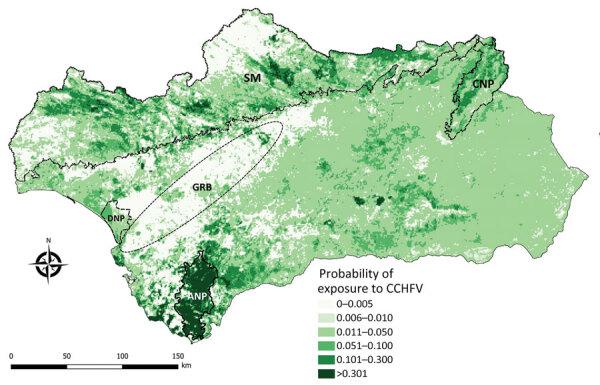
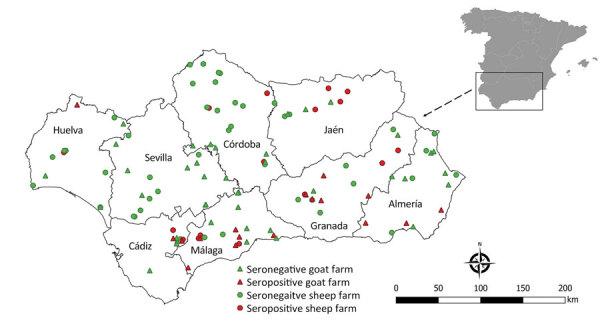
Animal Exposure Model for Mapping Crimean-Congo Hemorrhagic Fever Virus Emergence Risk.
出版信息
Emerg Infect Dis. 2024 Apr;30(4):672-680. doi: 10.3201/eid3004.221604.
To estimate the determinants of spatial variation in Crimean-Congo hemorrhagic fever virus (CCHFV) transmission and to create a risk map as a preventive public health tool, we designed a survey of small domestic ruminants in Andalusia, Spain. To assess CCHFV exposure spatial distribution, we analyzed serum from 2,440 sheep and goats by using a double-antigen ELISA and modeled exposure probability with environmental predictors by using generalized linear mixed models. CCHFV antibodies detected in 84 samples confirmed low CCHFV prevalence in small domestic ruminants in the region. The best-fitted statistical model indicated that the most significant predictors of virus exposure risk were cattle/horse density and the normalized difference vegetation index. Model validation showed 99.7% specificity and 10.2% sensitivity for identifying CCHFV circulation areas. To map CCHFV exposure risk, we projected the model at a 1 × 1-km spatial resolution. Our study provides insight into CCHFV ecology that is useful for preventing virus transmission.
为了评估克里米亚-刚果出血热病毒(CCHFV)传播的空间变异决定因素,并创建风险地图作为预防公共卫生工具,我们在西班牙安达卢西亚设计了一项针对小型家养反刍动物的调查。为了评估 CCHFV 暴露的空间分布,我们使用双抗原 ELISA 分析了 2440 只绵羊和山羊的血清,并使用广义线性混合模型,通过环境预测因子来模拟暴露概率。在 84 个样本中检测到的 CCHFV 抗体证实了该地区小型家养反刍动物中 CCHFV 的低流行率。最佳拟合的统计模型表明,病毒暴露风险的最显著预测因子是牛/马密度和归一化差异植被指数。模型验证表明,用于识别 CCHFV 循环区域的特异性为 99.7%,敏感性为 10.2%。为了绘制 CCHFV 暴露风险图,我们以 1×1km 的空间分辨率对模型进行了预测。我们的研究提供了有关 CCHFV 生态学的见解,这对于预防病毒传播非常有用。

 Zotero 插件