Herbst Charlotte, Bothe Viktoria, Wegler Meret, Axer-Schaefer Susanne, Audebert-Bellanger Séverine, Gecz Jozef, Cogne Benjamin, Feldman Hagit Baris, Horn Anselm H C, Hurst Anna C E, Kelly Melissa A, Kruer Michael C, Kurolap Alina, Laquerriere Annie, Li Megan, Mark Paul R, Morawski Markus, Nizon Mathilde, Pastinen Tomi, Polster Tilman, Saugier-Veber Pascale, SeSong Jang, Sticht Heinrich, Stieler Jens T, Thifffault Isabelle, van Eyk Clare L, Marcorelles Pascale, Vezain-Mouchard Myriam, Abou Jamra Rami, Oppermann Henry
Institute of Human Genetics, University of Leipzig Medical Center, 04103, Leipzig, Germany.
Department of Epileptology, Krankenhaus Mara Bethel Epilepsy Center Medical School OWL, Bielefeld University, Campus Bethel, Bielefeld, Germany.
Hum Genet. 2024 Mar;143(3):455-469. doi: 10.1007/s00439-024-02655-4. Epub 2024 Mar 25.
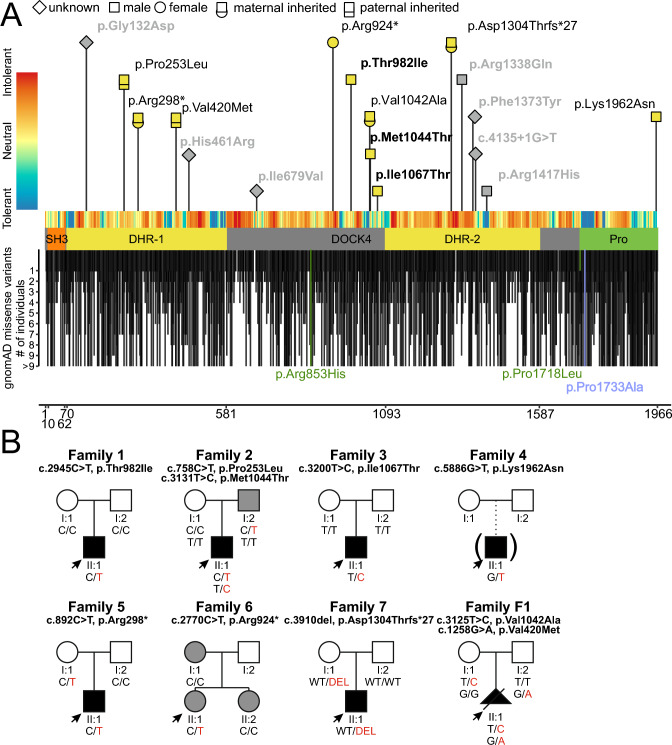
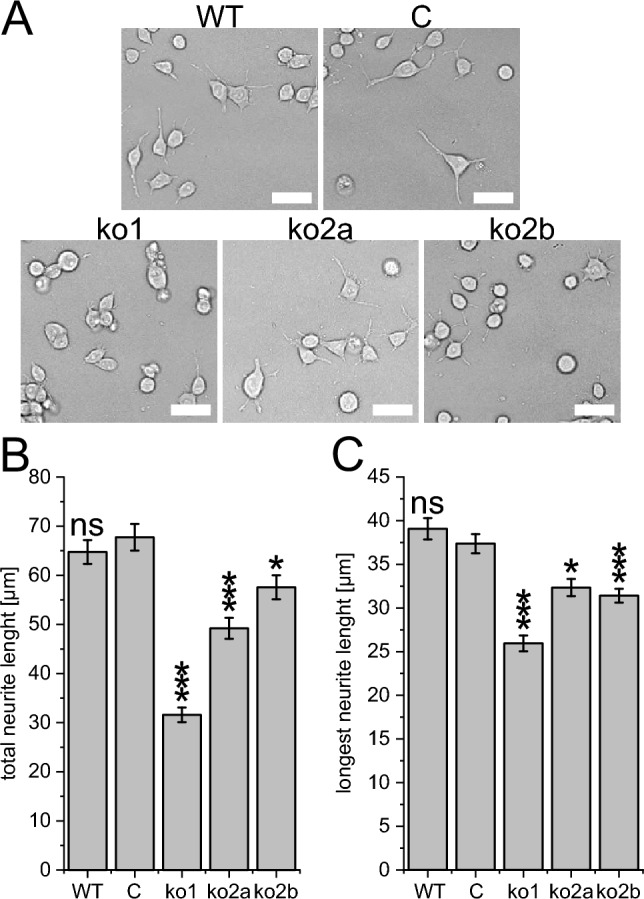
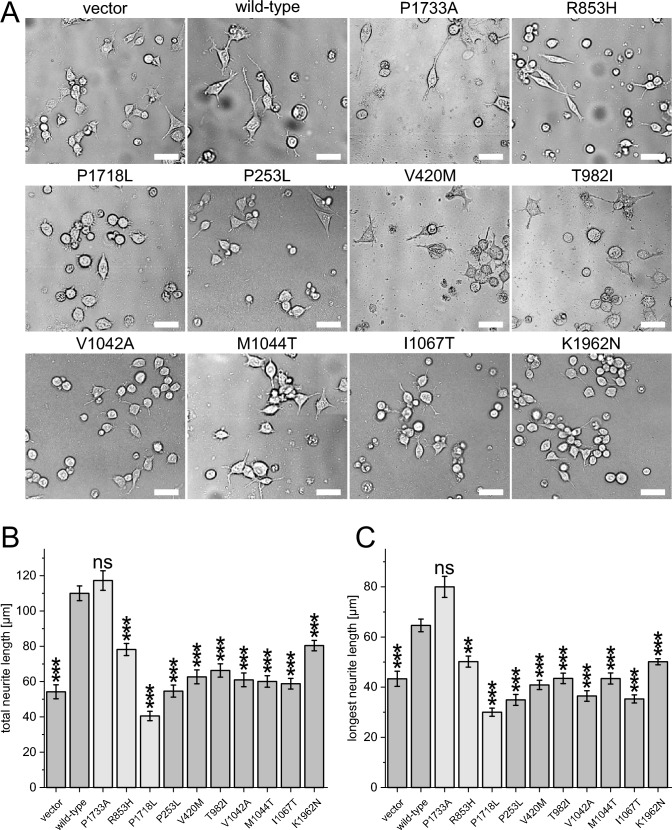
Neurons form the basic anatomical and functional structure of the nervous system, and defects in neuronal differentiation or formation of neurites are associated with various psychiatric and neurodevelopmental disorders. Dynamic changes in the cytoskeleton are essential for this process, which is, inter alia, controlled by the dedicator of cytokinesis 4 (DOCK4) through the activation of RAC1. Here, we clinically describe 7 individuals (6 males and one female) with variants in DOCK4 and overlapping phenotype of mild to severe global developmental delay. Additional symptoms include coordination or gait abnormalities, microcephaly, nonspecific brain malformations, hypotonia and seizures. Four individuals carry missense variants (three of them detected de novo) and three individuals carry null variants (two of them maternally inherited). Molecular modeling of the heterozygous missense variants suggests that the majority of them affect the globular structure of DOCK4. In vitro functional expression studies in transfected Neuro-2A cells showed that all missense variants impaired neurite outgrowth. Furthermore, Dock4 knockout Neuro-2A cells also exhibited defects in promoting neurite outgrowth. Our results, including clinical, molecular and functional data, suggest that loss-of-function variants in DOCK4 probable cause a variable spectrum of a novel neurodevelopmental disorder with microcephaly.
神经元构成了神经系统的基本解剖和功能结构,神经元分化或神经突形成的缺陷与各种精神疾病和神经发育障碍有关。细胞骨架的动态变化对于这一过程至关重要,这一过程尤其由胞质分裂 dedicator 4(DOCK4)通过激活RAC1来控制。在此,我们临床描述了7名个体(6名男性和1名女性),他们携带DOCK4变体且具有从轻度到重度的全球发育迟缓的重叠表型。其他症状包括协调或步态异常、小头畸形、非特异性脑畸形、肌张力减退和癫痫发作。4名个体携带错义变体(其中3个是新发检测到的),3名个体携带无效变体(其中2个是母系遗传的)。杂合错义变体的分子建模表明,它们中的大多数影响DOCK4的球状结构。在转染的Neuro-2A细胞中进行的体外功能表达研究表明,所有错义变体均损害神经突生长。此外,Dock4基因敲除的Neuro-2A细胞在促进神经突生长方面也表现出缺陷。我们的结果,包括临床、分子和功能数据,表明DOCK4功能丧失变体可能导致一种以小头畸形为特征的新型神经发育障碍的可变谱系。