Swain Chandan Kumar, Rout Himanshu Sekhar, Jakovljevic Mihajlo
Department of Analytical & Applied Economics, Utkal University, Vani Vihar, Bhubaneswar, Odisha, 751 004, India.
Department of Analytical and Applied Economics & RUSA Centre of Excellence in Public Policy and Governance, Utkal University, Vani Vihar, Bhubaneswar, Odisha, 751 004, India.
Int J Gen Med. 2024 Mar 21;17:1101-1116. doi: 10.2147/IJGM.S449364. eCollection 2024.
The lack of focus on the health status of shrimp cultivators by previous studies while the production of shrimp has been rising over the years after the introduction of the blue revolution in India. The present study estimated the burden of diseases among shrimp cultivators in India.
Primary data were collected by using simple random sampling. The sample size was 357. The classification of diseases were made by using the international classification of diseases, tenth revision (ICD-10), version 2019. Disability-adjusted life years (DALY) were used to measure the health status of shrimp cultivators. DALY is the summation of the burden of disease from mortality and morbidity. Sensitive and uncertainty analysis was used by changing the value of the parameter and method, respectively.
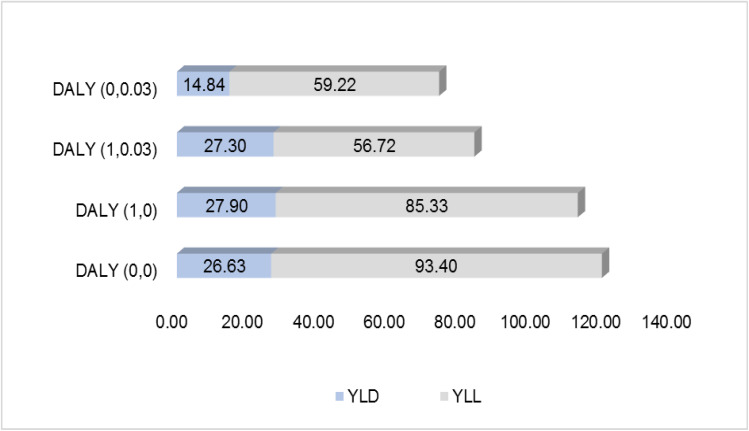
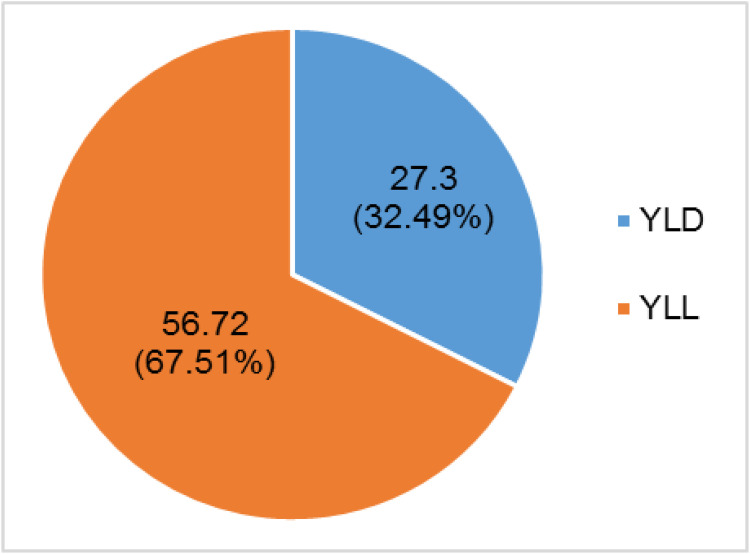
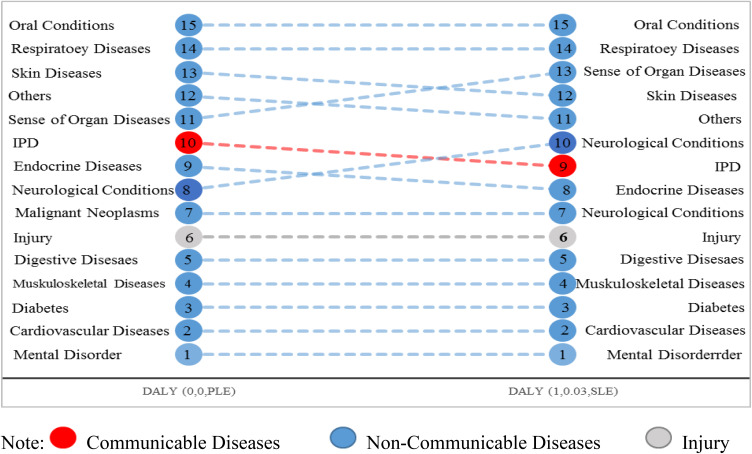
The burden of disease among shrimp cultivators in 2020 ranges from 101.03 DALY based on equal age weightage, without discount rate, and potential life expectancy (DALY) to 84.02 DALY based on unequal age weightage, discount rate, and standardized life expectancy (DALY). The burden of disease per 100,000 shrimp cultivators was 28,477.74 DALY and 23,600.84 DALY when calculated by using DALY and DALY method, respectively. The higher burden of diseases from non-communicable diseases was followed by injury and communicable diseases for both methods. The disease burden from mortality was more than two-thirds of the total burden of disease and the rest from morbidity. The burden of disease among shrimp cultivators was sensitive to parameter changes because it changes between 92.10 DALY and 63.03 DALY with the change in the parameter. Uncertainty in the burden of disease among them was due to method variation, which ranges from 120.03 DALY to 74.06 DALY.
The higher burden of non-communicable diseases, and the lower burden of communicable, and injuries per 100,000 shrimp cultivators compared to the national level in India.
在印度引入蓝色革命后的数年里,虾产量一直在增长,但以往的研究却未关注虾养殖者的健康状况。本研究估算了印度虾养殖者的疾病负担。
采用简单随机抽样收集原始数据。样本量为357。疾病分类依据国际疾病分类第十版(ICD - 10),2019年版。伤残调整生命年(DALY)用于衡量虾养殖者们健康状况。DALY是疾病死亡率和发病率负担的总和。分别通过改变参数值和方法进行敏感性和不确定性分析。
2020年虾养殖者的疾病负担范围从基于相等年龄权重、无贴现率和潜在预期寿命计算的101.03伤残调整生命年(DALY)到基于不等年龄权重、贴现率和标准化预期寿命计算的84.02伤残调整生命年(DALY)。按DALY和DALY方法计算时,每10万名虾养殖者的疾病负担分别为28477.74 DALY和23600.84 DALY。两种方法中,非传染性疾病导致的疾病负担较高,其次是伤害和传染病。死亡导致的疾病负担超过疾病总负担的三分之二,其余来自发病率。虾养殖者的疾病负担对参数变化敏感,因为随着参数变化,负担在92.10 DALY和63.03 DALY之间变动。他们疾病负担的不确定性源于方法差异,范围在120.03 DALY至74.06 DALY之间。
与印度全国水平相比,每10万名虾养殖者中非传染性疾病负担较高,而传染病和伤害负担较低。