Mariotti Federica, Castagnini Francesco, De Paolis Massimiliano, Montalti Maurizio, Diquattro Emanuele, Cosentino Monica, Bordini Barbara, Traina Francesco
Ortopedia-Traumatologia e Chirurgia Protesica e dei reimpianti di Anca e di Ginocchio, IRCCS Istituto Ortopedico Rizzoli, Bologna, Italy.
Ortopedia e traumatologia, IRCCS Azienda Ospedaliera Universitaria di Bologna, Bologna, Italy.
Ann Jt. 2023 Mar 29;8:14. doi: 10.21037/aoj-22-45. eCollection 2023.
The correct management and treatment of pseudotumors due to metal-on-metal (MOM) hip arthroplasty are still debated. The purpose of this study is to analyze the surgical treatment and the clinical and radiographic 3-year outcomes of MOM arthroplasty revisions due to pseudotumor treated with a strategy of excision and revision.
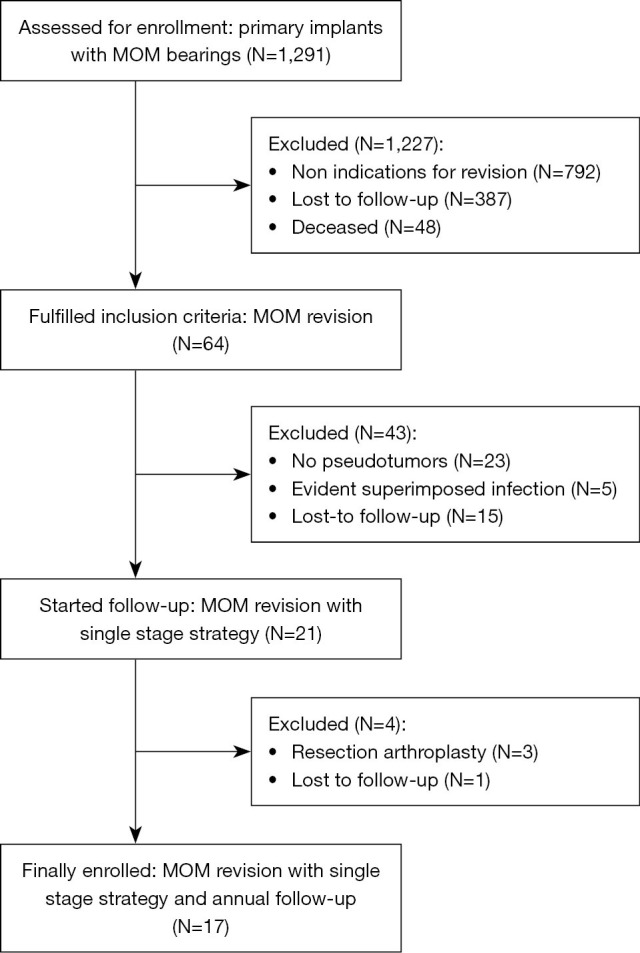
Consecutive, retrospective series of 21 patients (8 males/13 females) with pseudotumor due to MOM hip arthroplasty was surgically treated at a single tertiary center. Demographic, clinical, radiological and implant-related features were collected pre-operatively. Post-revision clinical and radiographic parameters were evaluated. Chromium (Cr) and cobalt (Co) blood samples were collected before and after surgery.
Three patients (14.2%) with pseudotumor underwent a resection arthroplasty due to infection (perioperative finding) and could not be reimplanted due to septic relapses. Twenty (95.2%) pseudotumors were completely resected. Revisions [2 total hip reimplantations (11.1%) and 16 isolated component revisions (88.9%)] were performed with non-MOM couplings. A clinical improvement at a mean post-revision follow-up 3.3 years [standard deviation (SD), ±2.2 years] was observed, from 50.3 (SD, ±4.6) to 88.3 (SD, ±9.2) Harris hip score (HHS) points (P<0.001). Among revisions, there were 5 complications (23.8%): 1 dislocation, 1 psoas impingement, and 3 infections (14.2%). No re-revision was carried out. Three (14.2%) pseudotumors recurred: 1 was surgically treated, 1 was treated with selective arterial embolization, and 1 clinically followed. At the final follow-up, Cr and Co blood ions beyond the threshold decreased from 85.7% cases to 0% in the seven patients that could be evaluated.
The one-stage strategy of radical excision and revision with non-MOM couplings in pseudotumors due to MOM hip arthroplasty achieved good 3-year outcomes. However, complications were frequent (23%). Recurrences were not rare (14%) and did not require implant re-revision.
金属对金属(MOM)髋关节置换术后假瘤的正确管理和治疗仍存在争议。本研究的目的是分析采用切除和翻修策略治疗因假瘤而行MOM关节置换翻修术的手术治疗方法以及临床和影像学3年随访结果。
在一家三级中心对21例(8例男性/13例女性)因MOM髋关节置换导致假瘤的患者进行了连续的回顾性系列手术治疗。术前收集人口统计学、临床、放射学和植入物相关特征。评估翻修术后的临床和影像学参数。术前和术后采集铬(Cr)和钴(Co)血样。
3例(14.2%)因感染(围手术期发现)出现假瘤的患者接受了切除关节成形术,因败血症复发无法再次植入。20例(95.2%)假瘤被完全切除。采用非MOM连接件进行翻修[2例全髋关节再植入(11.1%)和16例单独部件翻修(88.9%)]。翻修术后平均3.3年[标准差(SD),±2.2年]的随访观察到临床改善,Harris髋关节评分(HHS)从50.3(SD,±4.6)分提高到88.3(SD,±9.2)分(P<0.001)。在翻修病例中,有5例并发症(23.8%):1例脱位、1例腰大肌撞击和3例感染(14.2%)。未进行再次翻修。3例(14.2%)假瘤复发:1例接受手术治疗,1例接受选择性动脉栓塞治疗,1例进行临床随访。在最后随访时,7例可评估患者中,超过阈值的Cr和Co血离子病例从85.7%降至0%。
对于MOM髋关节置换术后假瘤,采用非MOM连接件进行一期根治性切除和翻修的策略取得了良好的3年随访结果。然而,并发症很常见(23%)。复发并不罕见(14%),且不需要再次植入翻修。