Funk Anna, Florin Todd A, Kuppermann Nathan, Finkelstein Yaron, Kazakoff Alissa, Baldovsky Michael, Tancredi Daniel J, Breslin Kristen, Bergmann Kelly R, Gardiner Michael, Pruitt Christopher M, Liu Deborah R, Neuman Mark I, Wilkinson Matthew, Ambroggio Lilliam, Pang Xiao-Li, Cauchemez Simon, Malley Richard, Klassen Terry P, Lee Bonita E, Payne Daniel C, Mahmud Salaheddin M, Freedman Stephen B
Department of Obstetrics and Gynecology, Cumming School of Medicine, University of Calgary, Calgary, Alberta, Canada.
Department of Pediatrics, Feinberg School of Medicine, Northwestern University, Chicago, Illinois, USA.
Clin Infect Dis. 2024 Jun 14;78(6):1522-1530. doi: 10.1093/cid/ciae069.
Asymptomatic SARS-CoV-2 infection in children is highly prevalent but its acute and chronic implications have been minimally described.
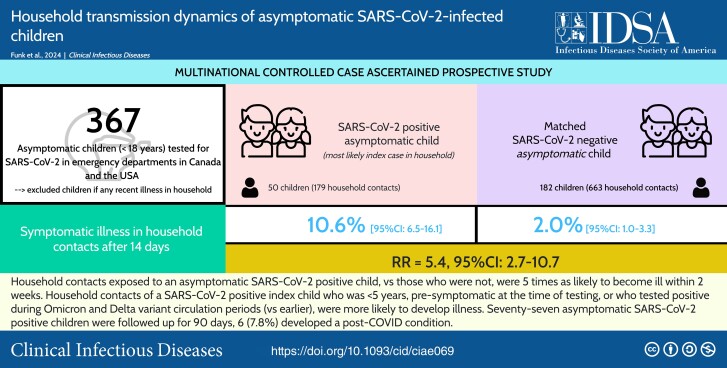
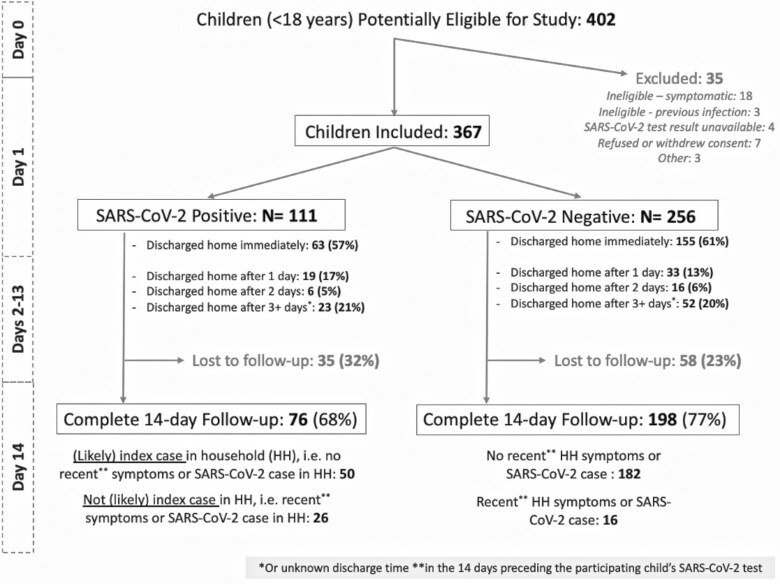
In this controlled case-ascertained household transmission study, we recruited asymptomatic children <18 years with SARS-CoV-2 nucleic acid testing performed at 12 tertiary care pediatric institutions in Canada and the United States. We attempted to recruit all test-positive children and 1 to 3 test-negative, site-matched controls. After 14 days' follow-up we assessed the clinical (ie, symptomatic) and combined (ie, test-positive, or symptomatic) secondary attack rates (SARs) among household contacts. Additionally, post-COVID-19 condition (PCC) was assessed in SARS-CoV-2-positive participating children after 90 days' follow-up.
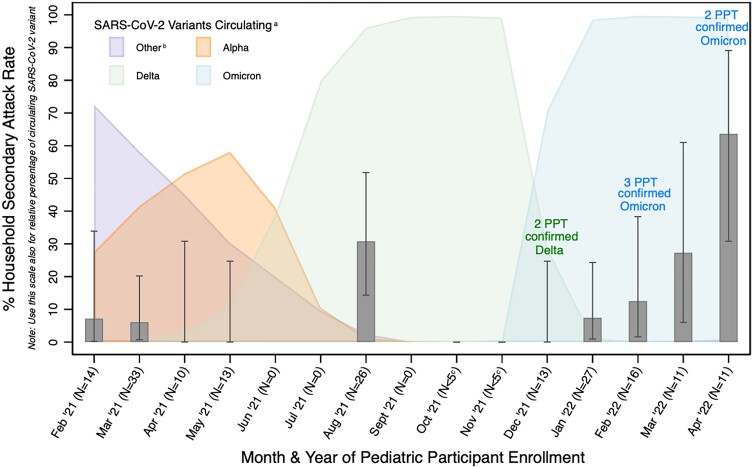
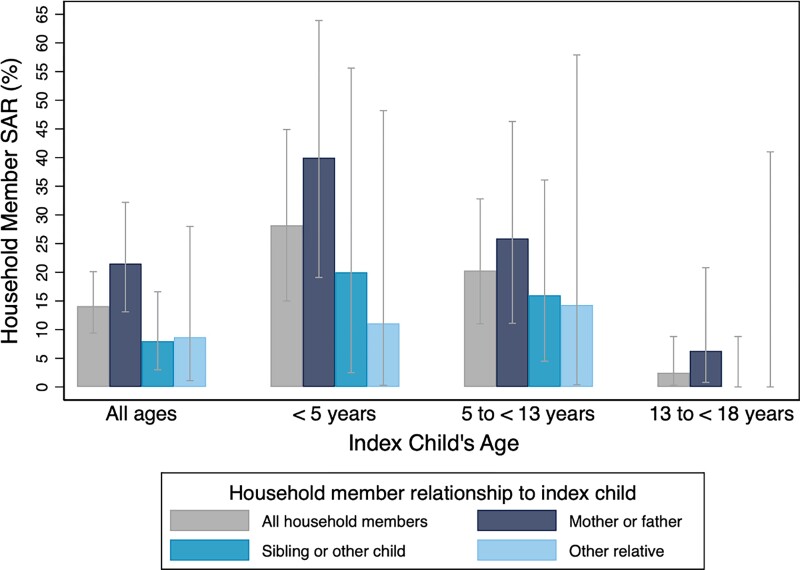
A total of 111 test-positive and 256 SARS-CoV-2 test-negative asymptomatic children were enrolled between January 2021 and April 2022. After 14 days, excluding households with co-primary cases, the clinical SAR among household contacts of SARS-CoV-2-positive and -negative index children was 10.6% (19/179; 95% CI: 6.5%-16.1%) and 2.0% (13/663; 95% CI: 1.0%-3.3%), respectively (relative risk = 5.4; 95% CI: 2.7-10.7). In households with a SARS-CoV-2-positive index child, age <5 years, being pre-symptomatic (ie, developed symptoms after test), and testing positive during Omicron and Delta circulation periods (vs earlier) were associated with increased clinical and combined SARs among household contacts. Among 77 asymptomatic SARS-CoV-2-infected children with 90-day follow-up, 6 (7.8%; 95% CI: 2.9%-16.2%) reported PCC.
Asymptomatic SARS-CoV-2-infected children, especially those <5 years, are important contributors to household transmission, with 1 in 10 exposed household contacts developing symptomatic illness within 14 days. Asymptomatic SARS-CoV-2-infected children may develop PCC.
儿童无症状性严重急性呼吸综合征冠状病毒2(SARS-CoV-2)感染非常普遍,但其急性和慢性影响鲜有描述。
在这项病例对照的家庭传播研究中,我们招募了加拿大和美国12家三级医疗儿科机构中18岁以下的无症状儿童,并对其进行SARS-CoV-2核酸检测。我们试图招募所有检测呈阳性的儿童以及1至3名检测呈阴性且与检测阳性儿童来自同一地点的对照儿童。经过14天的随访,我们评估了家庭接触者中的临床(即出现症状)和综合(即检测呈阳性或出现症状)二代发病率(SARs)。此外,在对SARS-CoV-2检测呈阳性的参与研究儿童进行90天随访后,评估了新冠后状况(PCC)。
2021年1月至2022年4月期间,共招募了111名检测呈阳性和256名SARS-CoV-2检测呈阴性的无症状儿童。14天后,排除有共同原发病例的家庭,SARS-CoV-2检测呈阳性和阴性的索引儿童家庭接触者中的临床二代发病率分别为10.6%(19/179;95%置信区间:6.5%-16.1%)和2.0%(13/663;95%置信区间:1.0%-3.3%)(相对风险=5.4;95%置信区间:2.7-10.7)。在有SARS-CoV-2检测呈阳性索引儿童的家庭中,年龄<5岁、处于症状前驱期(即检测后出现症状)以及在奥密克戎和德尔塔流行期间(与早期相比)检测呈阳性,与家庭接触者中临床和综合二代发病率增加相关。在77名接受90天随访的无症状SARS-CoV-2感染儿童中,6名(7.8%;95%置信区间:2.9%-16.2%)报告了新冠后状况。
无症状SARS-CoV-2感染儿童,尤其是5岁以下儿童,是家庭传播的重要促成因素,每10名暴露的家庭接触者中有1人在14天内出现症状性疾病。无症状SARS-CoV-2感染儿童可能会出现新冠后状况。