Department of Genetics, Stanford University, Stanford, California 94305, USA
AIRNA Corporation, Cambridge, Massachusetts 02142, USA.
RNA. 2024 Apr 16;30(5):500-511. doi: 10.1261/rna.079953.124.
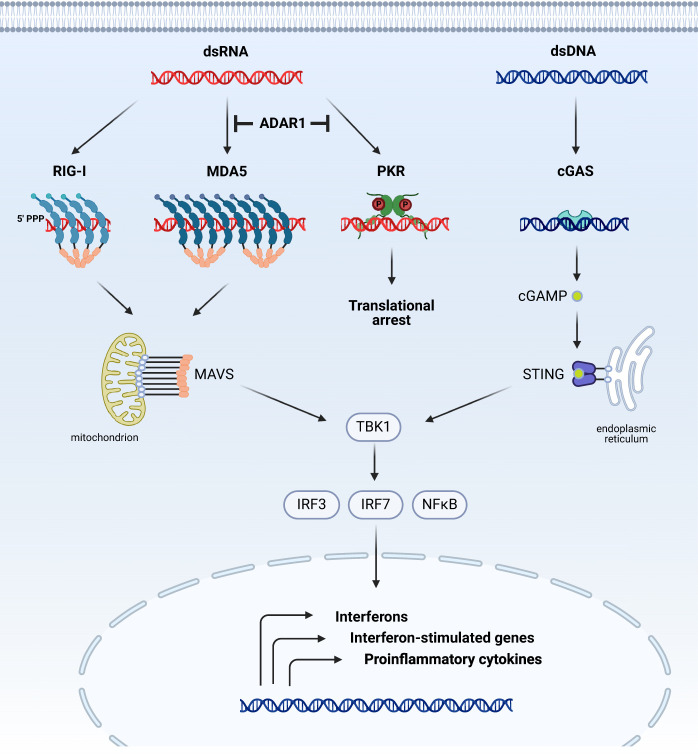
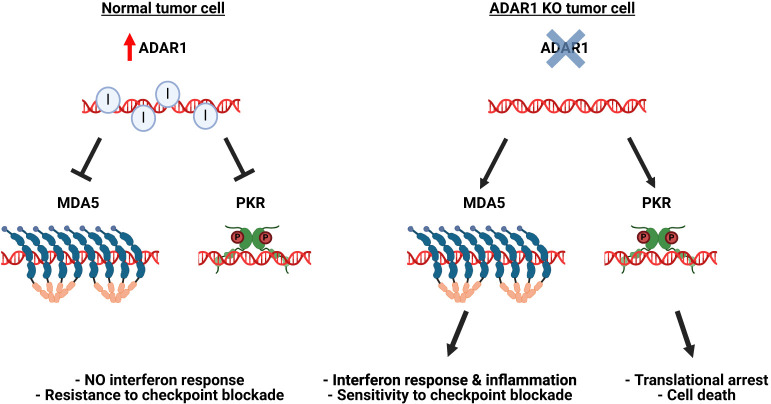
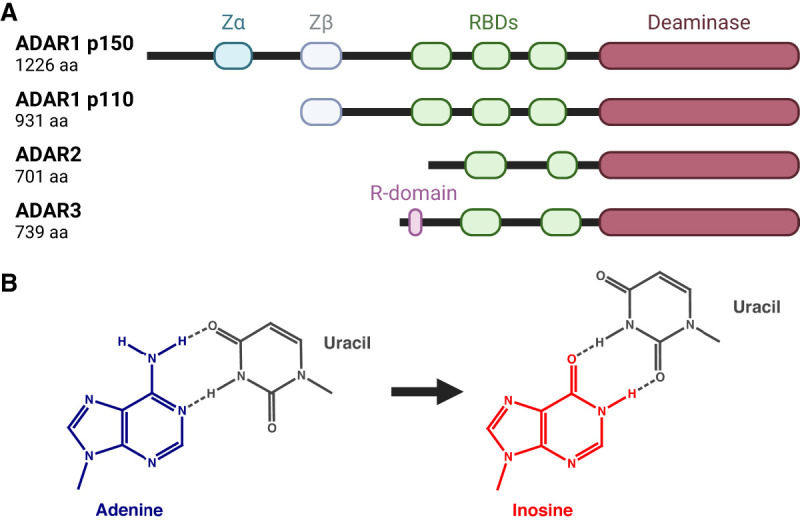
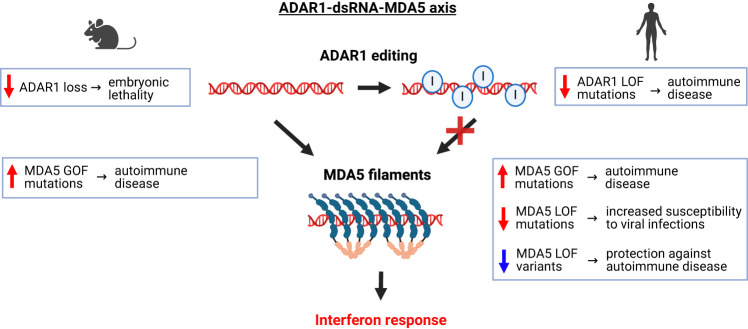
Innate immunity must be tightly regulated to enable sensitive pathogen detection while averting autoimmunity triggered by pathogen-like host molecules. A hallmark of viral infection, double-stranded RNAs (dsRNAs) are also abundantly encoded in mammalian genomes, necessitating surveillance mechanisms to distinguish "self" from "nonself." ADAR1, an RNA editing enzyme, has emerged as an essential safeguard against dsRNA-induced autoimmunity. By converting adenosines to inosines (A-to-I) in long dsRNAs, ADAR1 covalently marks endogenous dsRNAs, thereby blocking the activation of the cytoplasmic dsRNA sensor MDA5. Moreover, beyond its editing function, ADAR1 binding to dsRNA impedes the activation of innate immune sensors PKR and ZBP1. Recent landmark studies underscore the utility of silencing ADAR1 for cancer immunotherapy, by exploiting the ADAR1-dependence developed by certain tumors to unleash an antitumor immune response. In this perspective, we summarize the genetic and mechanistic evidence for ADAR1's multipronged role in suppressing dsRNA-mediated autoimmunity and explore the evolving roles of ADAR1 as an immuno-oncology target.
先天免疫必须受到严格的调控,以实现对病原体的敏感检测,同时避免由病原体样宿主分子引发的自身免疫。双链 RNA(dsRNA)是病毒感染的一个标志特征,也大量存在于哺乳动物基因组中,这就需要有监控机制来区分“自我”和“非自我”。RNA 编辑酶 ADAR1 的出现,成为了抵御 dsRNA 诱导的自身免疫的重要保障。ADAR1 通过将长 dsRNA 中的腺苷转换为肌苷(A-to-I),使内源性 dsRNA 发生共价修饰,从而阻断细胞质 dsRNA 传感器 MDA5 的激活。此外,ADAR1 与 dsRNA 的结合作用不仅抑制了先天免疫传感器 PKR 和 ZBP1 的激活,还能阻碍它们的激活。最近的重要研究强调了沉默 ADAR1 在癌症免疫治疗中的应用潜力,通过利用某些肿瘤发展出的 ADAR1 依赖性,引发抗肿瘤免疫反应。在本观点中,我们总结了 ADAR1 在抑制 dsRNA 介导的自身免疫方面的多效性的遗传和机制证据,并探讨了 ADAR1 作为免疫肿瘤学靶点的不断发展的作用。