
慢性炎症与认知衰退的生物标志物:一项前瞻性观察研究。
Biomarkers of chronic inflammation and cognitive decline: A prospective observational study.
作者信息
Guduguntla Bhavna A, Vasbinder Alexi, Anderson Elizabeth, Azam Tariq U, Blakely Pennelope, Webster Noah J, Gonzalez Richard, Atonucci Toni, Heidebrink Judith L, Giordani Bruno, Zahodne Laura, Hampstead Benjamin M, Ajrouch Kristine J, Hayek Salim S
机构信息
University of Michigan Medical School Ann Arbor Michigan USA.
Division of Cardiology Department of Internal Medicine University of Michigan Ann Arbor Michigan USA.
出版信息
Alzheimers Dement (Amst). 2024 Mar 26;16(1):e12568. doi: 10.1002/dad2.12568. eCollection 2024 Jan-Mar.
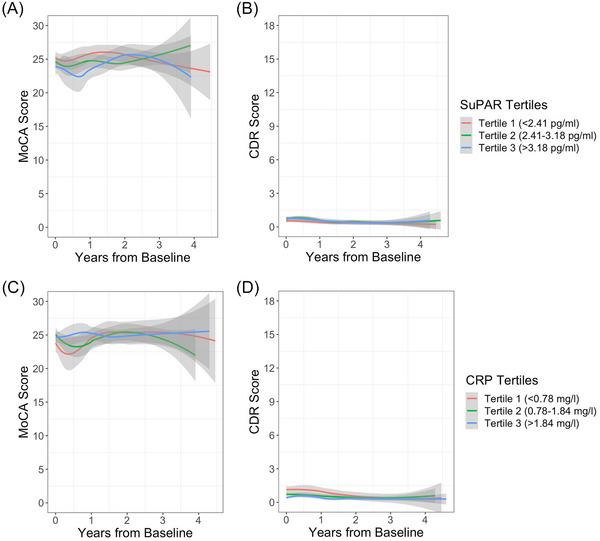
We sought to determine whether the biomarkers of chronic inflammation predict cognitive decline in a prospective observational study. We measured baseline serum soluble urokinase plasminogen activator receptor (suPAR) and high sensitivity C-reactive protein (hs-CRP) levels in 282 participants of the University of Michigan Memory and Aging Project. Cognitive function was measured using the Montreal Cognitive Assessment (MoCA) and the Clinical Dementia Rating (CDR) scale for up to five time points. SuPAR and hs-CRP levels were not significantly higher in participants with mild cognitive impairment ( = 97) or dementia ( = 59), compared to those with normal cognitive function ( = 126). Overall, 14% of participants experienced significant cognitive decline over the study period. The change in MoCA or CDR scores over time did not differ significantly according to baseline suPAR or hs-CRP levels. Chronic systemic inflammation, as measured by serum suPAR or hs-CRP levels, is unlikely to contribute significantly to cognitive decline.
在一项前瞻性观察性研究中,我们试图确定慢性炎症的生物标志物是否能预测认知能力下降。我们测量了密歇根大学记忆与衰老项目282名参与者的基线血清可溶性尿激酶型纤溶酶原激活物受体(suPAR)和高敏C反应蛋白(hs-CRP)水平。使用蒙特利尔认知评估量表(MoCA)和临床痴呆评定量表(CDR)对认知功能进行了多达五个时间点的测量。与认知功能正常的参与者(n = 126)相比,轻度认知障碍参与者(n = 97)或痴呆患者(n = 59)的suPAR和hs-CRP水平并无显著升高。总体而言,14%的参与者在研究期间出现了显著的认知能力下降。根据基线suPAR或hs-CRP水平,MoCA或CDR分数随时间的变化并无显著差异。通过血清suPAR或hs-CRP水平测量的慢性全身性炎症不太可能对认知能力下降有显著影响。

 Zotero 插件