Seppänen Sanna, Vuorenmaa Kukka, Suominen Auli, Ogawa Mika, Pohjola Vesa, Rantavuori Kari, Karlsson Hasse, Karlsson Linnea, Lahti Satu
Department of Community Dentistry, University of Turku, 20014 Turku, Finland.
FinnBrain Birth Cohort Study, Department of Clinical Medicine, Turku Brain and Mind Center, University of Turku, 20014 Turku, Finland.
Dent J (Basel). 2024 Feb 27;12(3):53. doi: 10.3390/dj12030053.
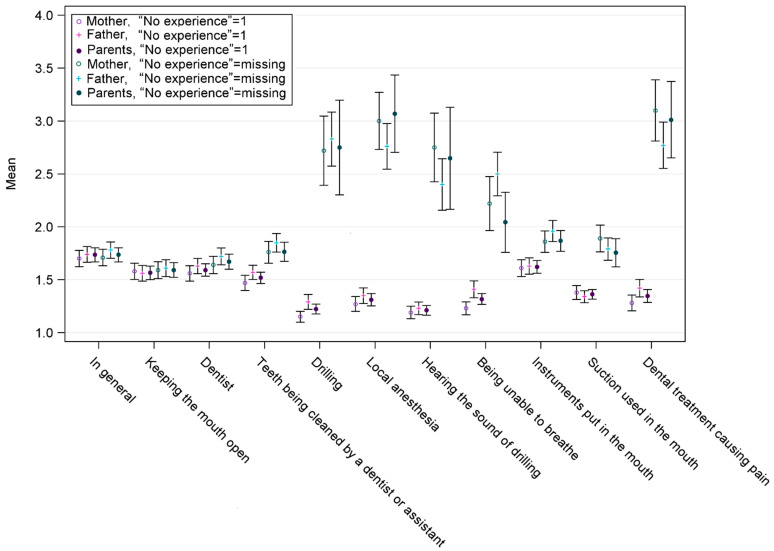
The aim of this study was to evaluate the concordance of parents' assessments of their child's dental fear. Cross-sectional secondary analysis used data from the multidisciplinary FinnBrain Birth Cohort Study. Child dental fear was assessed at age 5 with the Finnish translation of the modified Children's Fear Survey Schedule Dental Subscale (CFSS-M) by both fathers (n = 588) and mothers (n = 1100). Reply alternatives were from 1 = not afraid to 5 = very afraid and 6 = no experience coded as missing and 1. In total, 514 mother-father pairs were eligible for the analyses. Descriptive statistics, percentage agreement and Cohen's Kappa coefficients were used in the analyses. The concordance of parents' assessments was poor (Kappa range 0.072-0.258). The majority of parents replied "No Experience" to items related to invasive treatment or being unable to breathe. Thus, coding of this reply alternative had a significant impact on the mean values of the child's fear. When assessing the fear of a five-year-old child, it might not be safe to rely only on one parent's assessment, and whether or not the child has experience with the question asked should also be considered.
本研究的目的是评估父母对其孩子牙科恐惧评估的一致性。横断面二次分析使用了多学科芬兰大脑出生队列研究的数据。通过改良儿童恐惧调查量表牙科分量表(CFSS-M)的芬兰语翻译版本,在孩子5岁时对其牙科恐惧进行评估,父亲(n = 588)和母亲(n = 1100)均参与评估。回答选项从1 = 不害怕到5 = 非常害怕,6 = 无经历编码为缺失值和1。总共514对父母符合分析条件。分析中使用了描述性统计、百分比一致性和科恩kappa系数。父母评估的一致性较差(kappa范围为0.072 - 0.258)。大多数父母对与侵入性治疗或无法呼吸相关的项目回答“无经历”。因此,该回答选项的编码对孩子恐惧的平均值有显著影响。在评估五岁孩子的恐惧时,仅依靠一方父母的评估可能不安全,还应考虑孩子是否有与所问问题相关的经历。