Department of Biochemistry & Structural Biology, Long School of Medicine, University of Texas Health Science Center at San Antonio, San Antonio, TX 78229, USA.
Mays Cancer Center, University of Texas Health Science Center at San Antonio, San Antonio, TX 78229, USA.
Cells. 2024 Mar 17;13(6):528. doi: 10.3390/cells13060528.
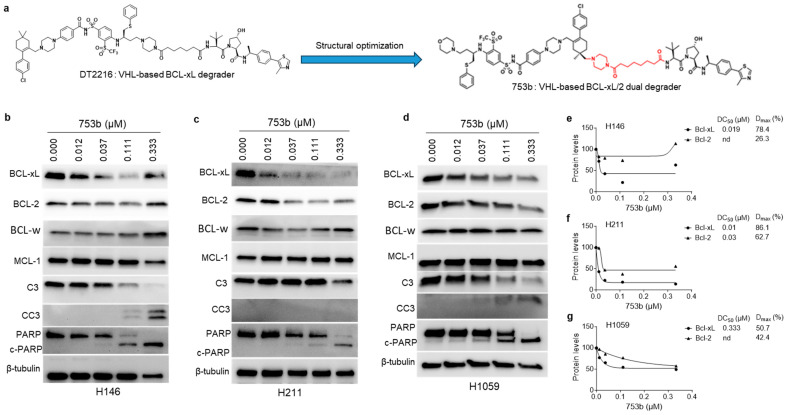
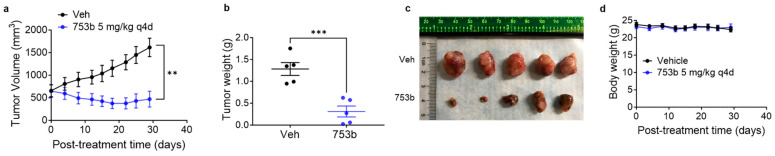
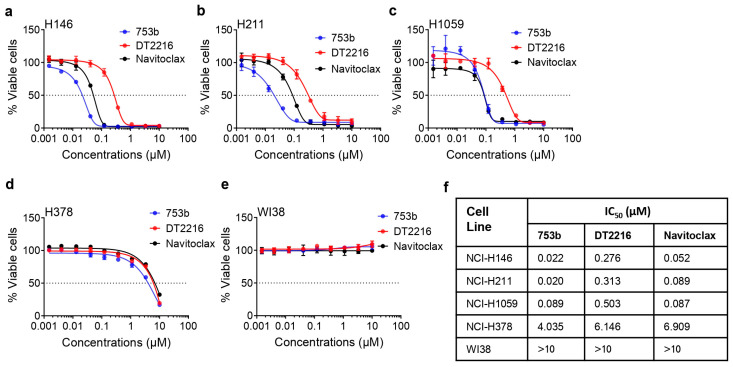
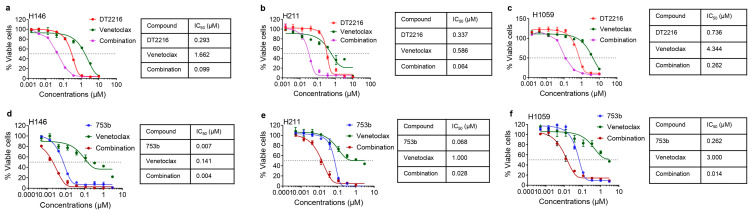
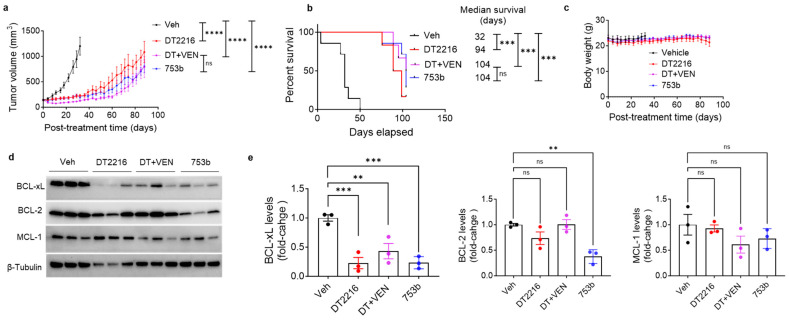
BCL-xL and BCL-2 are validated therapeutic targets in small-cell lung cancer (SCLC). Targeting these proteins with navitoclax (formerly ABT263, a dual BCL-xL/2 inhibitor) induces dose-limiting thrombocytopenia through on-target BCL-xL inhibition in platelets. Therefore, platelet toxicity poses a barrier in advancing the clinical translation of navitoclax. We have developed a strategy to selectively target BCL-xL in tumors, while sparing platelets, by utilizing proteolysis-targeting chimeras (PROTACs) that hijack the cellular ubiquitin proteasome system for target ubiquitination and subsequent degradation. In our previous study, the first-in-class BCL-xL PROTAC, called DT2216, was shown to have synergistic antitumor activities when combined with venetoclax (formerly ABT199, BCL-2-selective inhibitor) in a BCL-xL/2 co-dependent SCLC cell line, NCI-H146 (hereafter referred to as H146), in vitro and in a xenograft model. Guided by these findings, we evaluated our newly developed BCL-xL/2 dual degrader, called 753b, in three BCL-xL/2 co-dependent SCLC cell lines and the H146 xenograft models. 753b was found to degrade both BCL-xL and BCL-2 in these cell lines. Importantly, it was considerably more potent than DT2216, navitoclax, or DT2216 + venetoclax in reducing the viability of BCL-xL/2 co-dependent SCLC cell lines in cell culture. In vivo, 5 mg/kg weekly dosing of 753b was found to lead to significant tumor growth delay, similar to the DT2216 + venetoclax combination in H146 xenografts, by degrading both BCL-xL and BCL-2. Additionally, 753b administration at 5 mg/kg every four days induced tumor regressions. At this dosage, 753b was well tolerated in mice, without observable induction of severe thrombocytopenia as seen with navitoclax, and no evidence of significant changes in mouse body weights. These results suggest that the BCL-xL/2 dual degrader could be an effective and safe therapeutic for a subset of SCLC patients, warranting clinical trials in future.
BCL-xL 和 BCL-2 是小细胞肺癌(SCLC)的经过验证的治疗靶点。使用 navitoclax(以前称为 ABT263,一种双重 BCL-xL/2 抑制剂)靶向这些蛋白会通过抑制血小板中的靶标 BCL-xL 导致剂量限制的血小板减少症。因此,血小板毒性是推进 navitoclax 临床转化的一个障碍。我们已经开发了一种策略,通过利用蛋白水解靶向嵌合体(PROTAC)选择性地靶向肿瘤中的 BCL-xL,同时保留血小板,PROTAC 会劫持细胞内的泛素蛋白酶体系统,对靶标进行泛素化和随后的降解。在我们之前的研究中,第一种 BCL-xL PROTAC,称为 DT2216,在体外和异种移植模型中,当与 venetoclax(以前称为 ABT199,BCL-2 选择性抑制剂)联合用于 BCL-xL/2 共依赖性 SCLC 细胞系 NCI-H146(此后称为 H146)时,表现出协同的抗肿瘤活性。基于这些发现,我们在三种 BCL-xL/2 共依赖性 SCLC 细胞系和 H146 异种移植模型中评估了我们新开发的 BCL-xL/2 双降解剂 753b。在这些细胞系中,753b 被发现可降解 BCL-xL 和 BCL-2。重要的是,它在降低 BCL-xL/2 共依赖性 SCLC 细胞系的活力方面比 DT2216、navitoclax 或 DT2216+venetoclax 更为有效。在体内,每周一次 5mg/kg 的 753b 剂量导致肿瘤生长显著延迟,与 H146 异种移植中的 DT2216+venetoclax 组合相似,通过降解 BCL-xL 和 BCL-2。此外,753b 以 5mg/kg 每四天一次的剂量给药可诱导肿瘤消退。在该剂量下,753b 在小鼠中耐受性良好,未观察到 navitoclax 引起的严重血小板减少症,小鼠体重也没有明显变化。这些结果表明,BCL-xL/2 双降解剂可能是 SCLC 患者亚群的一种有效且安全的治疗方法,值得在未来进行临床试验。