School of Computing Technologies, RMIT University, Melbourne, Australia.
School of Health, Medical and Applied Sciences, Central Queensland University, Queensland, Australia.
J Occup Rehabil. 2024 Dec;34(4):770-782. doi: 10.1007/s10926-024-10175-1. Epub 2024 Mar 27.
Through electronic health records (EHRs), musculoskeletal (MSK) therapists such as chiropractors and physical therapists, as well as occupational medicine physicians could collect data on many variables that can be traditionally challenging to collect in managing work-related musculoskeletal disorders (WMSDs). The review's objectives were to explore the extent of research using EHRs in predicting outcomes of WMSDs by MSK therapists.
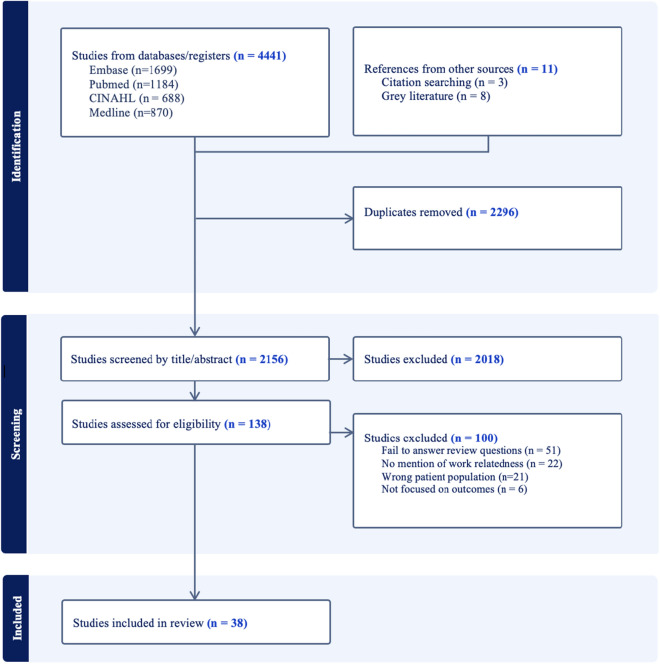
A systematic search was conducted in Medline, PubMed, CINAHL, and Embase. Grey literature was searched. 2156 unique papers were retrieved, of which 38 were included. Three themes were explored, the use of EHRs to predict outcomes to WMSDs, data sources for predicting outcomes to WMSDs, and adoption of standardised information for managing WMSDs.
Predicting outcomes of all MSK disorders using EHRs has been researched in 6 studies, with only 3 focusing on MSK therapists and 4 addressing WMSDs. Similar to all secondary data source research, the challenges include data quality, missing data and unstructured data. There is not yet a standardised or minimum set of data that has been defined for MSK therapists to collect when managing WMSD. Further work based on existing frameworks is required to reduce the documentation burden and increase usability.
The review outlines the limited research on using EHRs to predict outcomes of WMSDs. It highlights the need for EHR design to address data quality issues and develop a standardised data set in occupational healthcare that includes known factors that potentially predict outcomes to help regulators, research efforts, and practitioners make better informed clinical decisions.
通过电子健康记录(EHR),肌肉骨骼(MSK)治疗师(如脊医和物理治疗师)以及职业医学医师,可以收集许多传统上难以在管理与工作相关的肌肉骨骼疾病(WMSD)中收集的数据变量。本综述的目的是探讨 MSK 治疗师使用 EHR 预测 WMSD 结局的研究程度。
在 Medline、PubMed、CINAHL 和 Embase 中进行了系统检索。检索了灰色文献。共检索到 2156 篇独特的论文,其中 38 篇被纳入。探讨了三个主题,即 EHR 用于预测 WMSD 结局、预测 WMSD 结局的数据来源,以及采用标准化信息管理 WMSD。
已有 6 项研究探讨了使用 EHR 预测所有 MSK 疾病的结局,其中仅 3 项研究聚焦于 MSK 治疗师,4 项研究针对 WMSD。与所有二次数据源研究一样,挑战包括数据质量、缺失数据和非结构化数据。目前还没有为管理 WMSD 的 MSK 治疗师定义一套标准化或最小的数据集合。需要进一步开展基于现有框架的工作,以减少文档负担并提高可用性。
本综述概述了使用 EHR 预测 WMSD 结局的有限研究。它强调了 EHR 设计需要解决数据质量问题,并在职业医疗保健中开发标准化数据集,其中包括潜在预测结局的已知因素,以帮助监管机构、研究工作者和从业者做出更明智的临床决策。