Zucker School of Medicine at Hofstra/Northwell, Hempstead, NY, USA.
Center for Molecular Innovation, The Feinstein Institutes for Medical Research, Manhasset, NY, USA.
Mol Med. 2024 Mar 27;30(1):43. doi: 10.1186/s10020-024-00803-0.
Macrophage migration inhibitory factor (MIF) is a pleiotropic cytokine that has been implicated in multiple inflammatory and non-inflammatory diseases, including liver injury induced by acetaminophen (APAP) overdose. Multiple small molecule inhibitors of MIF have been described, including the clinically available anti-rheumatic drug T-614 (iguratimod); however, this drug's mode of inhibition has not been fully investigated.
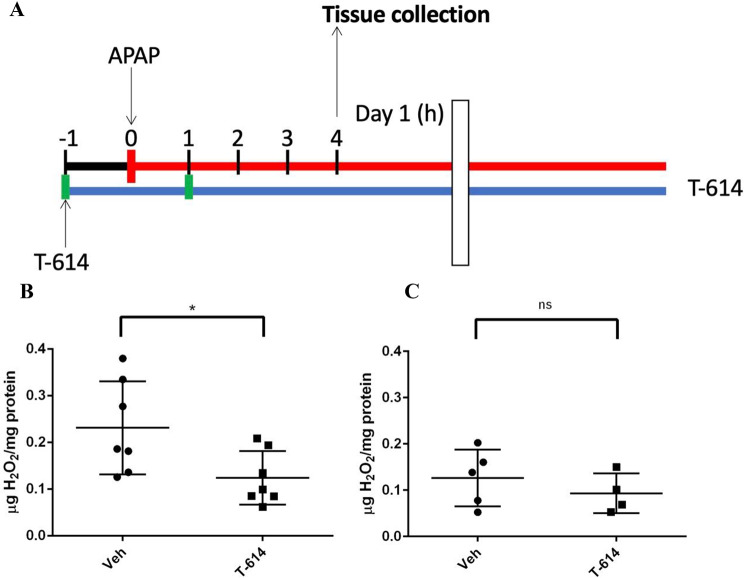
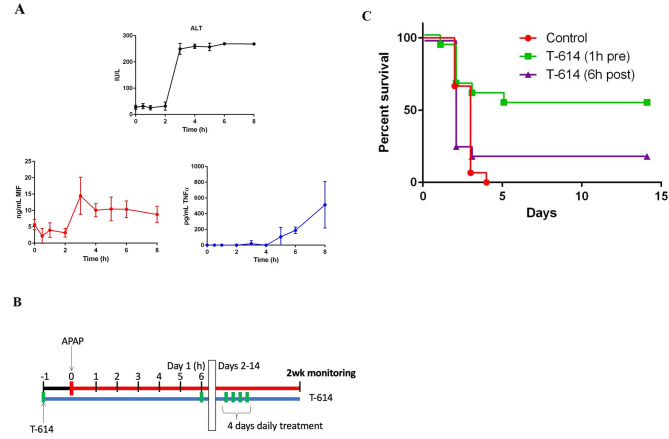
We conducted in vitro testing including kinetic analysis and protein crystallography to elucidate the interactions between MIF and T-614. We also performed in vivo experiments testing the efficacy of T-614 in a murine model of acetaminophen toxicity. We analyzed survival in lethal APAP overdose with and without T-614 and using two different dosing schedules of T-614. We also examined MIF and MIF inhibition effects on hepatic hydrogen peroxide (HO) as a surrogate of oxidative stress in non-lethal APAP overdose.
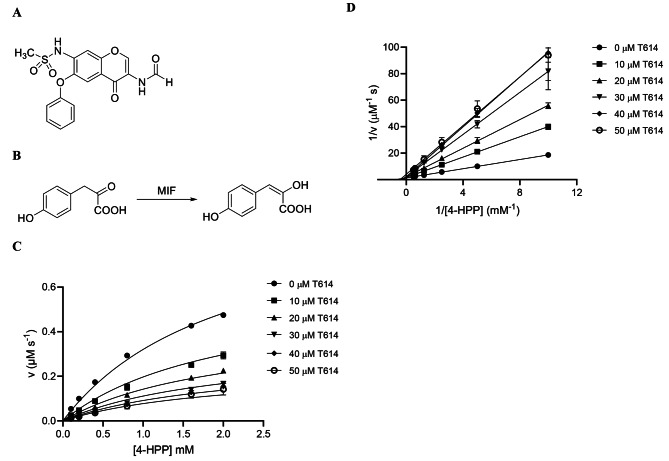
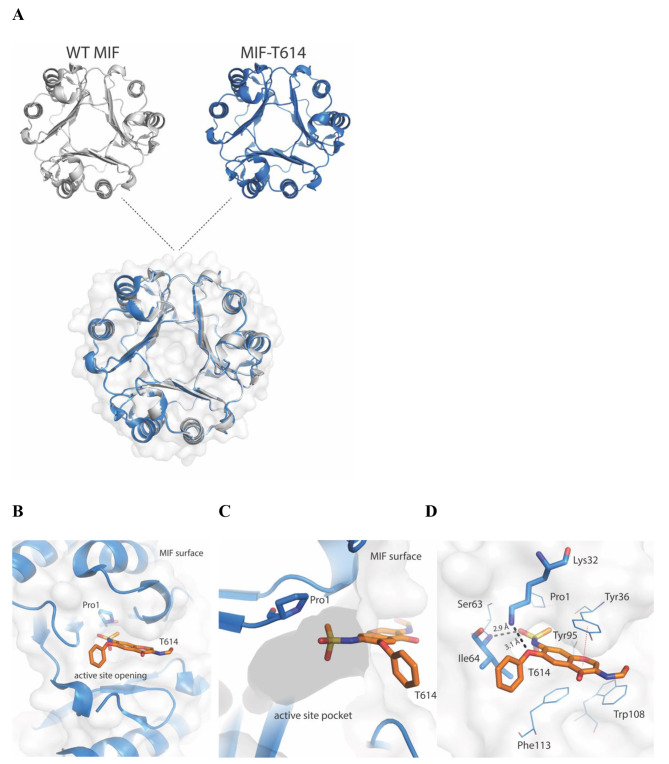
Kinetic analysis was consistent with a non-competitive type of inhibition and an inhibition constant (K) value of 16 µM. Crystallographic analysis revealed that T-614 binds outside of the tautomerase active site of the MIF trimer, with only the mesyl group of the molecule entering the active site pocket. T-614 improved survival in lethal APAP overdose when given prophylactically, but this protection was not observed when the drug was administered late (6 h after APAP). T-614 also decreased hepatic hydrogen peroxide concentrations during non-lethal APAP overdose in a MIF-dependent fashion.
T-614 is an allosteric inhibitor of MIF that prevented death and decreased hepatic hydrogen peroxide concentrations when given prophylactically in a murine model of acetaminophen overdose. Further studies are needed to elucidate the mechanistic role of MIF in APAP toxicity.
巨噬细胞移动抑制因子(MIF)是一种多功能细胞因子,与多种炎症性和非炎症性疾病有关,包括对乙酰氨基酚(APAP)过量引起的肝损伤。已经描述了多种 MIF 的小分子抑制剂,包括临床可用的抗风湿药物 T-614(依古曲班);然而,这种药物的抑制模式尚未完全研究。
我们进行了体外测试,包括动力学分析和蛋白质晶体学,以阐明 MIF 和 T-614 之间的相互作用。我们还在一种乙酰氨基酚毒性的小鼠模型中进行了体内实验,以测试 T-614 的疗效。我们分析了在有和没有 T-614 以及使用两种不同 T-614 剂量方案的情况下,在致死性 APAP 过量时的生存情况。我们还检查了 MIF 和 MIF 抑制作用对非致死性 APAP 过量中肝过氧化氢(HO)的影响,作为氧化应激的替代物。
动力学分析与非竞争性抑制类型一致,抑制常数(K)值为 16µM。晶体学分析显示,T-614 结合在 MIF 三聚体的 tautomerase 活性部位之外,只有分子的甲磺酰基进入活性部位口袋。T-614 在预防性给药时可改善致死性 APAP 过量中的生存,但在晚期(APAP 后 6 小时)给药时未观察到这种保护作用。T-614 还以 MIF 依赖性方式降低非致死性 APAP 过量期间的肝过氧化氢浓度。
T-614 是 MIF 的别构抑制剂,在乙酰氨基酚过量的小鼠模型中预防性给药可预防死亡并降低肝过氧化氢浓度。需要进一步研究阐明 MIF 在 APAP 毒性中的机制作用。