Mazzella Antonio, Casiraghi Monica, Uslenghi Clarissa, Orlandi Riccardo, Lo Iacono Giorgio, Bertolaccini Luca, Varano Gianluca Maria, Orsi Franco, Spaggiari Lorenzo
Division of Thoracic Surgery, IEO, European Institute of Oncology IRCCS, 20141 Milan, Italy.
Division of Interventional Radiology, IEO, European Institute of Oncology IRCCS, 20141 Milan, Italy.
Cancers (Basel). 2024 Mar 14;16(6):1146. doi: 10.3390/cancers16061146.
Our goal is to evaluate the correct management of broncho-pleural fistula (BPF) after lobectomy for lung cancer.
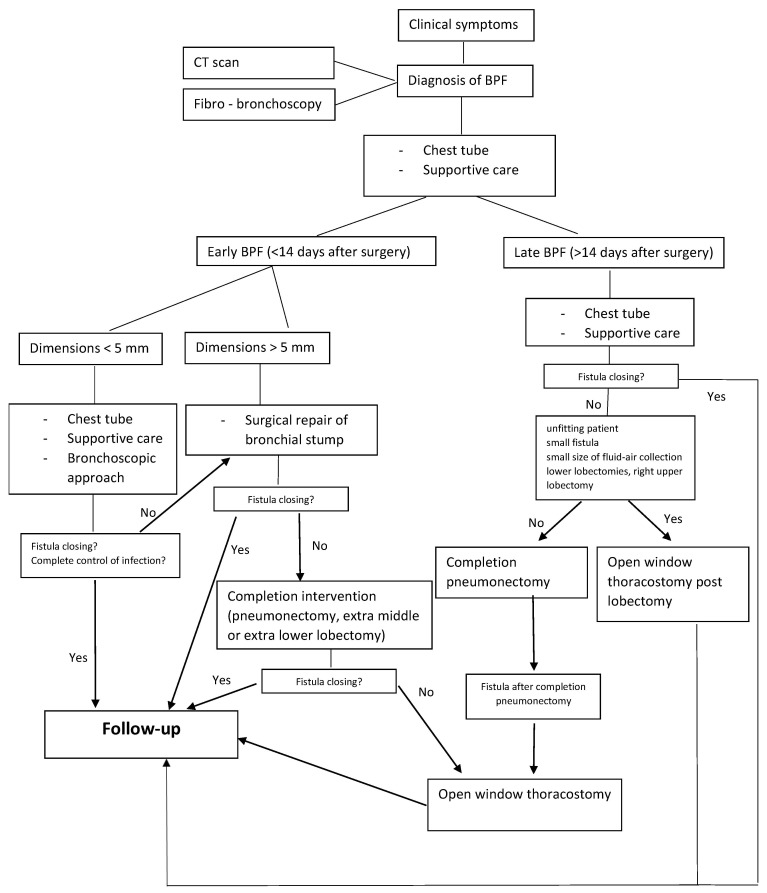
We retrospectively reviewed our 25-years' experience and reported our strategies and our diagnostic algorithm for the management of post-lobectomy broncho-pleural fistula.
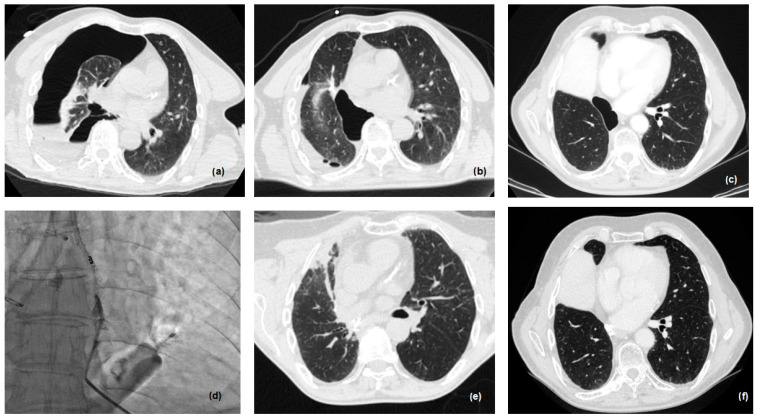
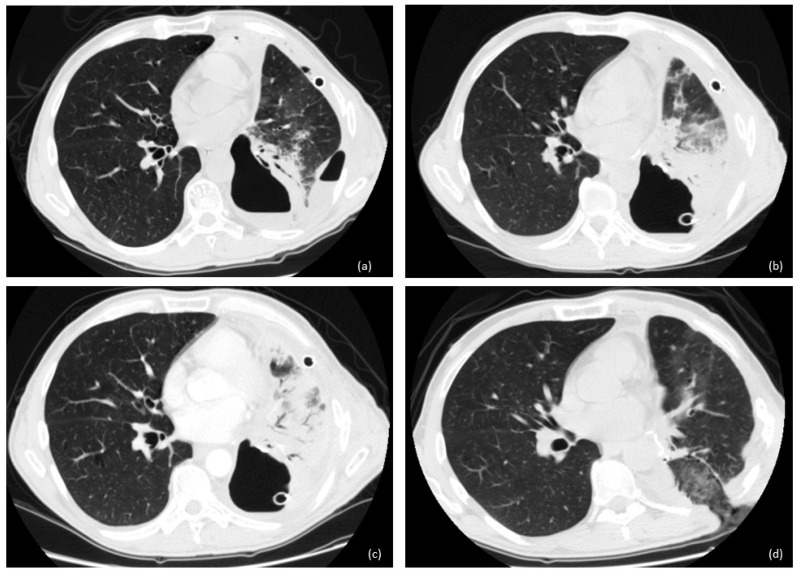
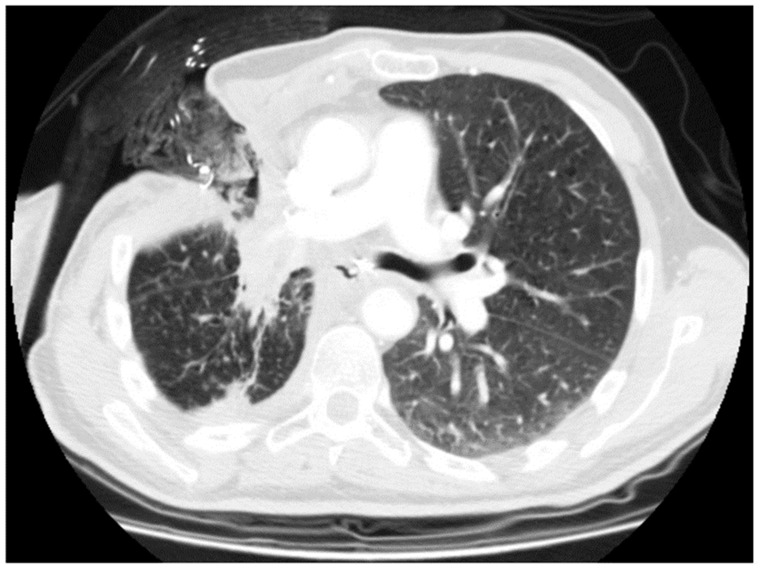
Five thousand one hundred and fifty (5150) patients underwent lobectomy for lung cancer in the period between 1998 and 2023. A total of 44 (0.85%) out of 5150 developed post-operative BPF. In 11 cases, BPF was solved by non-invasive treatment. In nine cases, direct surgical repair of the bronchial stump allowed BPF resolution. In 14 cases, a completion intervention was performed. In six cases, we performed open window thoracostomy (OWT) after lobectomy; in two cases, the BPF was closed by percutaneous injection of an n-butyl cyanoacrylate glue mixture. In two cases, no surgical procedure was performed because of the clinical status of the patient at the time of fistula developing. Thirty-day and ninety-day mortality from fistula onset was, respectively, 18.2% (eight patients) and 22.7% (ten patients). Thirty-day and ninety-day mortality after completion pneumonectomy (12 patients) was, respectively, 8.3% (one patient) and 16.6% (two patients).
The correct management of BPF depends on various factors: timing of onset, size of the fistula, anatomic localization, and the general condition of the patient. In the case of failure of various initial therapeutic approaches, completion intervention or OWT could be considered.
我们的目标是评估肺癌肺叶切除术后支气管胸膜瘘(BPF)的正确处理方法。
我们回顾了25年的经验,并报告了我们处理肺叶切除术后支气管胸膜瘘的策略和诊断算法。
1998年至2023年期间,5150例患者接受了肺癌肺叶切除术。5150例患者中共有44例(0.85%)发生术后BPF。11例患者通过非侵入性治疗解决了BPF。9例患者通过直接手术修复支气管残端使BPF得到解决。14例患者进行了补充干预。6例患者在肺叶切除术后进行了开窗胸廓造口术(OWT);2例患者通过经皮注射氰基丙烯酸正丁酯胶水混合物封闭了BPF。2例患者由于瘘管形成时患者的临床状况未进行手术。从瘘管发作起30天和90天的死亡率分别为18.2%(8例患者)和22.7%(10例患者)。全肺切除术后(12例患者)30天和90天的死亡率分别为8.3%(1例患者)和16.6%(2例患者)。
BPF的正确处理取决于多种因素:发作时间、瘘管大小、解剖定位以及患者的一般状况。在各种初始治疗方法失败的情况下,可以考虑进行补充干预或OWT。