Chen Shengpeng, Yang Wenyi, Wang Wei, Mai Jianting, Liang Jian, Zhang Xiaohu
School of Aeronautics and Astronautics, Sun Yat-sen University, Shenzhen 510275, China.
Sensors (Basel). 2024 Mar 12;24(6):1828. doi: 10.3390/s24061828.
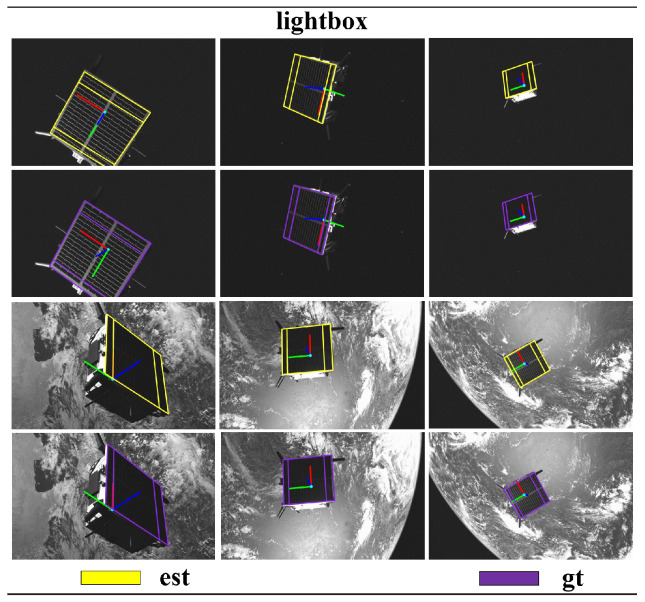
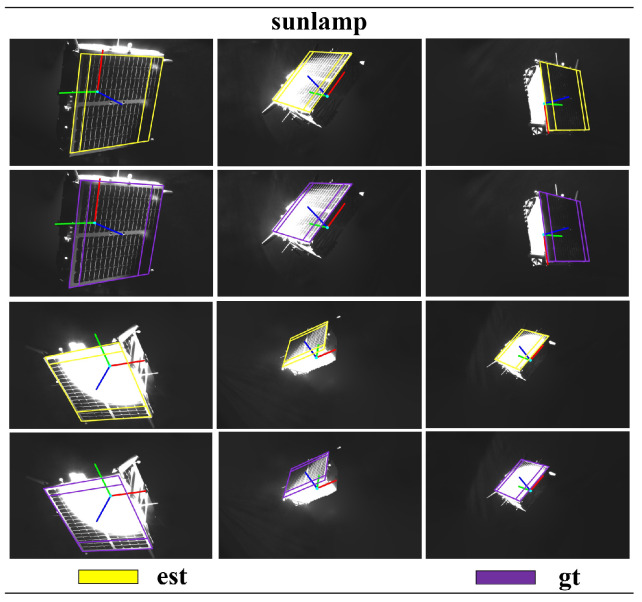
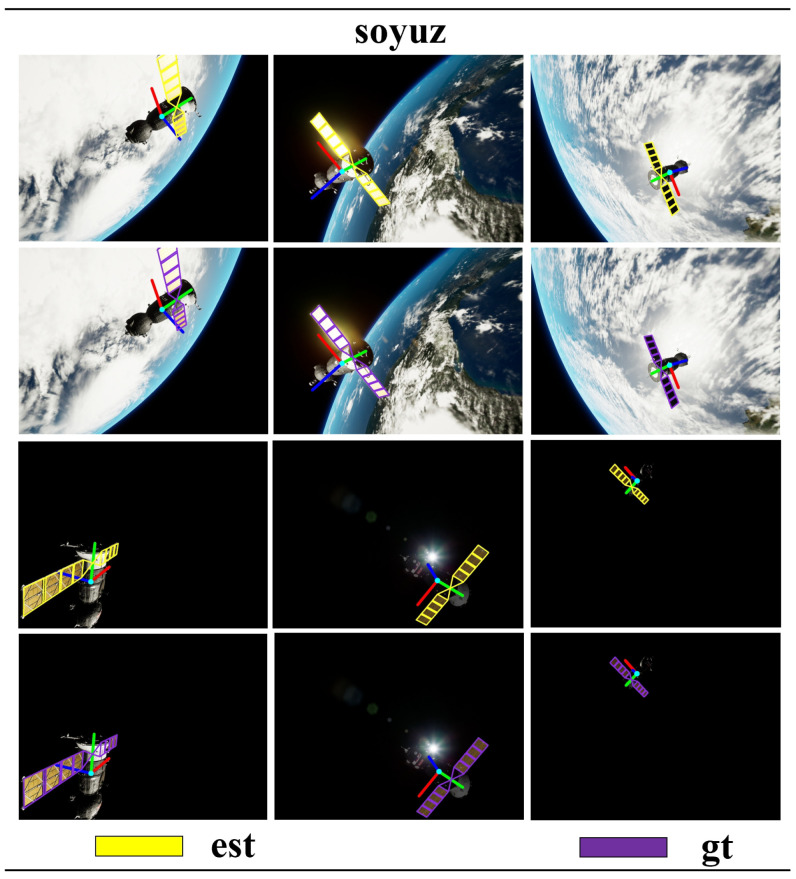
Spacecraft pose estimation using computer vision has garnered increasing attention in research areas such as automation system theory, control theory, sensors and instruments, robot technology, and automation software. Confronted with the extreme environment of space, existing spacecraft pose estimation methods are predominantly multi-stage networks with complex operations. In this study, we propose an approach for spacecraft homography pose estimation with a single-stage deep convolutional neural network for the first time. We formulated a homomorphic geometric constraint equation for spacecraft with planar features. Additionally, we employed a single-stage 2D keypoint regression network to obtain homography 2D keypoint coordinates for spacecraft. After decomposition to obtain the rough spacecraft pose based on the homography matrix constructed according to the geometric constraint equation, a loss function based on pixel errors was employed to refine the spacecraft pose. We conducted extensive experiments using widely used spacecraft pose estimation datasets and compared our method with state-of-the-art techniques in the field to demonstrate its effectiveness.
利用计算机视觉进行航天器姿态估计在自动化系统理论、控制理论、传感器与仪器、机器人技术以及自动化软件等研究领域受到了越来越多的关注。面对太空的极端环境,现有的航天器姿态估计方法主要是具有复杂操作的多阶段网络。在本研究中,我们首次提出了一种使用单阶段深度卷积神经网络进行航天器单应性姿态估计的方法。我们为具有平面特征的航天器制定了一个同态几何约束方程。此外,我们采用了单阶段二维关键点回归网络来获取航天器的单应性二维关键点坐标。在根据几何约束方程构建的单应性矩阵分解以获得航天器的粗略姿态后,采用基于像素误差的损失函数来细化航天器姿态。我们使用广泛使用的航天器姿态估计数据集进行了大量实验,并将我们的方法与该领域的最新技术进行了比较,以证明其有效性。