Hong Tao, Yu Xiao, Liu Ziwei, Ding Xiaojin, Zhang Gengxin
School of Communications and Information Engineering, Nanjing University of Posts and Telecommunications, Nanjing 210003, China.
Sensors (Basel). 2024 Mar 21;24(6):2004. doi: 10.3390/s24062004.
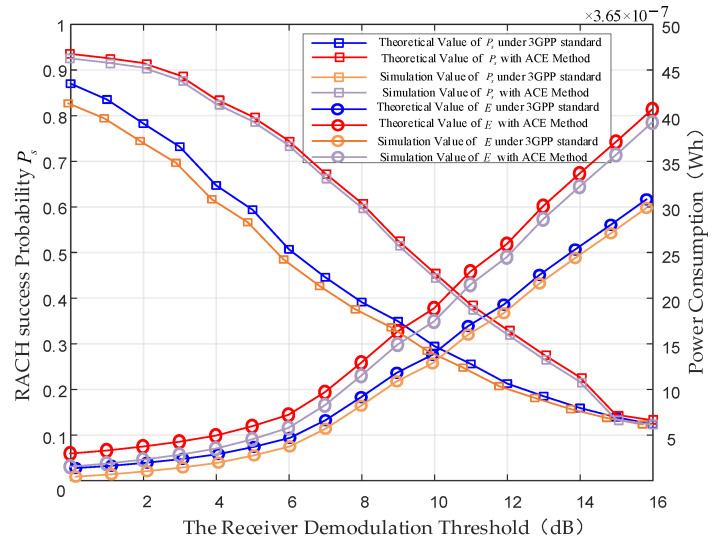
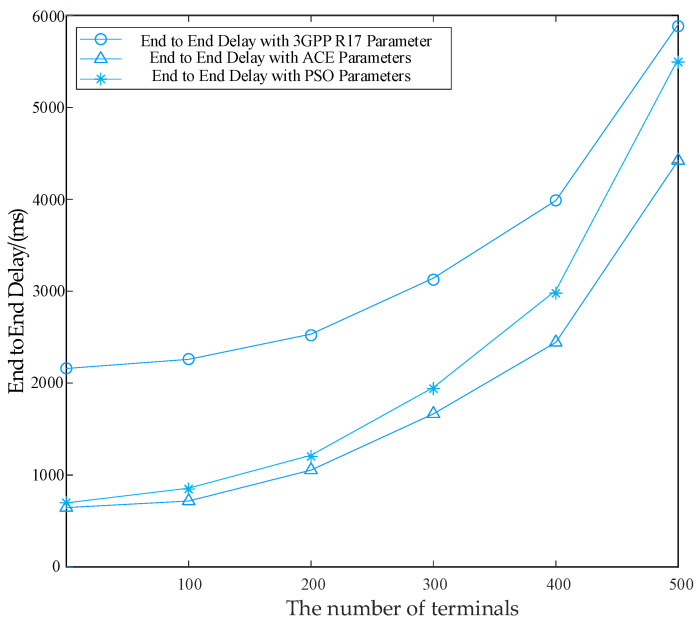
With the development of IoT technology and 5G massive machine-type communication, the 3GPP standardization body considered as viable the integration of Narrowband Internet of Things (NB-IoT) in low Earth orbit (LEO) satellite-based architectures. However, the presence of the LEO satellite channel comes up with new challenges for the NB-IoT random access procedures and coverage enhancement mechanism. In this paper, an Adaptive Coverage Enhancement (ACE) method is proposed to meet the requirement of random access parameter configurations for diverse applications. Based on stochastic geometry theory, an expression of random access channel (RACH) success probability is derived for LEO satellite-based NB-IoT networks. On the basis of a power consumption model of the NB-IoT terminal, a multi-objective optimization problem is formulated to trade-off RACH success probability and power consumption. To solve this multi-objective optimization problem, we employ the Non-dominated Sorting Genetic Algorithms-II (NSGA-II) method to obtain the Pareto-front solution set. According to different application requirements, we also design a random access parameter configuration method to minimize the power consumption under the constraints of RACH success probability requirements. Simulation results show that the maximum number of repetitions and back-off window size have a great influence on the system performance and their value ranges should be set within [4, 18] and [0, 2048]. The power consumption of coverage enhancement with ACE is about 58% lower than that of the 3GPP proposed model. All this research together provides good reference for the scale deployment of NB-IoT in LEO satellite networks.
随着物联网技术和5G海量机器类型通信的发展,3GPP标准化组织认为将窄带物联网(NB-IoT)集成到低地球轨道(LEO)卫星架构中是可行的。然而,LEO卫星信道的存在给NB-IoT随机接入过程和覆盖增强机制带来了新的挑战。本文提出了一种自适应覆盖增强(ACE)方法,以满足不同应用对随机接入参数配置的要求。基于随机几何理论,推导了基于LEO卫星的NB-IoT网络随机接入信道(RACH)成功概率的表达式。基于NB-IoT终端的功耗模型,建立了一个多目标优化问题,以权衡RACH成功概率和功耗。为了解决这个多目标优化问题,我们采用非支配排序遗传算法-II(NSGA-II)方法来获得帕累托前沿解集。根据不同的应用需求,我们还设计了一种随机接入参数配置方法,以在RACH成功概率要求的约束下最小化功耗。仿真结果表明,最大重复次数和退避窗口大小对系统性能有很大影响,其取值范围应设置在[4, 18]和[0, 2048]内。采用ACE进行覆盖增强的功耗比3GPP提出的模型低约58%。所有这些研究为NB-IoT在LEO卫星网络中的规模部署提供了很好的参考。