Ahmed Sophia, Ibbotson Denali, Somodi Chase, Shamberger Patrick J
Department of Materials Science and Engineering, Texas A&M University, College Station, Texas 77843, United States.
ACS Appl Eng Mater. 2023 Dec 20;2(3):530-541. doi: 10.1021/acsaenm.3c00444. eCollection 2024 Mar 22.
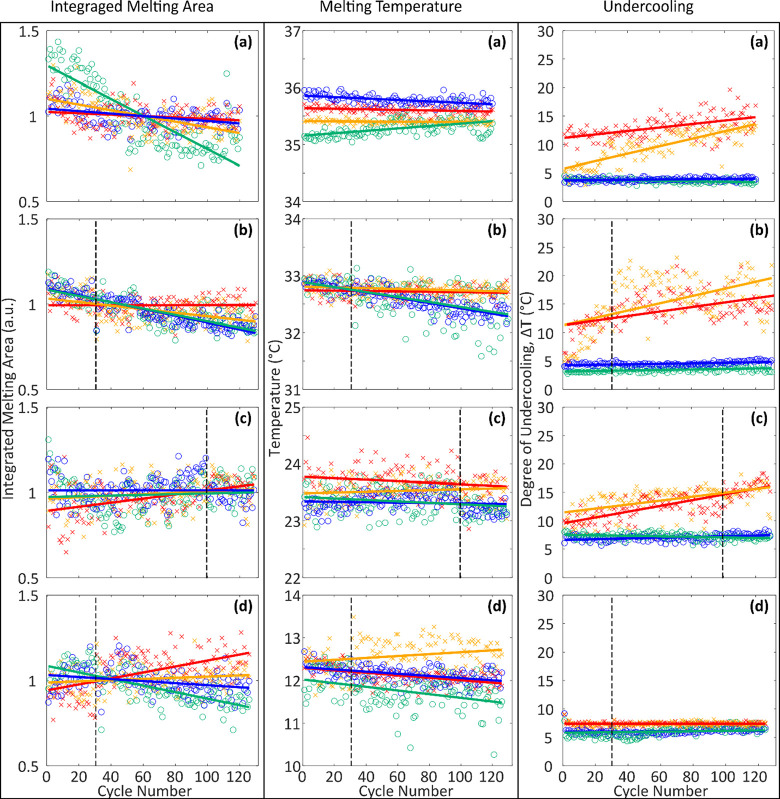
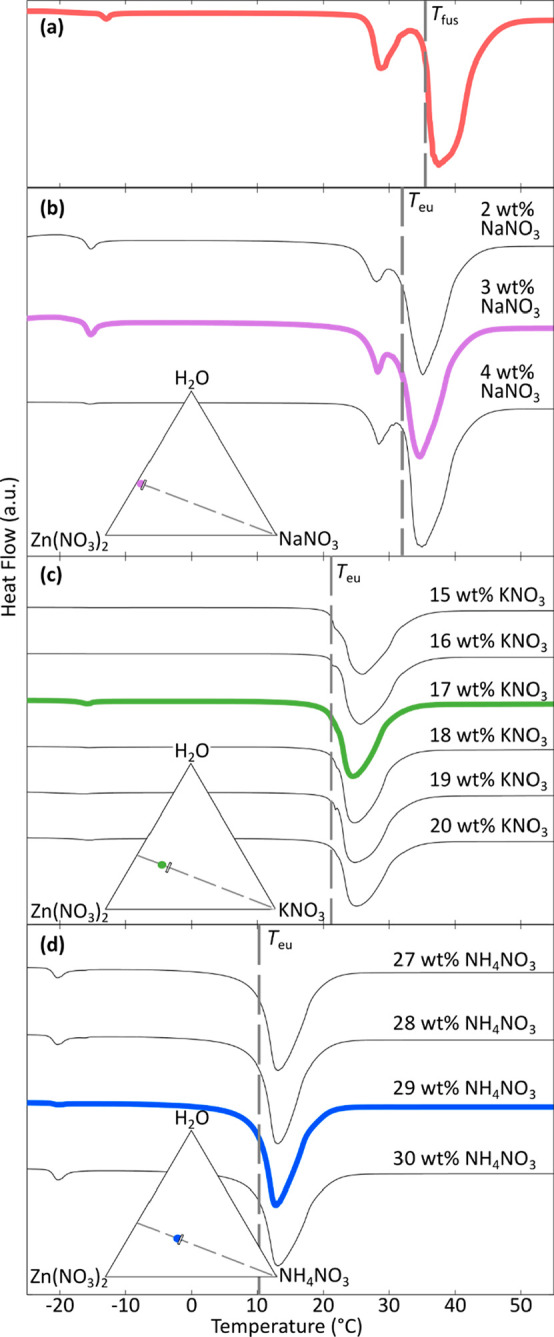
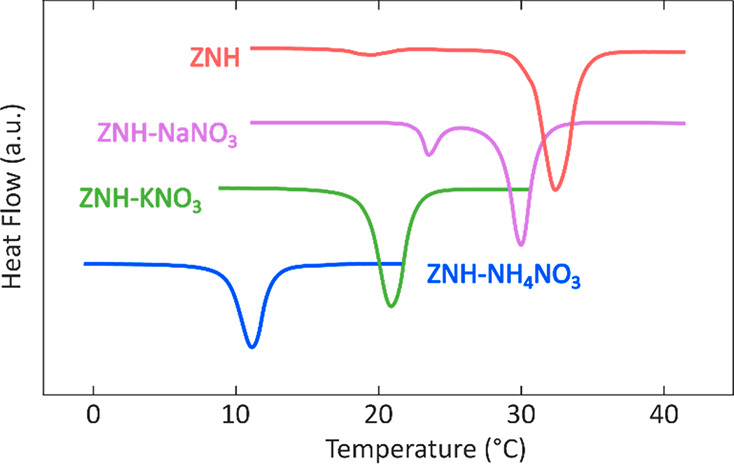
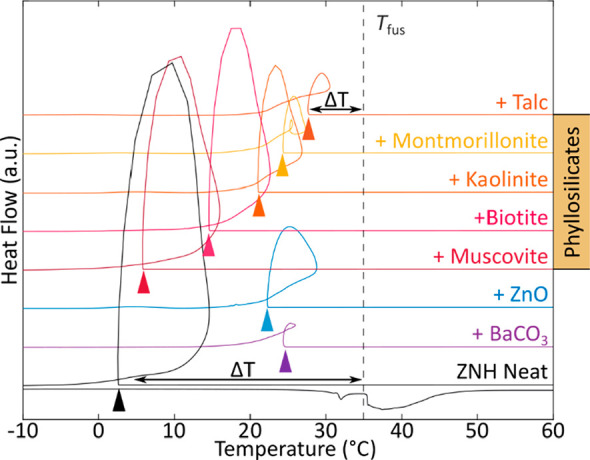
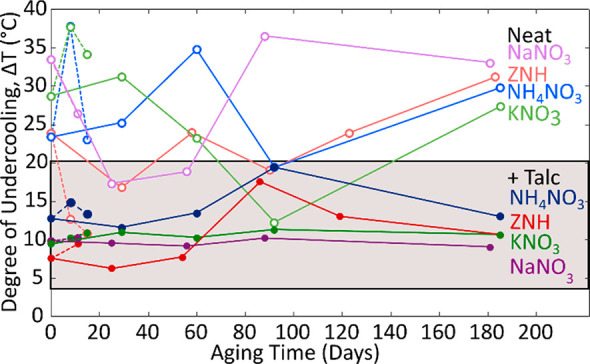
Stoichiometric salt hydrates can be inexpensive and provide higher volumetric energy density relative to other near-room-temperature phase change materials (PCMs), but few salt hydrates exhibit congruent melting behavior between 0 and 30 °C. Eutectic salt hydrates offer a strategy to design bespoke PCMs with tailored application-specific eutectic melting temperatures. However, the general solidification behavior and stability of eutectic salt hydrate systems remain unclear, as metastable solidification in eutectic salt hydrates may introduce opportunities for phase segregation. Here, we present a new family of low-cost zinc-nitrate-hexahydrate-based eutectics: Zn(NO)·6(HO)-NaNO ( = 32.7 ± 0.3 °C; = 151 ± 6 J·g), Zn(NO)·6(HO)-KNO ( = 22.1 ± 0.3 °C; = 140 ± 6 J·g), Zn(NO)·6(HO)-NHNO ( = 11.2 ± 0.3 °C; = 137 ± 5 J·g). While the tendency to undercool varies greatly between different eutectics in the family, the geologic mineral talc has been identified as an active and stable phase that dramatically reduces undercooling in Zn(NO)·6(HO) and all related eutectics. Zn(NO)·6(HO) and its related eutectics have shown stability for over a hundred thermal cycles in mL scale volumes, suggesting that they are capable of serving as robust and stable media for near-room-temperature thermal energy storage applications in buildings.
化学计量盐水合物成本低廉,相对于其他近室温相变材料(PCM)具有更高的体积能量密度,但很少有盐水合物在0至30°C之间表现出一致熔化行为。低共熔盐水合物提供了一种策略,可设计具有特定应用定制低共熔熔化温度的定制PCM。然而,低共熔盐水合物系统的一般凝固行为和稳定性仍不清楚,因为低共熔盐水合物中的亚稳凝固可能会引入相分离的机会。在此,我们展示了一个基于六水合硝酸锌的新型低成本低共熔物系列:Zn(NO₃)₂·6H₂O-NaNO₃(熔点 = 32.7 ± 0.3 °C;熔化潜热 = 151 ± 6 J·g⁻¹),Zn(NO₃)₂·6H₂O-KNO₃(熔点 = 22.1 ± 0.3 °C;熔化潜热 = 140 ± 6 J·g⁻¹),Zn(NO₃)₂·6H₂O-NH₄NO₃(熔点 = 11.2 ± 0.3 °C;熔化潜热 = 137 ± 5 J·g⁻¹)。虽然该系列中不同低共熔物的过冷倾向差异很大,但已确定地质矿物滑石是一种活性且稳定的相,可显著降低Zn(NO₃)₂·6H₂O及其所有相关低共熔物中的过冷现象。Zn(NO₃)₂·6H₂O及其相关低共熔物在毫升规模体积中经过一百多个热循环后仍表现出稳定性,这表明它们能够作为建筑物中近室温热能存储应用的坚固且稳定的介质。