Saenz Hinojosa Samantha, Reyes Carlos, Romero Vanessa I
School of Medicine, Universidad San Francisco de Quito, Quito, Ecuador.
Genetics Department, Hospital de Especialidades Eugenio Espejo, Quito, Ecuador.
Heliyon. 2024 Mar 15;10(6):e28024. doi: 10.1016/j.heliyon.2024.e28024. eCollection 2024 Mar 30.
In resource-limited settings, patients with uncommon phenotypes often face prolonged diagnostic journeys and potential misdiagnoses. Coloboma, heart defects, atresia choanae, restricted growth and development, genital and ear abnormalities syndrome (CHARGE) syndrome, a congenital condition affecting various body parts such as the heart, ears, eyes, and genitals, exemplifies this challenge.
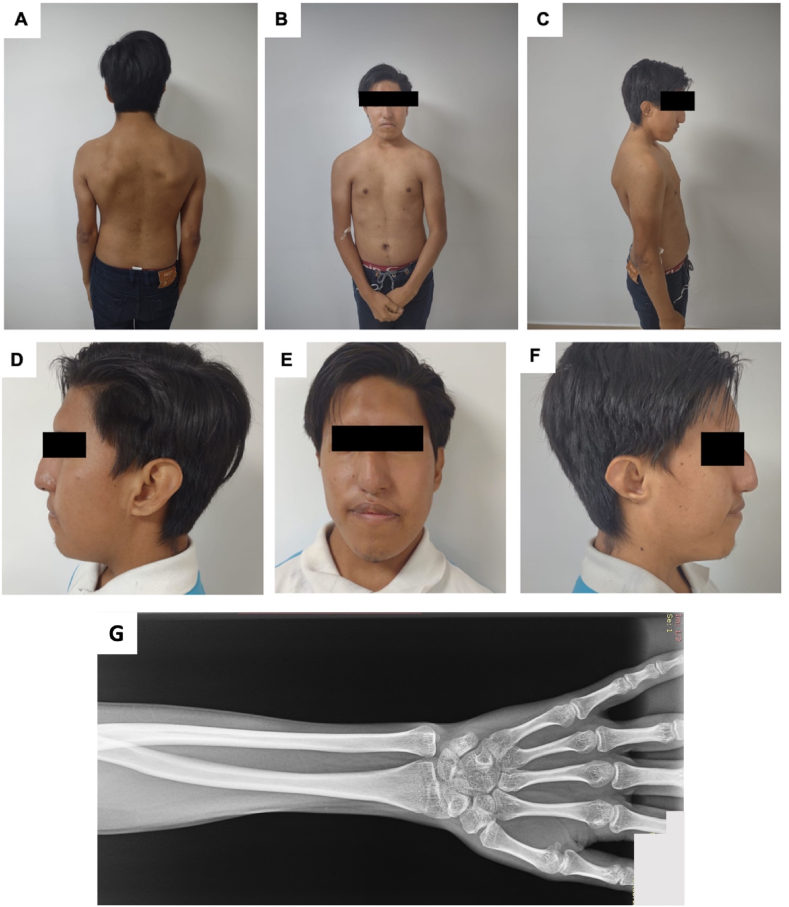
We present the case of a 21-year-old male patient from Ecuador who exhibited hypogonadism, facial deformities, and stunted growth. Due to the scarcity of genetic specialists and limited access to genetic testing in Ecuador, the patient received a misdiagnosis of Noonan syndrome. However, a correct diagnosis of CHARGE syndrome was ultimately reached after eight years, facilitated by genetic sequencing that identified a novel mutation in the Chromodomain helicase DNA binding protein 7 gene.
This case highlights the critical role of meticulously assessing patients' symptoms and emphasizes the necessity for enhanced collaboration among physicians and researchers. Such efforts are pivotal in advancing healthcare access and equity for individuals in developing nations.
在资源有限的环境中,具有罕见表型的患者往往面临漫长的诊断过程和潜在的误诊。眼缺损、心脏缺陷、后鼻孔闭锁、生长发育受限、生殖器和耳部异常综合征(CHARGE综合征)是一种影响心脏、耳朵、眼睛和生殖器等多个身体部位的先天性疾病,就是这一挑战的典型例子。
我们报告一例来自厄瓜多尔的21岁男性患者,该患者表现为性腺功能减退、面部畸形和生长发育迟缓。由于厄瓜多尔遗传专家稀缺且基因检测机会有限,该患者被误诊为努南综合征。然而,八年后通过基因测序最终确诊为CHARGE综合征,该测序在染色质结构域解旋酶DNA结合蛋白7基因中发现了一个新的突变。
该病例突出了细致评估患者症状的关键作用,并强调了医生和研究人员加强合作的必要性。这些努力对于改善发展中国家个人的医疗服务可及性和公平性至关重要。