Department of Clinical Laboratory, The First Affiliated Hospital of Zhengzhou University, Key Clinical Laboratory of Henan Province, Zhengzhou, Henan, China.
PLoS One. 2024 Mar 28;19(3):e0300143. doi: 10.1371/journal.pone.0300143. eCollection 2024.
Observational studies had investigated the association of iron metabolism with anxiety disorders. The conclusions were inconsistent and not available to reveal the causal or reverse-causal association due to the confounding. In this study we estimated the potential causal effect of iron homeostasis markers on anxiety disorders using two-sample Mendelian randomization (MR) analysis.
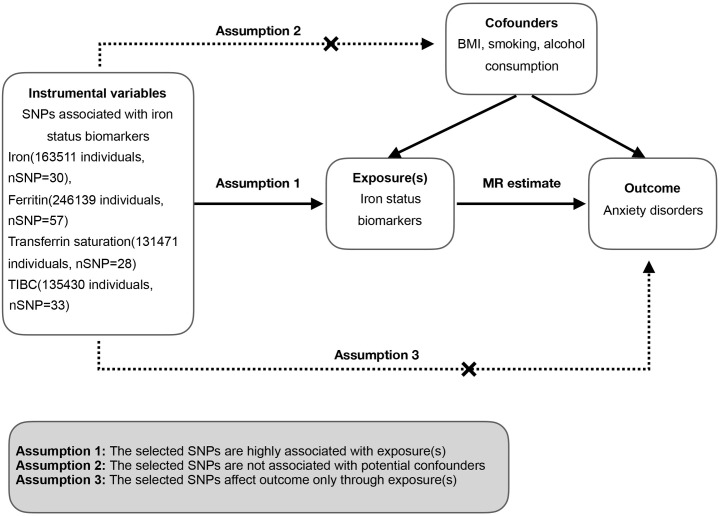
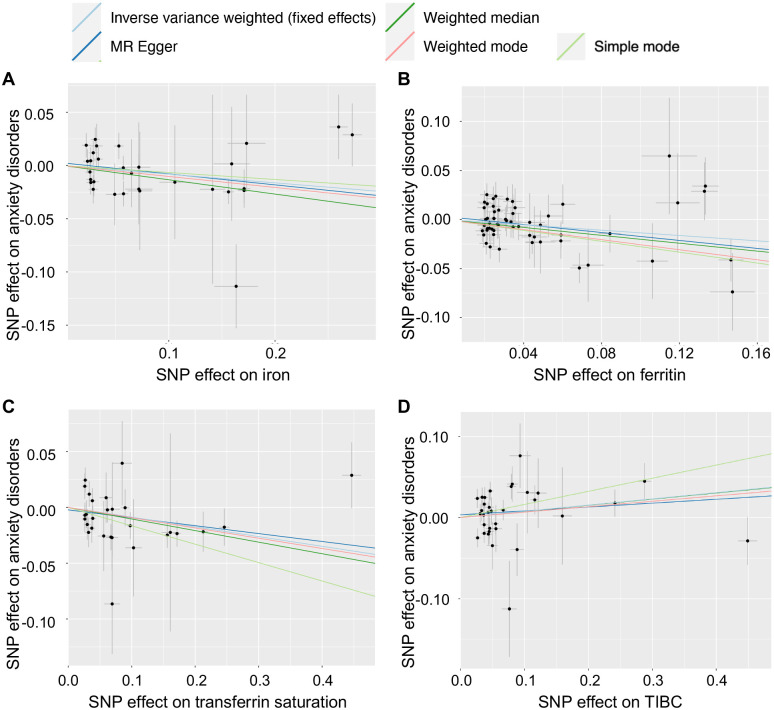
Summary data of single nucleotide polymorphisms (SNPs) associated with four iron-related biomarkers were extracted from a recent report about analysis of three genome-wide association study (GWAS), the sample size of which ranged from 131471 to 246139 individuals. The corresponding data for anxiety disorders were from Finngen database (20992 cases and 197800 controls). The analyses were mainly based on inverse variance weighted (IVW) method. In addition, the heterogeneity and pleiotropy of the results were assessed by Cochran's Q test and MR-Egger regression.
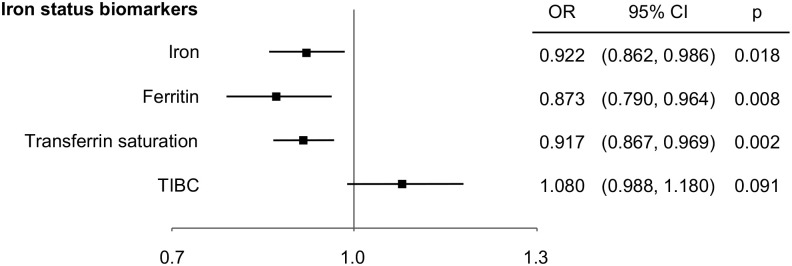
Basing on IVW method, genetically predicted serum iron level, ferritin and transferrin had negative effects on anxiety disorders. The odd ratios (OR) of anxiety disorders per 1 standard deviation (SD) unit increment in iron status biomarkers were 0.922 (95% confidence interval (CI) 0.862-0.986; p = 0.018) for serum iron level, 0.873 (95% CI 0.790-0.964; p = 0.008) for log-transformed ferritin and 0.917 (95% CI 0.867-0.969; p = 0.002) for transferrin saturation. But no statical significance was found in the association of 1 SD unit increased total iron-binding capacity (TIBC) with anxiety disorders (OR 1.080; 95% CI 0.988-1.180; p = 0.091). The analyses were supported by pleiotropy test which suggested no pleiotropic bias.
Our results indicated that genetically determined iron status biomarkers causally linked to the risk of anxiety disorders, providing valuable insights into the genetic research and clinical intervention of anxiety disorders.
观察性研究已经探讨了铁代谢与焦虑障碍之间的关联。由于存在混杂因素,这些结论不一致,无法揭示因果或反向因果关联。在这项研究中,我们使用两样本 Mendelian 随机化(MR)分析来估计铁稳态标志物对焦虑障碍的潜在因果效应。
从最近关于三项全基因组关联研究(GWAS)分析的报告中提取与四个铁相关生物标志物相关的单核苷酸多态性(SNP)的汇总数据,样本量范围为 131471 至 246139 人。焦虑障碍的相应数据来自 Finngen 数据库(20992 例病例和 197800 例对照)。分析主要基于逆方差加权(IVW)法。此外,还通过 Cochran's Q 检验和 MR-Egger 回归评估结果的异质性和多效性。
基于 IVW 方法,遗传预测的血清铁水平、铁蛋白和转铁蛋白对焦虑障碍有负面影响。每增加一个铁状态生物标志物的标准偏差(SD)单位,焦虑障碍的比值比(OR)为 0.922(95%置信区间(CI)0.862-0.986;p=0.018)对于血清铁水平,0.873(95%CI 0.790-0.964;p=0.008)对于对数变换的铁蛋白,0.917(95%CI 0.867-0.969;p=0.002)对于转铁蛋白饱和度。但是,总铁结合能力(TIBC)每增加 1 SD 单位与焦虑障碍之间的关联无统计学意义(OR 1.080;95%CI 0.988-1.180;p=0.091)。多效性检验支持了这些分析,表明不存在多效性偏差。
我们的结果表明,遗传决定的铁状态生物标志物与焦虑障碍的风险有因果关系,为焦虑障碍的遗传研究和临床干预提供了有价值的见解。