Université Paris Saclay, INRAE, AgroParisTech, GABI, 78350, Jouy-en-Josas, France.
Institut de L'Elevage, 75012, Paris, France.
Genet Sel Evol. 2024 Mar 29;56(1):23. doi: 10.1186/s12711-024-00889-4.
In the current context of climate change, livestock production faces many challenges to improve the sustainability of systems. Dairy farming, in particular, must find ways to select animals that will be able to achieve sufficient overall production while maintaining their reproductive ability in environments with increasing temperatures. With future forecasted climate conditions in mind, this study used data from Holstein and Montbeliarde dairy cattle to: (1) estimate the genetic-by-temperature-humidity index (THI) interactions for female fertility, and (2) evaluate the production-fertility trade-off with increasing values of THI.
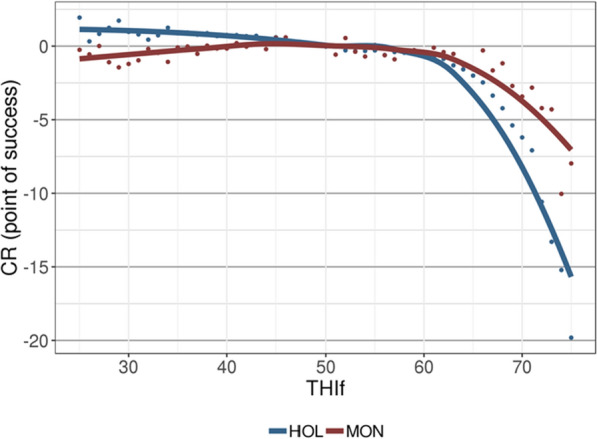
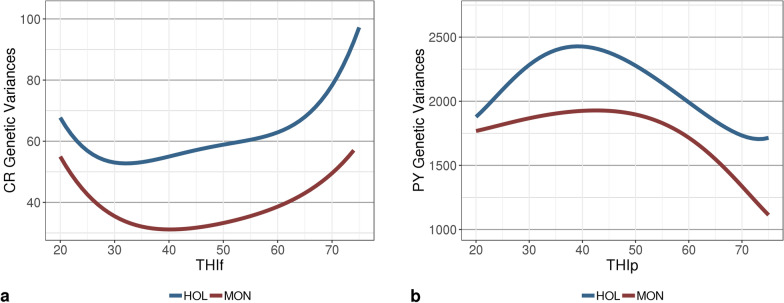
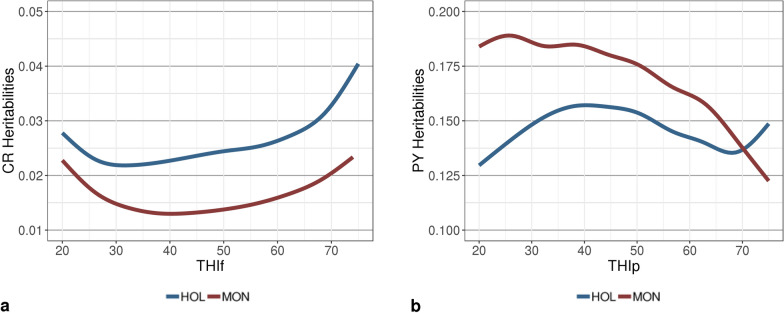
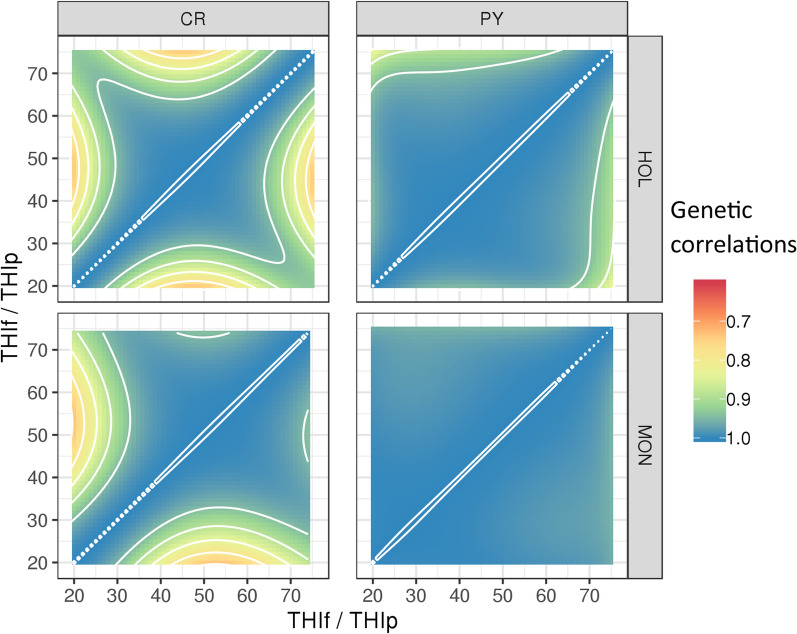
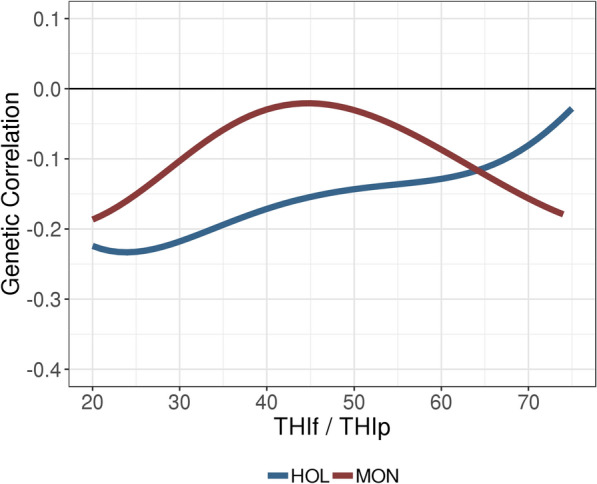
Two-trait random regression models were fitted for conception rate (fertility) and test-day protein yield (production). For fertility, genetic correlations between different THI values were generally above 0.75, suggesting weak genotype-by-THI interactions for conception rate in both breeds. However, the genetic correlations between the conception rate breeding values at the current average THI (THI = 50, corresponding to a 24-h average temperature of 8 °C at 50% relative humidity) and their slopes (i.e., potential reranking) for heat stress scenarios (THI > 70), were different for each breed. For Montbeliarde, this correlation tended to be positive (i.e., overall the best reproducers are less affected by heat stress), whereas for Holstein it was approximately zero. Finally, our results indicated a weak antagonism between production and fertility, although for Montbeliarde this antagonism intensified with increasing THI.
Within the range of weather conditions studied, increasing temperatures are not expected to exacerbate the fertility-production trade-off. However, our results indicated that the animals with the best breeding values for production today will be the most affected by temperature increases, both in terms of fertility and production. Nonetheless, these animals should remain among the most productive ones during heat waves. For Montbeliarde, the current selection program for fertility seems to be adequate for ensuring the adaptation of fertility traits to temperature increases, without adverse effects on production. Such a conclusion cannot be drawn for Holstein. In the future, the incorporation of a heat tolerance index into dairy cattle breeding programs would be valuable to promote the selection of animals adapted to future climate conditions.
在当前气候变化的背景下,畜牧业生产面临着许多挑战,需要提高系统的可持续性。特别是奶牛养殖,必须找到方法来选择能够在气温升高的环境中保持足够的整体生产能力同时保持其繁殖能力的动物。考虑到未来预测的气候条件,本研究使用了荷斯坦和蒙贝利亚尔奶牛的数据:(1)估计雌性生育力的遗传-温度-湿度指数(THI)互作,(2)评估随着 THI 值的增加生产-生育力权衡。
为受孕率(生育力)和测试日蛋白质产量(生产)拟合了两性状随机回归模型。对于生育力,不同 THI 值之间的遗传相关系数通常高于 0.75,表明两种品种的受孕率的基因型-THI 互作较弱。然而,当前平均 THI(THI=50,相当于相对湿度为 50%时 24 小时平均温度为 8°C)的受孕率育种值与热应激情景(THI>70)的斜率(即潜在重新排序)之间的遗传相关系数因品种而异。对于蒙贝利亚尔牛,这种相关性往往是正的(即总体而言,繁殖能力最好的牛受热应激的影响较小),而对于荷斯坦牛则几乎为零。最后,我们的结果表明生产和生育力之间存在弱拮抗作用,尽管对于蒙贝利亚尔牛,这种拮抗作用随着 THI 的增加而加剧。
在所研究的天气条件范围内,预计温度升高不会加剧生育力-生产权衡。然而,我们的结果表明,今天生产性状最佳的动物在生育力和生产方面受温度升高的影响最大。尽管如此,在热浪期间,这些动物仍应保持最高的生产力。对于蒙贝利亚尔牛,当前的生育力选择计划似乎足以确保生育力性状适应温度升高,而不会对生产产生不利影响。对于荷斯坦牛,不能得出这样的结论。在未来,将耐热性指数纳入奶牛育种计划将有助于促进对适应未来气候条件的动物的选择。