King Van Lewis, Siegel Gregg, Priesmeyer Henry Richard, Siegel Leslie H, Potter Jennifer S
Department of Psychiatry and Behavioral Sciences, University of Texas Health Science Center San Antonio, San Antonio, TX, United States.
Biomedical Development Corporation, San Antonio, TX, United States.
JMIR Form Res. 2024 Apr 1;8:e48068. doi: 10.2196/48068.
Self-management of opioid use disorder (OUD) is an important component of treatment. Many patients receiving opioid agonist treatment in methadone maintenance treatment settings benefit from counseling treatments to help them improve their recovery skills but have insufficient access to these treatments between clinic appointments. In addition, many addiction medicine clinicians treating patients with OUD in a general medical clinic setting do not have consistent access to counseling referrals for their patients. This can lead to decreases in both treatment retention and overall progress in the patient's recovery from substance misuse. Digital apps may help to bridge this gap by coaching, supporting, and reinforcing behavioral change that is initiated and directed by their psychosocial and medical providers.
This study aimed to conduct an acceptability, usability, and utility pilot study of the KIOS app to address these clinical needs.
We developed a unique, patient-centered computational software system (KIOS; Biomedical Development Corporation) to assist in managing OUD in an outpatient, methadone maintenance clinic setting. KIOS tracks interacting self-reported symptoms (craving, depressed mood, anxiety, irritability, pain, agitation or restlessness, difficulty sleeping, absenteeism, difficulty with usual activities, and conflicts with others) to determine changes in both the trajectory and severity of symptom patterns over time. KIOS then applies a proprietary algorithm to assess the individual's patterns of symptom interaction in accordance with models previously established by OUD experts. After this analysis, KIOS provides specific behavioral advice addressing the individual's changing trajectory of symptoms to help the person self-manage their symptoms. The KIOS software also provides analytics on the self-reported data that can be used by patients, clinicians, and researchers to track outcomes.
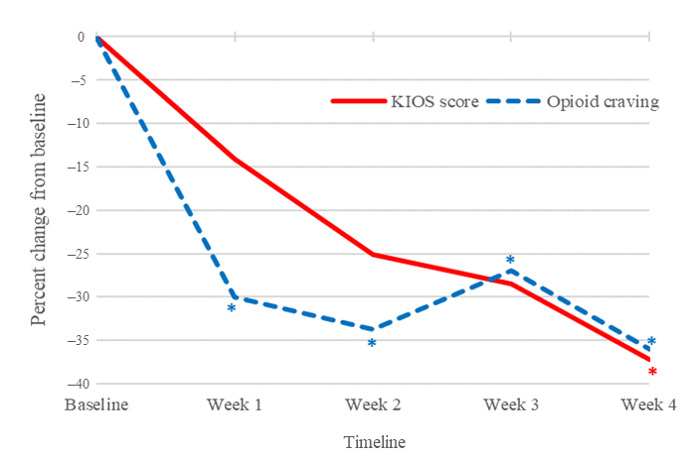
In a 4-week acceptability, usability (mean System Usability Scale-Modified score 89.5, SD 9.2, maximum of 10.0), and utility (mean KIOS utility questionnaire score 6.32, SD 0.25, maximum of 7.0) pilot study of 15 methadone-maintained participants with OUD, user experience, usability, and software-generated advice received high and positive assessment scores. The KIOS clinical variables closely correlated with craving self-report measures. Therefore, managing these variables with advice generated by the KIOS software could have an impact on craving and ultimately substance use.
KIOS tracks key clinical variables and generates advice specifically relevant to the patient's current and changing clinical state. Patients in this pilot study assigned high positive values to the KIOS user experience, ease of use, and the appropriateness, relevance, and usefulness of the specific behavioral guidance they received to match their evolving experiences. KIOS may therefore be useful to augment in-person treatment of opioid agonist patients and help fill treatment gaps that currently exist in the continuum of care. A National Institute on Drug Abuse-funded randomized controlled trial of KIOS to augment in-person treatment of patients with OUD is currently being conducted.
阿片类物质使用障碍(OUD)的自我管理是治疗的重要组成部分。许多在美沙酮维持治疗环境中接受阿片类激动剂治疗的患者受益于咨询治疗,以帮助他们提高康复技能,但在门诊预约之间获得这些治疗的机会不足。此外,许多在普通医疗诊所环境中治疗OUD患者的成瘾医学临床医生无法始终为其患者提供咨询转诊服务。这可能导致治疗留存率下降以及患者从药物滥用中康复的整体进程受阻。数字应用程序可能有助于弥合这一差距,通过指导、支持和强化由其心理社会和医疗服务提供者发起和指导的行为改变。
本研究旨在对KIOS应用程序进行可接受性、可用性和效用的试点研究,以满足这些临床需求。
我们开发了一个独特的、以患者为中心的计算软件系统(KIOS;生物医学开发公司),以协助在门诊美沙酮维持诊所环境中管理OUD。KIOS跟踪相互作用的自我报告症状(渴望、情绪低落、焦虑、易怒、疼痛、激动或不安、睡眠困难、旷工、日常活动困难以及与他人冲突),以确定症状模式随时间的轨迹和严重程度的变化。然后,KIOS应用专有算法,根据OUD专家先前建立的模型评估个体的症状相互作用模式。经过此分析后,KIOS提供针对个体症状变化轨迹的具体行为建议,以帮助其自我管理症状。KIOS软件还提供对自我报告数据的分析,可供患者、临床医生和研究人员用于跟踪结果。
在一项针对15名接受美沙酮维持治疗的OUD参与者的为期4周的可接受性、可用性(平均系统可用性量表 - 修改后得分89.5,标准差9.2,满分10.0)和效用(平均KIOS效用问卷得分6.32,标准差0.25,满分7.0)试点研究中,用户体验、可用性和软件生成的建议获得了高度积极的评估分数。KIOS临床变量与渴望自我报告测量密切相关。因此,使用KIOS软件生成的建议管理这些变量可能会对渴望产生影响,并最终影响药物使用。
KIOS跟踪关键临床变量,并生成与患者当前和不断变化的临床状态具体相关的建议。在这项试点研究中,患者对KIOS的用户体验、易用性以及他们收到的特定行为指导的适当性、相关性和有用性给予了高度积极评价,以匹配他们不断变化的经历。因此,KIOS可能有助于增强阿片类激动剂患者的面对面治疗,并帮助填补目前在连续护理中存在的治疗空白。目前正在进行一项由美国国家药物滥用研究所资助的KIOS随机对照试验,以增强对OUD患者的面对面治疗。