
高度令人难忘的图像的视觉感知是由腹侧视觉区域的分布式网络介导的,该网络能够产生晚期的记忆响应。
Visual perception of highly memorable images is mediated by a distributed network of ventral visual regions that enable a late memorability response.
机构信息
Computer Science and Artificial Intelligence Laboratory, Massachusetts Institute of Technology, Cambridge, Massachusetts, United States of America.
The Brain and Mind Institute, The University of Western Ontario, London, Canada.
出版信息
PLoS Biol. 2024 Apr 1;22(4):e3002564. doi: 10.1371/journal.pbio.3002564. eCollection 2024 Apr.
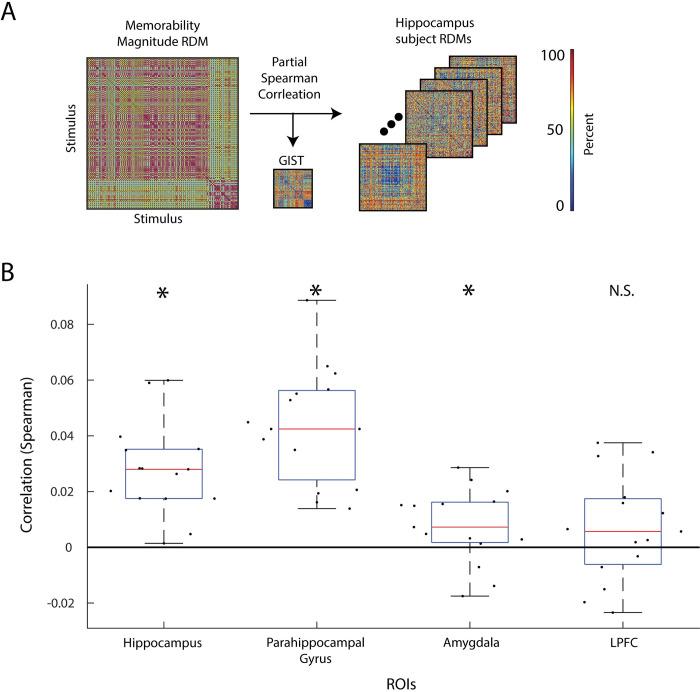
Behavioral and neuroscience studies in humans and primates have shown that memorability is an intrinsic property of an image that predicts its strength of encoding into and retrieval from memory. While previous work has independently probed when or where this memorability effect may occur in the human brain, a description of its spatiotemporal dynamics is missing. Here, we used representational similarity analysis (RSA) to combine functional magnetic resonance imaging (fMRI) with source-estimated magnetoencephalography (MEG) to simultaneously measure when and where the human cortex is sensitive to differences in image memorability. Results reveal that visual perception of High Memorable images, compared to Low Memorable images, recruits a set of regions of interest (ROIs) distributed throughout the ventral visual cortex: a late memorability response (from around 300 ms) in early visual cortex (EVC), inferior temporal cortex, lateral occipital cortex, fusiform gyrus, and banks of the superior temporal sulcus. Image memorability magnitude results are represented after high-level feature processing in visual regions and reflected in classical memory regions in the medial temporal lobe (MTL). Our results present, to our knowledge, the first unified spatiotemporal account of visual memorability effect across the human cortex, further supporting the levels-of-processing theory of perception and memory.
人类和灵长类动物的行为和神经科学研究表明,可记性是图像的固有属性,它可以预测其在记忆中的编码强度和检索强度。虽然之前的工作已经独立地探究了这种可记性效应可能在人类大脑中何时或何处发生,但它的时空动态描述却缺失了。在这里,我们使用代表性相似性分析(RSA)将功能磁共振成像(fMRI)与源估计脑磁图(MEG)结合起来,同时测量人类大脑皮质对图像可记性差异敏感的时间和位置。结果表明,与低可记性图像相比,高可记性图像的视觉感知会激活分布在腹侧视觉皮层中的一组感兴趣区域(ROI):早期视觉皮层(EVC)、颞下回、外侧枕叶皮层、梭状回和颞上沟的后可记性反应(约 300 毫秒)。在视觉区域进行高级特征处理后,会呈现图像可记性幅度的结果,并反映在中颞叶(MTL)的经典记忆区域中。我们的研究结果在人类大脑皮质中提供了可记性效应的第一个统一的时空描述,进一步支持了感知和记忆的加工水平理论。


 Zotero 插件